




💛 A quick favor, if you've got a second.
We're really happy that you chose to read one of our stories and sincerely hope you'll stick around to read more. We took our paywall down — for now — but that won't last forever, and when the gate goes back up, we'd love for you to already be on the inside.
It's free. So please enter your email here and don't forget to like and follow us on all of your favorite Social Media platforms!
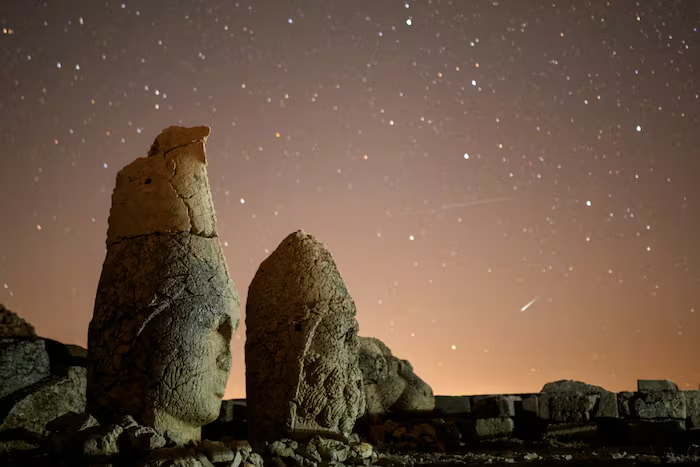
Skywatchers in the Northern Hemisphere have an exceptional opportunity this week to witness the annual Perseid meteor shower, which reaches its peak Wednesday night through Thursday morning under particularly favorable conditions. The celestial event coincides with a total solar eclipse visible across Spain, Iceland and Greenland, as well as a rare alignment of six planets, though optimal meteor viewing will occur after the eclipse’s conclusion.
NASA estimates observers in ideal locations may witness between 50 and 100 meteors per hour, while the American Meteor Society projects 30 to 50 meteors hourly from rural areas with minimal light pollution. These bright streaks result from Earth’s passage through debris trails scattered by comet 109P/Swift-Tuttle, which completes an orbit around the sun every 133 years and will not return until 2125.
The Perseids rank among astronomy’s most anticipated annual events, partly because summer temperatures eliminate the discomfort associated with winter meteor viewing. The shower’s debris produces particularly brilliant fireballs and has been documented by observers for more than 2,000 years.
Conditions this year benefit significantly from the moon’s new phase, which eliminates moonlight that typically washes out fainter meteors from view. Observers should travel away from urban light pollution, allow their eyes 30 minutes to adjust to darkness, and watch the northern sky where the constellation Perseus sits highest between midnight and dawn.



More Stories
Archaeologists Unearth 1,300-Year-Old Trading Hub Near Ancient Jaffa in Israel
Month-Long HEPA Use Linked to Faster Cognitive Processing in Middle-Aged Adults
NASA Launches $4.3 Billion Roman Space Telescope to Search for Exoplanets and Dark Energy