


💛 A quick favor, if you've got a second.
We're really happy that you chose to read one of our stories and sincerely hope you'll stick around to read more. We took our paywall down — for now — but that won't last forever, and when the gate goes back up, we'd love for you to already be on the inside.
It's free. So please enter your email here and don't forget to like and follow us on all of your favorite Social Media platforms!
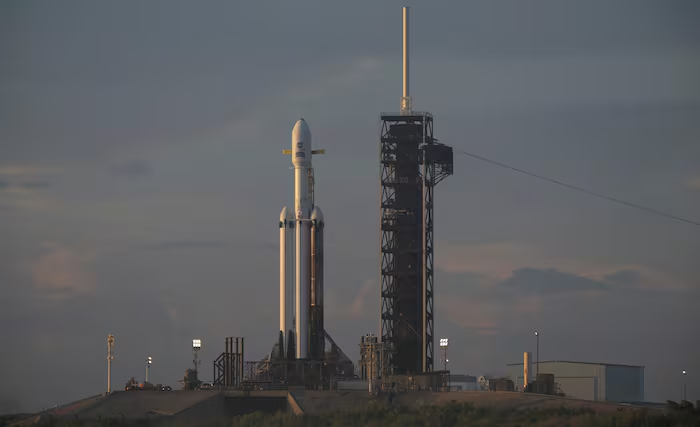
SpaceX successfully launched NASA’s Roman Space Telescope on Sunday morning from Kennedy Space Center in Florida, sending the $4.3 billion observatory on a three-month journey toward a gravitational observation point 1 million miles from Earth. The bus-sized instrument rode atop a Falcon Heavy rocket, the most powerful variant available, and will eventually share its distant location with the James Webb Space Telescope.
Named after Nancy Grace Roman, NASA’s first chief astronomer, the telescope will provide an unprecedented view of the cosmos with a field of vision more than 100 times broader than the Hubble Space Telescope. Once operational, Roman is expected to discover thousands of supernovae, tens of thousands of exoplanets, billions of galaxies and tens of billions of stars, according to NASA science mission director Nicky Fox.
The observatory’s primary strength lies in its speed and sensitivity. A single month of observations by Roman would require Hubble roughly a century to complete, senior project scientist Julie McEnery said. The telescope combines a wide-field infrared camera matching Hubble’s capabilities with a coronagraph instrument designed to block starlight and directly image faint planets orbiting distant stars.
Beyond exoplanet discovery, astronomers anticipate Roman will help solve fundamental mysteries about dark matter and dark energy, the invisible forces constituting most of the universe. The telescope’s extensive galactic catalog will enable scientists to measure the universe’s expansion rate and better understand these enigmatic phenomena.
Roman launches approximately one year ahead of schedule and within budget, making it NASA’s first space telescope named after a woman. The primary mirror, nearly 8 feet in diameter, originates from surplus spy satellite hardware donated by the National Reconnaissance Office more than a decade ago. The instrument is also designed for potential in-orbit refueling, which could extend its operational lifespan if robotic servicing missions become available.

More Stories
Trump Calls NASA to Congratulate Agency on Roman Space Telescope Launch
Archaeologists Unearth 1,300-Year-Old Trading Hub Near Ancient Jaffa in Israel
Month-Long HEPA Use Linked to Faster Cognitive Processing in Middle-Aged Adults