




💛 A quick favor, if you've got a second.
We're really happy that you chose to read one of our stories and sincerely hope you'll stick around to read more. We took our paywall down — for now — but that won't last forever, and when the gate goes back up, we'd love for you to already be on the inside.
It's free. So please enter your email here and don't forget to like and follow us on all of your favorite Social Media platforms!
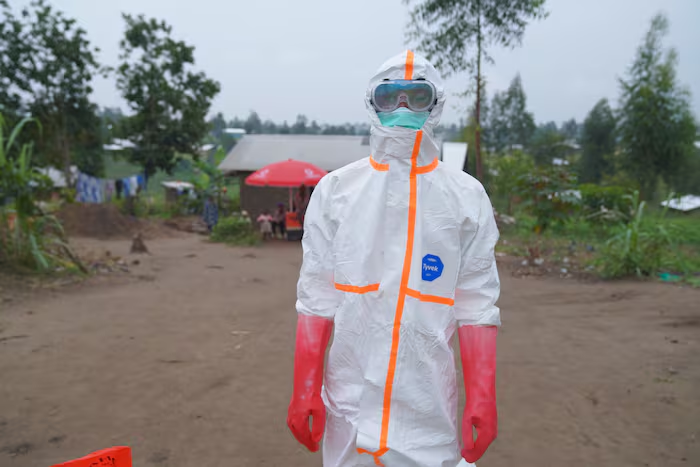
Congolese health officials announced Saturday that laboratory testing found no evidence of Ebola infection among the 200-plus passengers quarantined on a river vessel near the capital city of Kinshasa. The development provided relief after concerns surfaced that the Bundibugyo strain might reach the densely populated metropolis, which remains free of confirmed cases despite the ongoing outbreak.
Health ministry teams deployed to the port of Maluku, situated 65 kilometers from Kinshasa, examined all individuals aboard the boat after one former passenger died with Ebola-like symptoms. Laboratory samples were collected from those showing suspicious signs and tested by the National Institute of Biomedical Research, while the vessel underwent complete decontamination procedures.
The deceased passenger had fallen ill and left the boat nearly three weeks prior in Pimu, a town in Mongala province more than 1,000 kilometers upriver from Kinshasa, according to Africa CDC Director-General Jean Kaseya. All suspected cases returned negative results for Bundibugyo virus, prompting authorities to urge Kinshasa residents to remain calm.
Congo is contending with the fastest-spreading Ebola outbreak on record since May, with confirmed cases reaching 4,200 and deaths surpassing 1,900. The current epidemic ranks as the second-largest documented, trailing only the 2014-2016 West African crisis that claimed more than 28,000 lives across multiple nations.
Health officials report that 60 to 70 percent of new infections originate from contacts outside monitored populations, indicating transmission is outpacing surveillance efforts. Doctors Without Borders stated this week that the virus continues spreading at an “alarming and unprecedented rate” and that response systems remain unable to reach affected communities quickly enough to interrupt transmission chains.



More Stories
Colombia backs Trump security push while limiting U.S. role in anti-gang operations
Federal Prosecutors Convene Special Grand Jury to Investigate D.C. Schools’ Attendance and Graduation Practices
State Department Reissues Level 3 Travel Advisory for Israel Amid Terrorism and Armed Conflict Concerns