

💛 A quick favor, if you've got a second.
We're really happy that you chose to read one of our stories and sincerely hope you'll stick around to read more. We took our paywall down — for now — but that won't last forever, and when the gate goes back up, we'd love for you to already be on the inside.
It's free. So please enter your email here and don't forget to like and follow us on all of your favorite Social Media platforms!
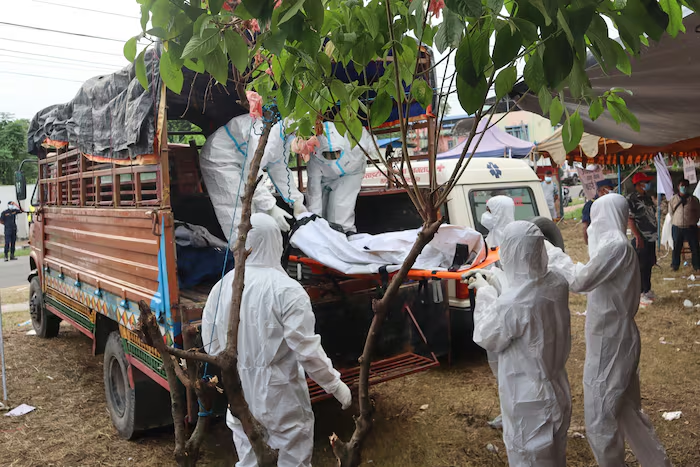
A catastrophic flash flood that swept through Nepal’s Himalayan region Wednesday has forced authorities to bury approximately 100 bodies in mass graves before they can be identified, igniting controversy over the violation of Hindu funeral customs. The disaster killed at least 800 people across Nepal and Tibet, with more than 3,000 still missing, according to officials coordinating the response in Chitwan district in south-central Nepal.
Approximately 250 bodies have accumulated in Chitwan awaiting identification after being carried hundreds of kilometers downstream by the Bhotekoshi River from the flood’s epicenter. The temporary burial commenced Saturday as forensic teams worked to process the overwhelming number of remains, with an additional 50 bodies scheduled for DNA sampling before likely burial Sunday, said police inspector Anil Thapa.
Officials defended the burials as a public health necessity, citing decomposition accelerated by high humidity and the bodies’ exposure to floodwaters for roughly four days. The district’s limited forensic infrastructure and inadequate morgue capacity left authorities with few alternatives, they said, while health experts warned that exposed remains could spread disease.
The decision has drawn sharp rebuke from families and political figures in the predominantly Hindu nation, where cremation along riverbanks surrounded by immediate family members remains the traditional funeral practice. Ruby Chaudhary, who has two missing relatives, said burials should require family consent, while former Prime Minister Baburam Bhattarai questioned whether authorities exhausted alternatives before disposing of unidentified remains.
Authorities said they are preserving DNA samples, photographing facial features, and recording identifying information for each body assigned a reference number, allowing families to claim remains later for proper funeral rites. Foreign Secretary Amrit Bahadur Rai stated the temporary burials comply with international disaster-management protocols established by the International Committee of the Red Cross, permitting later exhumation for necessary rituals.
Meanwhile, fresh landslides Sunday closed the main highway connecting Kathmandu and Chitwan, hampering efforts to transport bodies and deliver relief supplies to affected communities still buried under mud and debris from the disaster.

More Stories
Christa Pike Survives Botched Double Execution Attempt; Tennessee Halts Remaining 2026 Executions
Tennessee’s Lone Death Row Female is Scheduled for Execution Wednesday for 1995 Torture/Murder
Modern Science Finally Supports & Strengthens Biblical Account of the Crucifixion of Jesus Christ