


💛 A quick favor, if you've got a second.
We're really happy that you chose to read one of our stories and sincerely hope you'll stick around to read more. We took our paywall down — for now — but that won't last forever, and when the gate goes back up, we'd love for you to already be on the inside.
It's free. So please enter your email here and don't forget to like and follow us on all of your favorite Social Media platforms!
Right down to the ensuing earthquake…

Archaeologists say landscape under Jerusalem’s Church of the Holy Sepulchre matches Gospel description of Jesus’ burial
For nearly 1,700 years, Christians have venerated the Church of the Holy Sepulchre in Jerusalem as the place where Jesus was crucified, buried, and raised from the dead. A newly published archaeological report now says the ground beneath that basilica once looked much like the setting described in the New Testament: an abandoned quarry just outside the city walls, later used for small cultivated plots and rock-cut tombs.

Lead archaeologist Francesca Romana Stasolla of Sapienza University of Rome told the Daily Mail her team found “evidence of a funerary landscape, alongside small areas planted with vines and olive trees, as well as a pastoral area characterized by sporadic human activity.” Those conclusions appear in a 98-page preliminary report on the 2025 excavation campaign, published in Liber Annuus, the archaeological journal of Jerusalem’s Studium Biblicum Franciscanum.
The work does not claim to have identified Jesus’ body, nor does it “prove” the traditional tomb in a laboratory sense. What it does, researchers say, is reconstruct a first-century landscape that lines up with the details recorded in the Gospels.

A church built on Constantine’s choice
The first church over the site was commissioned in the fourth century by Roman Emperor Constantine. According to early Christian tradition, his mother, Helena, identified the place of the crucifixion and the nearby tomb. Generations of pilgrims have since come to pray at Calvary and at the Aedicule, the shrine that now encloses the rock-cut chamber long believed to be Jesus’ burial place.
That identification has always been a matter of faith as well as history. Rival claims exist, most famously the Garden Tomb north of the Old City. The new excavations do not settle every debate. They do, however, strengthen the case that Constantine’s architects were working with a real funerary and agricultural landscape, not an invented one.
Stasolla’s team began digging in 2022 during a long-delayed restoration of the church floor, with permission from the Greek Orthodox, Armenian Apostolic, and Roman Catholic communities that share custody of the site, and with a license from the Israel Antiquities Authority. Fieldwork inside the northern nave and the Rotunda intercolumniations concluded in 2025. Analysis of pottery, plant remains, and architecture is still underway.
What the Gospels describe
John 19:41–42 is the passage most often cited in coverage of the dig:
“Now in the place where he was crucified there was a garden, and in the garden a new tomb in which no one had yet been laid. So because of the Jewish day of Preparation, since the tomb was close at hand, they laid Jesus there.”
Hebrews 13:12 adds that Jesus suffered “outside the gate.” Matthew, Mark, and Luke describe a tomb hewn from rock, sealed with a stone, and unused.
The Holy Sepulchre compound contains both traditional Calvary and a nearby tomb. In the first century, that ground lay outside Jerusalem’s walls. Only later, under Emperor Hadrian in the second century, was the area absorbed into the rebuilt Roman city of Aelia Capitolina.
Quarry, garden, then graves
Stasolla has emphasized that the church stands on an ancient quarry, a fact that would surprise no one who knows Jerusalem’s geology. Much of the Old City sits on limestone that was cut for building stone from the Iron Age onward.
“The quarry was already active in the Iron Age,” she said. Excavators recovered pottery, oil lamps, and everyday objects from that period. As extraction slowed, the abandoned cuttings were reused. Low stone walls were built, soil was packed between them, and small plots were planted. Later, tombs were carved into the remaining bedrock at different levels.
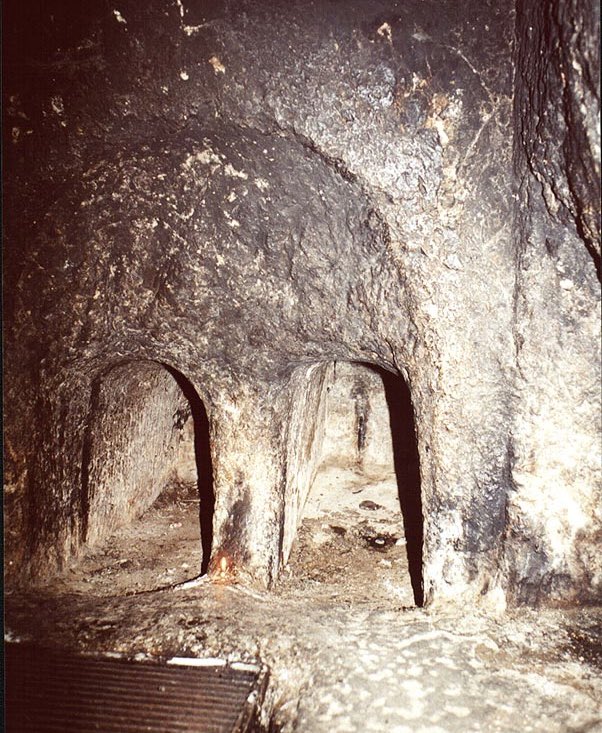
“We need to imagine that as the quarry was progressively abandoned, tombs were carved at different levels,” Stasolla said. “The area, therefore, featured several burials from that period. Constantine selected the one that had been venerated as the tomb where Jesus was buried, and he excavated around it in the area that corresponds to the current rotunda, isolating it from the other burials.”
Other tombs survive inside the compound, including one that Christian tradition associates with Joseph of Arimathea, the man the Gospels say offered his unused family tomb for Jesus’ burial.
Pollen, seeds, and a “green area”
The botanical evidence has drawn the most public attention. Archaeobotanical and pollen samples from under the church floor point to olive trees, grapevines, cereals, figs, and grasses. Researchers also recovered vine wood. Stasolla has said the cultivated patches are especially interesting because John mentions a green area between Calvary and the tomb.
“The gospel mentions a green area between the Calvary and the tomb, and we identified these cultivated fields,” she told The Times of Israel.
The plant remains are assigned, on stratigraphic grounds, to the period between the quarry’s decline and the Roman-era funerary use of the site — roughly the horizon of the first century. Full radiocarbon dating of every sample has not been completed, and the team has been careful to call the 2025 paper a preliminary report.
An older earthquake study returns to the debate
Coverage of the Holy Sepulchre work has also revived a separate 2012 geological paper in International Geology Review. That study, based on sediment cores from the Dead Sea, identified earthquake disruption around A.D. 31, plus or minus five years — a window that includes the commonly proposed crucifixion date of Friday, April 3, A.D. 33.
Matthew 27 records that after Jesus died, “the earth shook, and the rocks were split. The tombs also were opened.” The same chapter describes darkness from noon until about 3 p.m., the tearing of the temple veil, and the centurion’s confession: “Truly this was the Son of God.”
An earthquake in Judaea in those years is historically plausible. Linking one specific Dead Sea layer to the hour of the crucifixion remains an inference, not a closed case. Still, the study is consistent with Matthew’s claim that the ground moved at the time of Jesus’ death.
What the new work can and cannot show
Archaeology can test whether a traditional site fits the physical world the Gospels describe. On several points, the Holy Sepulchre now looks like a better match than critics sometimes allow:
- It stood outside the first-century walls.
- It sat on a quarry that had been turned to mixed agricultural and funerary use.
- Rock-cut tombs of the right type exist on the property.
- Plant remains support a cultivated “garden” between execution ground and tomb.
- Constantine isolated one venerated chamber from neighboring graves, which is what one would expect if a specific tomb already had a Christian memory attached to it.
What archaeology cannot do is recover a name carved above a first-century loculus that reads “Jesus of Nazareth.” The Aedicule has been rebuilt many times. Pilgrims, earthquakes, Crusader wars, and later restorations have all altered the fabric. The Italian team has reported a circular marble feature beneath the present shrine that may relate to Constantine’s original marking of the tomb, but that, too, is an interpretation still under study.
Douglas Estes, a scholar of early Christianity, told Fox News Digital that the completed excavations add archaeological support to details in the Gospel of John — support he found compelling precisely because John’s account reads like local knowledge of Jerusalem.
A site that is still a living church
The Church of the Holy Sepulchre is not a sealed museum. It remains a working sanctuary shared, sometimes uneasily, by several Christian communities and visited by millions of pilgrims a year. That is why the excavation had to proceed in sections, opening one area, recording it, and covering it again so worship could continue.
Stasolla has said the history of the site is, in miniature, the history of Jerusalem: quarry, garden, cemetery, pagan overlay, imperial basilica, Crusader church, Ottoman repairs, and modern restoration. The latest campaign gives that long story a clearer first-century chapter.
Believers will hear in the pollen and the quarry cuts a confirmation of what they already hold. Skeptics will note that a garden-and-tomb landscape outside the walls could have existed in more than one place. Both responses can sit with the same evidence. The ground under the Holy Sepulchre, the archaeologists now say, is no longer just tradition piled on stone. It is a mapped funerary garden that looks, in its main lines, like the one John described.
The following is a list of the sources used in compiling this story (As an interesting aside, I found exactly 33 sources that corroborated this evidence):
Supporting Bibliography
provided using the Chicago Manual of Style, 18th ed. (notes-bibliography):
All Israel News. “Excavations under Church of the Holy Sepulchre Reveal Evidence of Ancient Garden, Supporting Gospel of John.” Accessed September 2, 2026. https://db.allisraelnews.com/excavations-under-church-of-the-holy-sepulcher-reveal-evidence-of-ancient-garden-agreeing-with-gospel-of-john.
Altuntaş, Leman. “Archaeology Beneath the Holy Sepulchre Reveals a Landscape That Matches the Gospel Account of Jesus’ Burial.” Arkeonews, August 28, 2026. https://arkeonews.net/archaeology-beneath-the-holy-sepulchre-reveals-a-landscape-that-matches-the-gospel-account-of-jesus-burial/.
Aleteia. “Garden Found beneath Holy Sepulchre Echoes Gospel Account.” Aleteia, March 24, 2025. https://aleteia.org/2025/03/24/garden-found-beneath-church-of-holy-sepulchre-echoes-gospel-account/.
Berrien, Hank. “Archaeological Dig Uncovers Stunning Match to Bible’s Account of Jesus’ Tomb.” The Daily Wire, August 28, 2026. https://www.dailywire.com/news/archaeological-dig-uncovers-stunning-match-to-bibles-account-of-jesus-tomb.
Brepols Online. “Archaeological Excavations in the Holy Sepulchre, Jerusalem: 2025 Preliminary Report.” Liber Annuus 75 (2025): 619–716. https://www.brepolsonline.net/content/journals/10.1484/J.LA.5.155239.
Brepols Online. Search results for “Francesca Romana Stasolla.” Accessed September 2, 2026. https://www.brepolsonline.net/search?value1=Francesca+Romana+Stasolla&option1=author&noRedirect=true&sortField=prism_publicationDate&sortDescending=true.
Cost, Ben. “Archaeologists Might Have Found Jesus Tomb.” New York Post, August 27, 2026. https://nypost.com/2026/08/27/science/archaeologists-might-have-found-jesus-tomb/.
Fox News. “Church of the Holy Sepulchre Excavation’s Findings Support the Gospel of John.” Fox News, September 2, 2026. https://www.foxnews.com/travel/site-where-jesus-crucified-buried-reveals-new-evidence-backs-biblical-account.
Gaudium Press. “Discovered! The Garden of the Holy Sepulchre of Jesus, as Described in St. John’s Gospel.” Gaudium Press English Edition, April 7, 2025. https://www.gaudiumpress.ca/discovered-the-garden-of-the-holy-sepulchre-of-jesus-as-described-in-st-johns-gospel/.
Greek City Times. “Could This Ancient Garden Be Near Jesus’s Traditional Tomb?” Greek City Times, August 26–27, 2026. https://greekcitytimes.com/2026/08/27/could-this-ancient-garden-be-near-jesuss-traditional-tomb/.
InfoVaticana. “Nuevos hallazgos arqueológicos bajo el Santo Sepulcro coinciden con el paisaje descrito por el Evangelio de san Juan.” InfoVaticana, September 1, 2026. https://infovaticana.com/2026/09/01/nuevos-hallazgos-arqueologicos-bajo-el-santo-sepulcro-coinciden-con-el-paisaje-descrito-por-el-evangelio-de-san-juan/.
Jerusalem Post Staff. “Seeds, 3D Scans, and Finds Bolster Holy Sepulchre Garden Claim.” The Jerusalem Post, April 24, 2025. https://www.jpost.com/archaeology/archaeology-around-the-world/article-851319.
King, Jordan. “Possible Jesus Tomb Matching Bible Account Discovered.” Newsweek, August 28, 2026. https://www.newsweek.com/possible-jesus-tomb-matching-bible-account-discovered-12381399.
Masciullo, Gaetano. “Holy Sepulchre Archaeologists Find Proof for Gospel Account.” LifeSiteNews, August 31, 2026. https://www.lifesitenews.com/news/holy-sepulchre-archaeologists-find-proof-for-gospel-account/.
Museum Bollandianum. “Archaeological Excavations in Jerusalem, Holy Sepulchre: A Preliminary Report.” Catalog record 113703. Accessed September 2, 2026. https://museumbollandianum.be/records/113703.
Order of the Holy Sepulchre. “‘I Lived inside the Basilica of the Holy Sepulchre for Three Years.’” Interview with Francesca Romana Stasolla. Accessed September 2, 2026. https://www.oessh.va/content/ordineequestresantosepolcro/en/dalla-terra-santa/pellegrini-in-terra-santa/-ho-vissuto-tre-anni-allinterno-della-basilica-del-santo-sepolcr.html.
OrthoChristian. “Traces of Ancient Garden Found under Holy Sepulchre.” OrthoChristian.com, March 25, 2025. https://orthochristian.com/168429.html.
Popular Mechanics. “Archaeologists May Have Found the Site of Jesus’s Tomb.” Popular Mechanics, April 14, 2026. https://www.popularmechanics.com/science/archaeology/a71013025/jesus-tomb-garden-church-discovery/.
ProtoThema. “Archaeologists Unearth Ancient Burial Landscape, Maybe Jesus’, under the Church of the Holy Sepulchre.” ProtoThema English, August 28, 2026. https://en.protothema.gr/2026/08/28/archaeologists-unearth-ancient-burial-landscape-maybe-jesus-under-the-church-of-the-holy-sepulchre/.
Seidel, Jamie. “Jesus Tomb: New Clues Found at Church of Holy Sepulchre.” news.com.au, August 31, 2026. https://www.news.com.au/technology/science/archaeology/archaeologists-uncover-ancient-landscape-beneath-traditional-site-of-jesuss-tomb/news-story/03224d32754579589c43f79ea7717ed4.
Semantic Scholar. “Archaeological Excavations in Jerusalem, Holy Sepulchre: A Preliminary Report.” Corpus ID 258666985. Accessed September 2, 2026. https://www.semanticscholar.org/paper/Archaeological-excavations-in-Jerusalem%2C-Holy-a-Stasolla/e67824605ecf4c518fb0ca7a22fb5fa36f4bf2ea.
Stasolla, Francesca Romana. “Archaeological Excavations in Jerusalem, Holy Sepulchre: A Preliminary Report.” Liber Annuus 72 (2022): 449–86. Archived at https://web.archive.org/web/20231108061318/https:/www.brepolsonline.net/doi/10.1484/J.LA.5.134546.
Stasolla, Francesca Romana, Alessandro Melega, Amedeo Ricco, Federica Vacatello, A. D’Alessandro, and Luca Brancazi. “Archaeological Excavations in the Holy Sepulchre, Jerusalem: 2024 Preliminary Report.” Liber Annuus 74 (2024): 285–329. https://iris.uniroma1.it/handle/11573/1737697.
Stasolla, Francesca Romana, Luca Brancazi, Alessandro Melega, Amedeo Ricco, Federica Vacatello, Violetta Mattia, Flora Miele, Lorenzo Nigro, and Filomena Bisceglia. “Archaeological Excavations in the Holy Sepulchre, Jerusalem: 2025 Preliminary Report.” Liber Annuus 75 (2025): 619–716. https://hdl.handle.net/11573/1763575.
Studium Biblicum Franciscanum. “Liber Annuus 75 (2025).” Table of contents. Accessed September 2, 2026. https://sbf.custodia.org/it/publications/liber-annuus/liber-annuus-75-2025.
Tercatin, Rossella. “Echoing Gospel Account, Traces of Ancient Garden Found under Church of Holy Sepulchre.” The Times of Israel, March 22, 2025. https://www.timesofisrael.com/echoing-gospel-account-traces-of-ancient-garden-found-under-church-of-holy-sepulchre/.
— — — . “Echoing Gospel Account, Traces of Ancient Garden Found under Church of Holy Sepulchre.” The Times of Israel. Alternate retrieved URL. https://www.timesofisrael.com/echoing-gospel-account-traces-of-ancient-garden-found-under-church-of-holy-sepulchre.
Mastodon. “#ScalaScrittura.” Accessed September 2, 2026. https://mastodon.world/tags/ScalaScrittura.
Note on duplicates in the validation set. Several of the 33 retrieved records were the same article or catalog record returned more than once (Arkeonews; news.com.au; Newsweek; The Jerusalem Post; Greek City Times; The Times of Israel). They are represented above as distinct retrievals where the URL or imprint differed; the scholarly spine of the story is Stasolla et al., Liber Annuus 75 (2025): 619–716, with earlier campaign reports in vols. 72 and 74.

More Stories
Christa Pike Survives Botched Double Execution Attempt; Tennessee Halts Remaining 2026 Executions
Tennessee’s Lone Death Row Female is Scheduled for Execution Wednesday for 1995 Torture/Murder
Federal Prosecutors Convene Special Grand Jury to Investigate D.C. Schools’ Attendance and Graduation Practices