


💛 A quick favor, if you've got a second.
We're really happy that you chose to read one of our stories and sincerely hope you'll stick around to read more. We took our paywall down — for now — but that won't last forever, and when the gate goes back up, we'd love for you to already be on the inside.
It's free. So please enter your email here and don't forget to like and follow us on all of your favorite Social Media platforms!
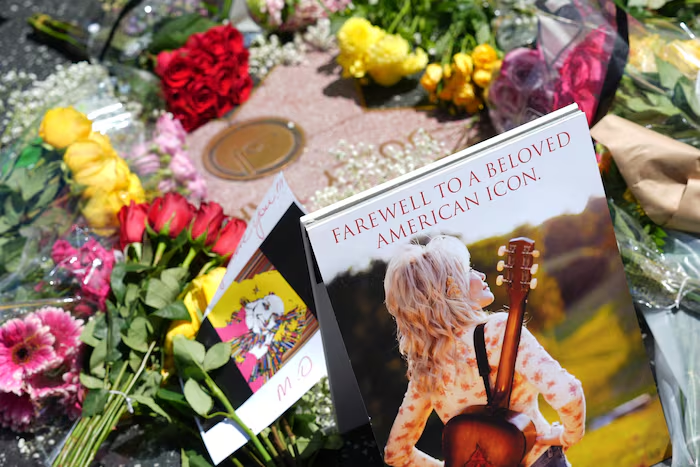
Country music icon Dolly Parton, who passed away Tuesday at her home in Tennessee, transcended the boundaries of celebrity through a combination of musical genius, entrepreneurial acumen, and unwavering philanthropic commitment. Standing at 5 feet tall but commanding an outsized presence in American culture, Parton became one of the most universally beloved artists in history, crossing divides of gender, race, and socioeconomic status that typically limit even the most celebrated figures.
Parton’s musical foundation rested on her extraordinary songwriting ability, which transformed personal experience into timeless compositions. Her catalog includes some of popular music’s most enduring hits, among them “Jolene” and “Coat of Many Colors,” though her greatest commercial impact came through “I Will Always Love You,” which achieved worldwide recognition when Whitney Houston recorded the song decades later.
Born into poverty as one of 12 children in Sevier County in rural East Tennessee, Parton began composing songs during childhood and entered the radio and television markets by age 10. Her professional debut at the Grand Ole Opry followed at age 13, and by her early twenties, she had already joined “The Porter Wagoner Show,” where her popularity quickly surpassed that of the program’s host.
Recognition for her contributions proved substantial and far-reaching. Parton earned 10 Grammy Awards and numerous inductions into prestigious music halls of fame while simultaneously revolutionizing opportunities for women in country music alongside contemporaries Loretta Lynn and Tammy Wynette. Her 1980 film debut in “9 to 5” established her as a Hollywood presence while celebrating workplace equality for women.
Parton’s distinctive image—featuring exaggerated makeup, elaborate wigs, acrylic nails, and form-fitting clothing—was entirely deliberate and controlled. This calculated presentation became a statement of artistic autonomy in itself; by embracing and weaponizing stereotypes, she maintained complete creative authority over her public persona and narrative.
Financial success extended far beyond music into business ventures. Unable to visit Disneyland as a child, Parton opened Dollywood, a theme park in Pigeon Forge, Tennessee, in 1986. Industry skeptics doubted the venture’s viability, but it ultimately became her most profitable business enterprise while generating approximately $1.8 billion annually for the regional economy, according to a 2021 Tennessee Aviation System Plan study.
Parton maintained strategic distance from partisan politics despite her enormous platform. During the 2016 presidential election, she made comments interpreted as supporting Democratic candidate Hillary Clinton, subsequently claiming her remarks had been mischaracterized. She declined the Presidential Medal of Freedom on three separate occasions—twice from President Donald Trump and once from President Joe Biden—to avoid appearing politically aligned.
Her philanthropic activities demonstrated the same dedication evident in her performances. The Dollywood Foundation, established in 1988, initially focused on reducing high school dropout rates through its Buddy Program, which provided $500 scholarships to junior high students in Sevier County who completed their secondary education.
When wildfires devastated the Great Smoky Mountains in 2016, Parton’s foundation provided $1,000 monthly assistance for six months to displaced families, ultimately distributing approximately $9 million to roughly 900 households during the initial recovery period. Additional charitable initiatives included establishing a bird sanctuary for bald eagles unable to survive independently and creating a $15,000 college scholarship program for five Sevier County high school seniors annually beginning in 2000.
Parton’s 1995 Imagination Library represents perhaps her most expansive charitable achievement. Motivated by her father’s illiteracy, she created an organization distributing free books to economically disadvantaged children. By 2025, the program had distributed more than 200 million books worldwide.
In 2020, Parton donated $1 million to COVID-19 vaccine research at Vanderbilt University, funding that contributed to Moderna’s development efforts. In her final public statements, Parton expressed hope that she would be remembered for attempting “to do some good in the world” and for leaving behind meaningful contributions to society.

More Stories
Christa Pike Survives Botched Double Execution Attempt; Tennessee Halts Remaining 2026 Executions
Tennessee’s Lone Death Row Female is Scheduled for Execution Wednesday for 1995 Torture/Murder
Modern Science Finally Supports & Strengthens Biblical Account of the Crucifixion of Jesus Christ