


💛 A quick favor, if you've got a second.
We're really happy that you chose to read one of our stories and sincerely hope you'll stick around to read more. We took our paywall down — for now — but that won't last forever, and when the gate goes back up, we'd love for you to already be on the inside.
It's free. So please enter your email here and don't forget to like and follow us on all of your favorite Social Media platforms!
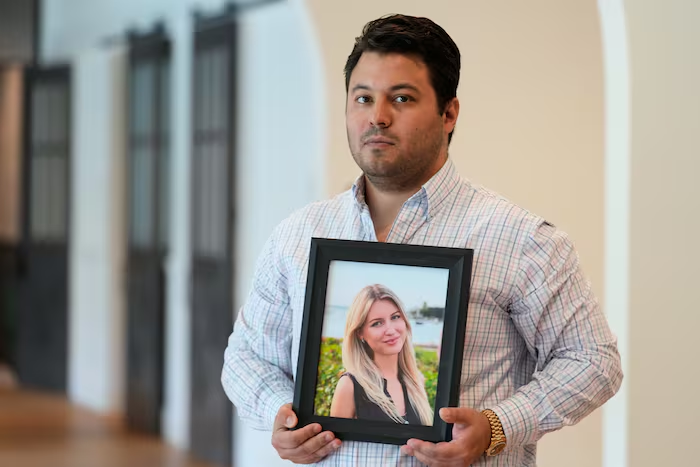
The recent release of Marine veteran Robert Gilman from Russian custody after more than four years in detention has reignited concerns about the medical treatment and wellbeing of other Americans still held in Russian prisons. Gilman’s visibly deteriorated physical condition upon his return to the United States has prompted advocates and family members of remaining detainees to question whether the government will act before other prisoners face life-threatening circumstances.
Harold Jezler, whose wife Olga has been detained in Russia since 2022 on drug possession charges she disputes, expressed alarm after seeing photographs of Gilman’s emaciated appearance following his release. Jezler noted that his wife faces her own serious health challenges while imprisoned, and he questioned what threshold of medical emergency must be reached before authorities prioritize securing the release of other American detainees.
Among the roughly 28 Americans currently jailed in Russia, several face documented medical crises, according to advocacy organizations tracking their cases. Conditions range from severe gastrointestinal illness to autoimmune diseases, significant dental damage requiring emergency surgery, and endometriosis in the case of Olga Jezler, a green card holder whose ovarian cysts continue to enlarge while in custody.
Paul Whelan, freed in 2024 after spending more than five years in Russian custody on espionage charges the U.S. government deemed baseless, provided firsthand testimony about the medical system’s inadequacies in Russian prisons. Whelan described an environment where teeth extraction was preferred over repair, where surgical instruments were handled with alarming carelessness, and where prisoners relied on bartered goods to obtain basic necessities like fresh produce and first aid supplies.
Before his release, Gilman had fallen into a state of dissociative stupor for 47 days due to abuse suffered during his imprisonment, advocates said. Hospital staff subsequently placed him on a feeding tube while restraining him to a bed, suggesting his condition had deteriorated to critical levels before authorities agreed to his departure from Russia.
Chuck Zimmerman, a 59-year-old sailor sentenced to five years in prison after his yacht was intercepted by Russian naval forces in June 2025, has developed severe abdominal pain so acute that he has resorted to inducing vomiting to manage the discomfort. Medical consultants have identified possible diagnoses including gastric ulcers, pancreatitis, or hiatal hernias, though definitive treatment remains unavailable to him in custody.
Sixteen U.S. senators recently submitted a letter to Secretary of State Marco Rubio citing Gilman’s condition as justification for accelerated efforts to secure the release of five other Americans, including Zimmerman, Olga Jezler, and three others facing serious medical and legal complications. The letter underscores growing frustration among lawmakers with the pace of diplomatic efforts to free detainees whose health is deteriorating in Russian penal facilities.
Olga Jezler arrived in Russia in 2022 to visit a sister battling cancer and was arrested after authorities accused her of carrying CBD capsules, substances her husband and representatives assert were legally permissible. Her endometriosis diagnosis and expanding ovarian cyst have prompted concerns that Russian medical authorities may opt for organ removal rather than tissue-preserving treatment, potentially affecting her future ability to conceive children.
The State Department acknowledged awareness of medical care concerns among American detainees and stated it continues raising these issues with Russian officials. However, the Russian Federal Penitentiary Service has not responded to inquiries regarding the treatment of prisoners or the specific complaints raised by advocacy organizations and families.

More Stories
Federal voting arrest in New Jersey adds new pressure point in Sherrill-Trump standoff
Colombia backs Trump security push while limiting U.S. role in anti-gang operations
Packers Running Back Josh Jacobs Placed on NFL Commissioner’s Exempt List Following Domestic Arrest