


💛 A quick favor, if you've got a second.
We're really happy that you chose to read one of our stories and sincerely hope you'll stick around to read more. We took our paywall down — for now — but that won't last forever, and when the gate goes back up, we'd love for you to already be on the inside.
It's free. So please enter your email here and don't forget to like and follow us on all of your favorite Social Media platforms!
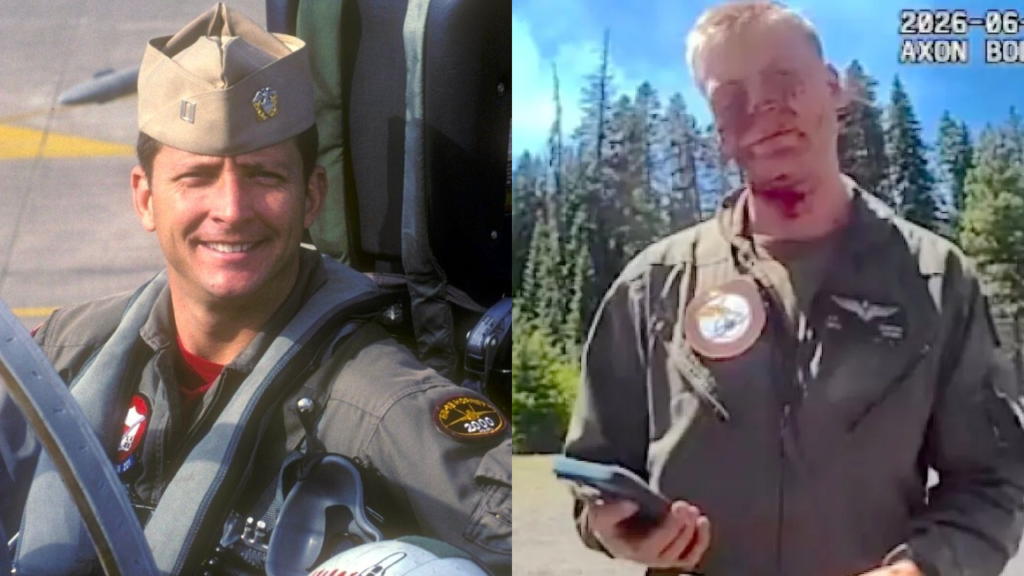
A retired naval aviator who flew F-18 Hornets throughout his 15-year career offered expert analysis of a Marine Corps pilot’s remarkable composure following an emergency ejection from his aircraft on June 13, 2026. Matthew “Whiz” Buckley explained to Fox News Digital that Major Jackson Simon’s apparent calm demeanor, captured on a sheriff’s deputy’s bodycam as he walked from the crash site near Rimrock Lake with visible injuries, reflected the complex physiological response pilots experience during such traumatic events.
Buckley attributed Simon’s subdued reaction to a convergence of shock, sudden adrenaline depletion, and rigorous training that conditions military pilots to suppress emotional responses under crisis conditions. The veteran aviator noted that pilots are trained to focus narrowly on immediate tasks, allowing all other concerns to fade from consciousness during emergencies. This psychological compartmentalization, combined with the body’s natural stress response, can create an illusion of serenity in the immediate aftermath of life-threatening incidents.
According to Buckley, ejection from a fighter aircraft ranks among the most violent experiences a human body can endure. The forces involved—typically ranging from 10 to 20 G’s of acceleration—often exceed a pilot’s conscious capacity to process, meaning many aviators retain no memory of the ejection itself, only the moment before pulling the handle and regaining awareness while suspended in their parachute.
A comprehensive analysis of 1,710 military aircrew ejections across studies published between 1971 and 2019 revealed a pooled mortality rate of 10.5 percent, with 29.8 percent sustaining major injuries. Buckley emphasized that survival depends heavily on proper body positioning at the moment of ejection, as even minor deviations can produce catastrophic consequences, including spinal compression that can permanently reduce a pilot’s height.
The incident occurred during a low-altitude demonstration flight when Simon’s F-18 struck power lines and subsequently crashed into a wooded area, triggering a small wildfire. Buckley expressed skepticism about the circumstances, noting that the aircraft appeared to be functioning properly based on Simon’s initial statements, and questioning why the plane descended below established minimum altitude restrictions.
Simon will face a formal review board to evaluate his actions preceding the crash. Depending on findings of responsibility, he could lose his flight certification or continue flying under restricted conditions, Buckley explained. The incident involved a $60 to $65 million aircraft, underscoring the stakes involved in determining what led to the mishap.

More Stories
USS George Washington Commanding Officer Reports Strong Crew Morale as Carrier Strike Group Assumes Middle East Operations
USS Abraham Lincoln Transits Singapore Strait, Concluding Extended Middle East Deployment
South African Rugby Match Features Extraordinarily Low Passenger Jet Flyover