


💛 A quick favor, if you've got a second.
We're really happy that you chose to read one of our stories and sincerely hope you'll stick around to read more. We took our paywall down — for now — but that won't last forever, and when the gate goes back up, we'd love for you to already be on the inside.
It's free. So please enter your email here and don't forget to like and follow us on all of your favorite Social Media platforms!
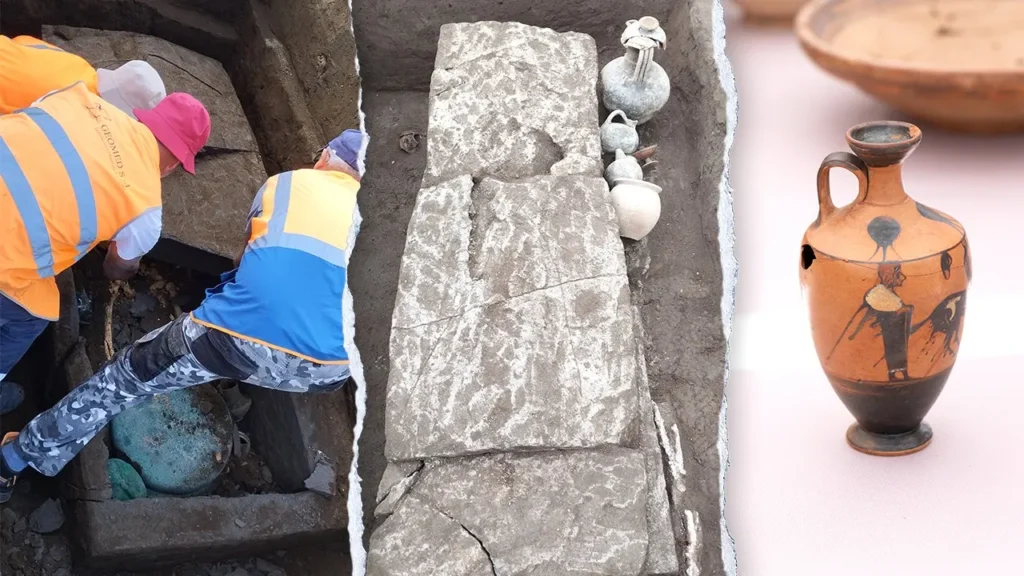
Construction work at the Pasta Garofalo manufacturing facility in Gragnano, near Naples, led to an unexpected archaeological breakthrough when excavation teams uncovered an ancient cemetery dating to the sixth century B.C. The necropolis emerged during preliminary work ahead of the factory’s planned expansion, with findings announced publicly in July following investigations conducted between 2025 and 2026.
The excavation revealed extensive stone burial chambers containing human remains alongside pottery and other artifacts spanning the Archaic period, centuries before Roman dominance of the Mediterranean. Researchers documented rows of tombs at the site and recovered exceptionally well-preserved materials including textiles, wooden objects and woven baskets that provide rare insight into funeral customs and daily life during this ancient era.
Among the most significant discoveries were grave goods demonstrating the region’s prominence in Mediterranean commerce. Archaeologists recovered Egyptian scarabs, animal-shaped amber ornaments, and silver and bronze objects of Etruscan origin, indicating Gragnano’s central position within trade networks connecting Greek, Egyptian and Etruscan civilizations.
Pasta Garofalo’s leadership expressed enthusiasm about the find’s connection to the company’s deep historical roots in the town. Chief Executive Officer Massimo Menna stated that the discovery reinforced the company’s commitment to preserving local heritage and contributing to understanding of Gragnano’s cultural significance.
Future research will focus on analyzing skeletal remains to reconstruct details about the ancient community’s diet, travel patterns and living standards. Scientists expect continued investigation will deepen knowledge of how populations thrived in the region during the Archaic period.

More Stories
Modern Science Finally Supports & Strengthens Biblical Account of the Crucifixion of Jesus Christ
Archaeologists Unearth 1,300-Year-Old Trading Hub Near Ancient Jaffa in Israel
Month-Long HEPA Use Linked to Faster Cognitive Processing in Middle-Aged Adults