


💛 A quick favor, if you've got a second.
We're really happy that you chose to read one of our stories and sincerely hope you'll stick around to read more. We took our paywall down — for now — but that won't last forever, and when the gate goes back up, we'd love for you to already be on the inside.
It's free. So please enter your email here and don't forget to like and follow us on all of your favorite Social Media platforms!
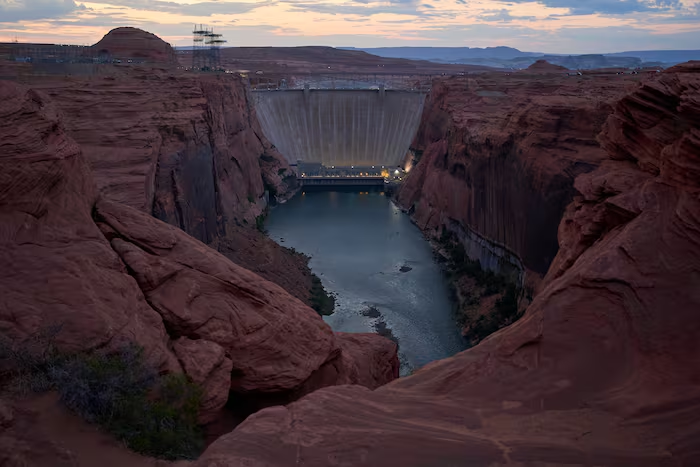
The Bureau of Reclamation on Friday unveiled mandatory water reductions affecting California, Nevada and Arizona over the next two years as the Colorado River faces continued depletion. The three states must collectively decrease their water consumption by 1.25 million acre-feet—roughly 1.54 billion cubic meters—annually, with potential for further cuts contingent on future hydrological conditions. Arizona will absorb the largest reduction among the three, while upstream states including Colorado, Utah, Wyoming and New Mexico have been spared immediate cuts.
Mexico will also trim its Colorado River allocation by 250,000 acre-feet annually under provisions of an existing U.S.-Mexico water treaty. Andrea Travnicek, assistant secretary for water and science at the Interior Department, emphasized the urgency of coordinated basin-wide management given persistent drought conditions. “We continue to see a prolonged drought in our future,” Travnicek stated, noting the region has endured 26 years of below-normal precipitation.
The current regulatory framework governing river water distribution expires in October, yet the seven basin states have failed to forge agreement on long-term allocation sharing. Last winter produced the Colorado River Basin’s worst snowpack on record, intensifying strain on agricultural operations, power generation facilities, wildlife habitats and the millions of residents—including dozens of Native American nations and two Mexican states—dependent on the waterway.
Decades of excessive water withdrawals, combined with drought and climate-driven temperature increases, have critically diminished Lake Mead and Lake Powell, the nation’s two largest reservoirs. Lake Mead recently hit its lowest elevation since filling began 90 years ago, followed shortly thereafter by Lake Powell reaching similar historic lows. Together, the reservoirs hold their minimum combined storage levels in approximately seven decades.
Arizona Water Resources Director Tom Buschatzke praised cooperative efforts by California and Nevada, characterizing the agreed reductions as providing “substantial stability” through 2028. California’s chief Colorado River negotiator, JB Hamby, described the arrangement as delivering “some badly needed near-term certainty at a moment of extraordinary risk,” while cautioning it represents “a bridge, not a permanent solution.”
Nevada officials expressed satisfaction with the three-state coordination and reiterated preference for reaching consensus among all seven basin states. Kyle Roerink, senior adviser at the Great Basin Water Network conservation organization, warned that intensified water shortages could constrain real estate expansion in the Las Vegas metropolitan area, noting stalled development of airport and commercial projects tied to the region’s deteriorating water outlook.

More Stories
California Legislation Would Formally Recognize Islamic Holidays Eid al-Fitr and Eid al-Adha
Meta Ordered to Implement Sweeping Teen Safety Restrictions Under Settlement
Forest Service Proposes Steep Fee Increases at Lake Tahoe Recreation Sites