


💛 A quick favor, if you've got a second.
We're really happy that you chose to read one of our stories and sincerely hope you'll stick around to read more. We took our paywall down — for now — but that won't last forever, and when the gate goes back up, we'd love for you to already be on the inside.
It's free. So please enter your email here and don't forget to like and follow us on all of your favorite Social Media platforms!
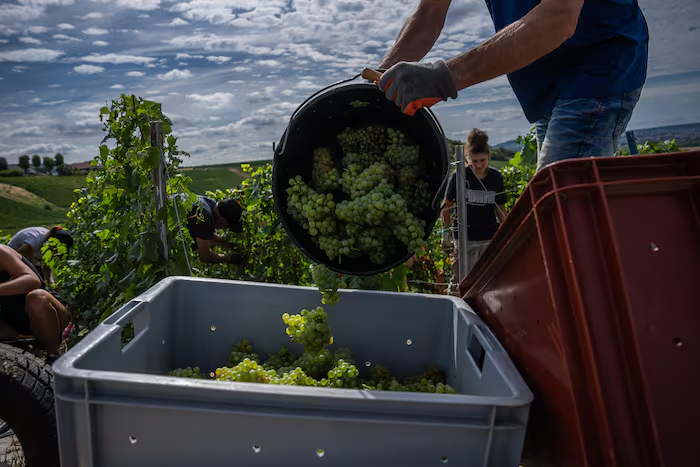
The Champagne region of France has begun what producers are calling a historic harvest, with grape picking operations commencing in mid-August — approximately a month earlier than the historical norm. Extreme heat waves and severe drought conditions accelerated the ripening cycle, compressing what had traditionally been a more extended growing season and forcing harvesters to work within a critical timeframe to maintain wine quality.
Alexandre Gobillard, who serves as production director at Gobillard & Fils and represents the fourth generation managing the family estate, described the timing as unprecedented in his three decades with the company. The estate operates 40 hectares of vines in the Hautvillers area, recognized as a UNESCO World Heritage site in 2015, and produces approximately 1.5 million bottles annually. Gobillard noted that August 15 traditionally marked the beginning of vacation season rather than harvest operations, underscoring the dramatic shift in growing conditions.
Multiple heat waves struck the region this year following a late-March frost that damaged early buds, reducing overall crop potential by 43 percent according to David Chatillon, president of the Union of Champagne Houses. The subsequent drought intensified yield losses, though industry leaders emphasized that quality control remains achievable despite the challenging conditions.
Temperature records reached 40 degrees Celsius (104 degrees Fahrenheit) across parts of Champagne in June, forcing grapes to concentrate sugars more rapidly as vines drew moisture from fruit to survive. Gobillard explained that this accelerated ripening process has compressed the traditional 100-day harvest cycle to approximately 80 days across three generations of his family’s vineyard management.
The early harvest creates substantial logistical constraints in a region dependent on hand-picking traditions. Gobillard & Fils requires roughly 120 workers, many recruited from France and Poland, with housing and transportation presenting significant organizational challenges during August when many laborers traditionally take vacation. Geoffrey Bonnet-Gobillard, the 30-year-old commercial director, acknowledged that such pressures may eventually necessitate adopting more mechanized harvesting methods.
According to Comité Champagne’s industry data, 266.1 million bottles shipped in the previous year generated 5.7 billion euros ($6.6 billion) in global sales, with Champagne commanding 31 percent of the sparkling wine market by value despite representing only 8 percent by volume. The sector supports approximately 30,000 permanent positions and requires around 100,000 seasonal workers annually.
Despite widespread concerns about drought-related crop reductions, Gobillard expressed optimism regarding the quality of grapes currently being harvested. He emphasized the necessity of completing operations swiftly, stating that early indications suggested sufficient quantity would be achieved while maintaining the delicate flavor profile characteristic of premium Champagne production.

More Stories
Four Kitchen Staples That Belong Outside the Freezer, According to Culinary Experts
CareCloud Breach Compromises 3.75 Million Patient Records, Among Largest Healthcare Data Thefts of 2026
Cyclospora Parasite Outbreak Tied to Recalled Lettuce Spreads to 20 States