

💛 A quick favor, if you've got a second.
We're really happy that you chose to read one of our stories and sincerely hope you'll stick around to read more. We took our paywall down — for now — but that won't last forever, and when the gate goes back up, we'd love for you to already be on the inside.
It's free. So please enter your email here and don't forget to like and follow us on all of your favorite Social Media platforms!
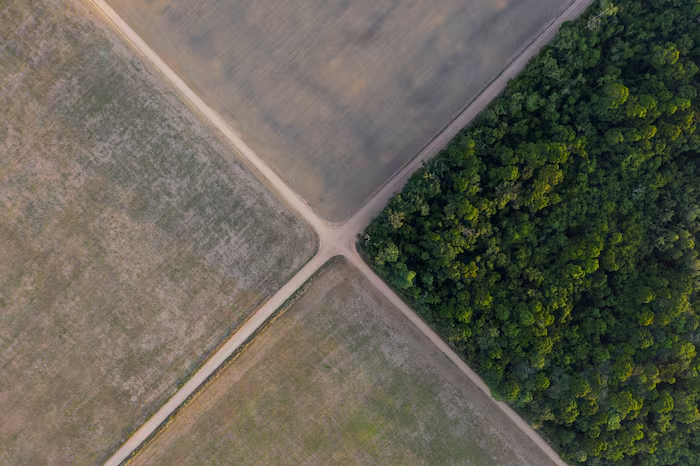
Brazil’s Supreme Court on Wednesday validated state legislation that strips tax benefits from farmers and companies adhering to the country’s soy moratorium, effectively dismantling the decades-old environmental agreement. The ruling affirmed both the constitutionality of the voluntary pact and the legality of state laws designed to penalize participants, creating what observers describe as a fundamental contradiction in environmental policy.
The moratorium, established in 2006 following pressure from environmental organizations and international purchasers, prohibited the purchase of soybeans grown on deforested Amazon land after July 2008. Major grain traders began withdrawing from the agreement in January after top soy-producing states, including Mato Grosso, Para, and Rondonia, enacted bills eliminating tax incentives for participating companies.
Brazil supplies approximately 40 percent of the world’s soybean output, producing 171.5 million metric tons during the 2024-25 season according to the U.S. Department of Agriculture. China represents the largest market for Brazilian soy exports, according to official trade statistics.
Research published in July in the journal Science found that the moratorium reduced deforestation in vulnerable areas by 35 percent during its first decade without compromising productivity. Scientists warn that dismantling the agreement could trigger up to 1.4 million hectares of forest loss over the next ten years, exposing territory equivalent to Portugal’s size to legal clearing.
Soy producers have long contended that the moratorium created unfair disadvantages because it exceeded Brazilian environmental law, which permits farmers in the Amazon to clear 20 percent of their land while preserving 80 percent. The voluntary agreement prohibited all deforestation regardless of legal authorization.
Angela Barbarulo, Greenpeace Brazil’s legal coordinator, acknowledged the court’s recognition of the moratorium’s environmental significance but criticized the ruling for endorsing state measures that discourage adoption of conservation standards beyond legal minimums. “When it comes to protecting the Amazon, we should not allow state legislation to create loopholes or incentives that undermine environmental commitments built collectively,” she said.
The Brazilian Association of Vegetable Oil Industries stated the Supreme Court decision resolves years of legal ambiguity and validates voluntary sustainability measures by traders. However, the organization referred to the moratorium using past tense language, suggesting the court’s decision is unlikely to restore the agreement.
Deforestation rates fell significantly under President Luiz Inácio Lula da Silva’s administration following elevated levels during former President Jair Bolsonaro’s 2019-2022 tenure, reaching decade-low levels. The Amazon rainforest serves critical functions in global climate regulation, with scientists cautioning that continued forest loss accelerates warming and threatens agricultural regions across the United States and Europe.

More Stories
Colombia backs Trump security push while limiting U.S. role in anti-gang operations
Federal Prosecutors Convene Special Grand Jury to Investigate D.C. Schools’ Attendance and Graduation Practices
State Department Reissues Level 3 Travel Advisory for Israel Amid Terrorism and Armed Conflict Concerns