




💛 A quick favor, if you've got a second.
We're really happy that you chose to read one of our stories and sincerely hope you'll stick around to read more. We took our paywall down — for now — but that won't last forever, and when the gate goes back up, we'd love for you to already be on the inside.
It's free. So please enter your email here and don't forget to like and follow us on all of your favorite Social Media platforms!
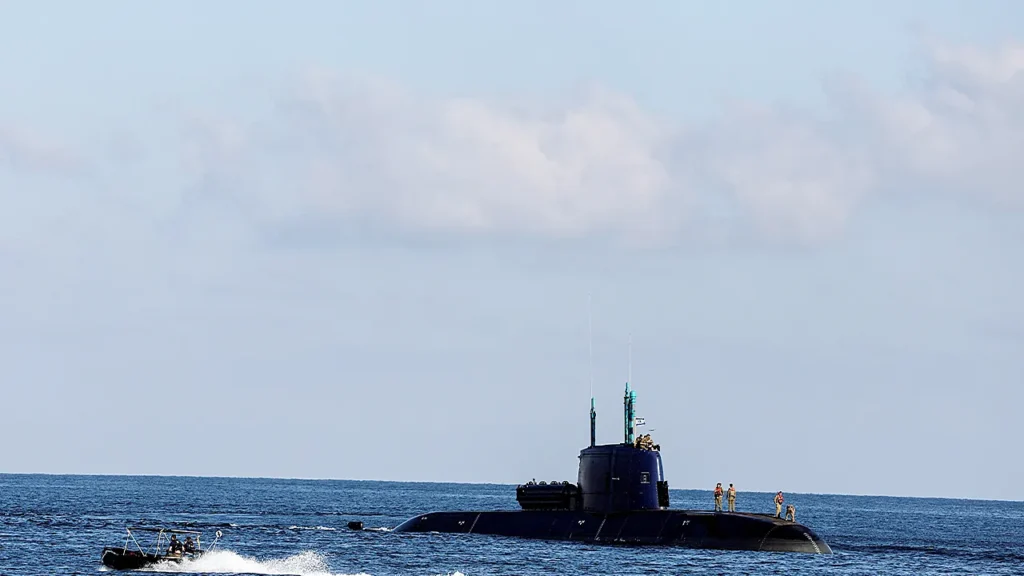
Israel has accepted delivery of the INS Drakon, its newest and most sophisticated submarine built by Germany’s ThyssenKrupp Marine Systems, marking a significant expansion of the nation’s underwater defense capabilities. The vessel represents a substantial investment in Israel’s strategic deterrence posture as tensions with Iran persist, according to defense sources and Israeli officials.
The Dolphin II-class submarine, which arrived at Israel’s ports in late July after construction in Kiel, Germany, measures over 70 meters in length and displaces more than 2,000 tons. At a cost of $634 million, the INS Drakon stands as the largest submarine built in Germany since World War II and serves as the third modified Dolphin II-class vessel in Israel’s fleet.
Dr. Ehud Eilam, an Israeli national security expert and former Ministry of Defense researcher, emphasized that maintaining continuous submarine presence at sea is essential for the nation’s survival. He noted that should Iran launch a devastating attack capable of neutralizing Israeli military infrastructure, submarines already deployed could execute retaliatory strikes, providing a critical safeguard when other assets remain vulnerable in port.
The submarine features advanced systems and proprietary technologies designed to extend operational reach across multiple domains, according to statements from Israel’s Ministry of Defense. Its larger size enables expanded missile range, potentially allowing strikes throughout Iranian territory without requiring vessels to approach Iran directly through the Suez Canal or circumnavigate Africa—both logistically challenging routes.
The vessel’s name references the mythical sea dragon symbolizing strength and power, while its Hebrew letters commemorate the INS Dakar, a submarine lost in 1968 with its entire crew. ThyssenKrupp CEO Oliver Burkhard confirmed construction proceeded on schedule, describing the program as advancing according to plan.



More Stories
Colombia backs Trump security push while limiting U.S. role in anti-gang operations
Chicago Mayor Issues Executive Order Requiring Contractor Diversity Disclosures and ICE Ties Reporting
Federal Prosecutors Convene Special Grand Jury to Investigate D.C. Schools’ Attendance and Graduation Practices