

💛 A quick favor, if you've got a second.
We're really happy that you chose to read one of our stories and sincerely hope you'll stick around to read more. We took our paywall down — for now — but that won't last forever, and when the gate goes back up, we'd love for you to already be on the inside.
It's free. So please enter your email here and don't forget to like and follow us on all of your favorite Social Media platforms!
Keith Hallegua entered the 458-year-old Paradesi Synagogue alone on Shavuot, the Jewish holiday marking God’s gift of the Torah to Moses. The Kochi resident donned his gray kippah and prepared to pray without a minyan—the 10-male quorum required for traditional Jewish communal worship. Hallegua stands as the sole remaining local Jewish member of the congregation in Kochi’s historic Jew Town neighborhood, carrying the weight of being Cochin’s last local Jew.
Across the city, Elias “Babu” Josephai mourned the loss of rituals at the centuries-old Kadavumbagam Synagogue, remembering his grandmother’s “chukkunda”—fried dough balls prepared for Shavuot celebrations. The two men represent the final chapter of a Jewish community that thrived peacefully for centuries alongside Hindu, Muslim and Christian neighbors in this southwestern Indian seaport. Fewer than 5,000 Jews now remain across all of India, the world’s most populous nation.
The Cochin Jewish exodus accelerated in the 1950s when much of the community immigrated to Israel, abandoning homes, houses of worship and burial grounds. The community’s complex history encompasses both religious freedom and deep internal divisions rooted in class and colorism. Hallegua belongs to the Paradesi Jews, descendants of fair-skinned Sephardic ancestors from Spain and Portugal who fled the Spanish Inquisition during the 16th century, while Josephai is a Malabari Jew whose darker-skinned ancestors trace their lineage back more than 2,000 years to the era of King Solomon.
The Paradesi community historically enslaved people, whose freed descendants—the Meshuchrarim Jews—endured lower social status and fought for religious equality. Malabari Jews faced discrimination from the dominant Paradesi group throughout their shared history. Though these divisions largely dissolved after emigration, their bitter legacy continues to complicate the community’s historical narrative.
Josephai spent years reconstructing Kadavumbagam Synagogue after vandals destroyed it, now maintaining the 12th-century structure virtually alone. He has pledged to keep the synagogue’s prayers alive following a promise made to his grandmother after his siblings left for Israel in 1972. “Every Jew has a dream that his last breath should be in Israel,” Josephai said. “I believe my last breath should be inside this synagogue.”
Hallegua remains in Kochi to fulfill family obligations, caring for his brother and mother while wrestling with the question of why his community has vanished. “Quite often, I walk to the synagogue and I ask HaShem, why have you done this?” he said. The Paradesi Synagogue now depends on tourists and visiting devotees to form a quorum for services in its sanctuary, adorned with 19th-century Belgian crystal chandeliers and blue-and-white Chinese porcelain tiles.
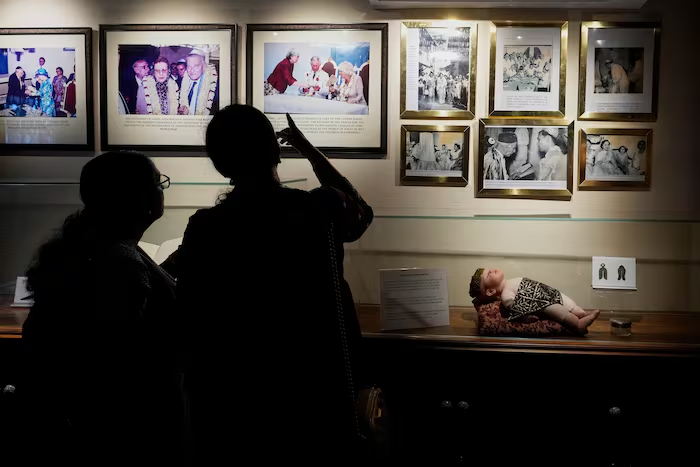
Preservation efforts extend beyond the Jewish community itself, demonstrating the deep social bonds forged over generations. M.C. Praveen, a Hindu trustee of the Paradesi Synagogue, spent his childhood in Jew Town attending school with Hallegua’s relatives, eating Shabbat dinners and playing cricket near the sanctuary. Synagogue leaders opened a museum earlier this year featuring two copper plates inscribed with a Hindu king’s charter from 1000 CE that granted the Jewish community religious freedom.
Thaha Ibrahim, a Muslim who runs an embroidery shop on Synagogue Lane, learned Cochin Jewish embroidery techniques from the late Sarah Cohen, a neighborhood matriarch. He now lights Shabbat candles on Fridays and closes his shop on Saturdays, teaching his son the traditional craft to honor Cohen’s legacy. “This is not about religion, it’s about human connection,” Ibrahim said, dismissing concerns that Muslim-Jewish tensions elsewhere might affect their relationship.
Josephai’s reconstruction of Kadavumbagam Synagogue showcased interfaith cooperation, with a Muslim donor providing lamps, a Christian contributor giving a Ten Commandments plaque and a Hindu foundation funding chandeliers. At 70 years old, Josephai hopes a Jewish organization will eventually assume stewardship of the synagogue, along with the library and museum he has built. “Once I’m gone, there is no one who can tell these stories,” he said.
Hallegua carries vivid memories of a vibrant community: the Paradesi Jewish melodies blending Sephardic chants with local folk elements, his mother’s chili chicken and his grandmother’s intensive Passover preparations. His favorite holiday, Rosh Hashanah, once brought new clothes and family celebrations that have now disappeared. “That’s never going to come back,” he acknowledged.
Despite the pain of witnessing his community’s dissolution, Hallegua remains anchored to his homeland and its history. “I was born a Jew in India and I shall die in India, a Jew,” he explained, accepting that his memories and knowledge will fade when he does. Both men represent a unique identity that is simultaneously ancient Jewish and deeply Indian, a heritage soon to exist only in museums and the receding memories of a diaspora.
More Stories
Colombia backs Trump security push while limiting U.S. role in anti-gang operations
Modern Science Finally Supports & Strengthens Biblical Account of the Crucifixion of Jesus Christ
Federal Prosecutors Convene Special Grand Jury to Investigate D.C. Schools’ Attendance and Graduation Practices