




💛 A quick favor, if you've got a second.
We're really happy that you chose to read one of our stories and sincerely hope you'll stick around to read more. We took our paywall down — for now — but that won't last forever, and when the gate goes back up, we'd love for you to already be on the inside.
It's free. So please enter your email here and don't forget to like and follow us on all of your favorite Social Media platforms!
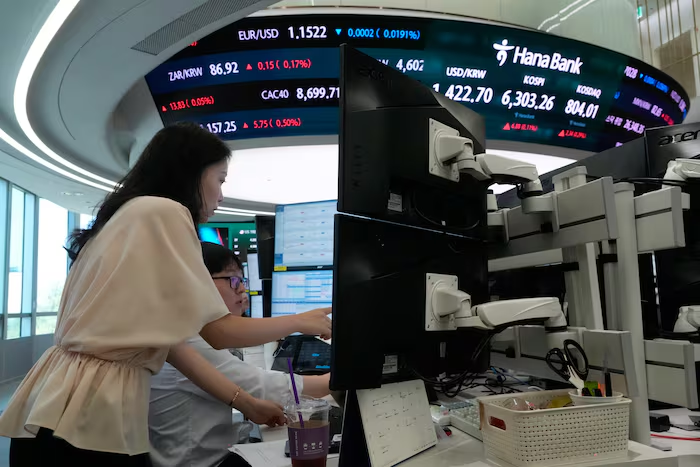
Stock indexes across Asia displayed divergent performance Friday as markets digested a pullback on Wall Street and rising energy costs. The Nikkei 225 in Tokyo fell 0.3% to 65,500.10, with declines in computer chipmakers and artificial intelligence-linked stocks moderating from earlier losses. The Kospi in South Korea shed 0.8% to 6,242.88 while Taiwan’s Taiex dropped 0.4%.
China’s Shanghai Composite bucked the regional trend, gaining 0.8% to 3,931.54 after government data showed export growth of approximately 24% in July despite a slower pace than recent months. Strong demand for electronics and high-tech products supported the gains, though China’s trade surplus contracted and imports also declined. Hong Kong’s Hang Seng rose 0.2% to 25,582.34, and Australia’s S&P/ASX 200 slipped less than 0.1% to 9,265.20.
Wall Street declined Thursday as crude oil prices surged on negotiations to reopen the Strait of Hormuz. The S&P 500 fell 0.2%, the Dow industrials dropped 0.9%, and the Nasdaq composite declined 0.1%. Brent crude jumped nearly 4% to $83.78, up 1.6% by early Friday, while U.S. benchmark crude advanced 1.2% to $78.22 per barrel.
Iran has indicated it is near a deal with Oman to restore passage through the strategic waterway, which historically carried one-fifth of globally traded oil and natural gas. The Trump administration previously stated an agreement was close, though negotiations have experienced multiple setbacks over five months. A key sticking point remains Iran’s demand for control measures, contradicting the U.S. position against allowing Iran to charge shipping fees.
Oil prices have escalated significantly amid the diplomatic impasse, peaking at $113 per barrel and fueling inflation pressures on gasoline prices and shipping costs worldwide. Despite concerns about potential artificial intelligence investment bubbles and Middle East tensions, strong corporate earnings have supported equity valuations on Wall Street.
Roughly 85% of S&P 500 companies have reported quarterly results showing earnings growth tracking toward the strongest performance since 2021. Warner Bros. Discovery advanced 1.7% following better-than-expected earnings, and Molson Coors rose 1.3% after solid results. Honeywell Aerospace plummeted 23.2% on disappointing performance, and AppLovin fell 19.7% after mixed quarterly results.
SpaceX rallied 6.1% as more than 911 million shares held by early investors and employees became eligible for sale following the expiration of a lockup period. This represents over double the shares initially offered during the company’s June debut, when the stock peaked at $225 before sliding to around $115, below its $135 initial offering price.
The July employment report, scheduled for release Friday, will provide fresh insight into U.S. labor market momentum. Weekly jobless claims rose last week, though layoffs remain historically modest. Job creation slowed in June when employers added only 57,000 positions, signaling moderating hiring growth despite overall employment strength.
Currency markets remained relatively stable Friday with the dollar trading at 158.35 Japanese yen, compared to 158.42 yen Thursday, while the euro held steady at $1.1524.


More Stories
Colombia backs Trump security push while limiting U.S. role in anti-gang operations
Federal Prosecutors Convene Special Grand Jury to Investigate D.C. Schools’ Attendance and Graduation Practices
State Department Reissues Level 3 Travel Advisory for Israel Amid Terrorism and Armed Conflict Concerns