



💛 A quick favor, if you've got a second.
We're really happy that you chose to read one of our stories and sincerely hope you'll stick around to read more. We took our paywall down — for now — but that won't last forever, and when the gate goes back up, we'd love for you to already be on the inside.
It's free. So please enter your email here and don't forget to like and follow us on all of your favorite Social Media platforms!
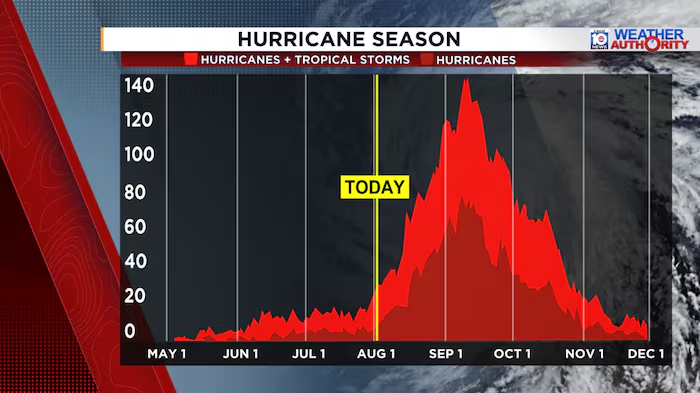
The Atlantic hurricane season exhibits distinctly different characteristics throughout its six-month span, with August serving as a transitional month between relative calm and intensifying storm activity. Early August typically brings minimal tropical development, though the latter part of the month frequently sees activity surge ahead of peak season in September. Historical data shows considerable variability, with some years producing no tropical systems whatsoever during the month’s opening weeks.
The 2022 Atlantic hurricane season provided a notable example of this pattern, recording zero tropical depressions, named storms, or hurricanes throughout August before exploding into activity in September. That season produced Hurricane Ian, which inflicted severe damage across southwest Florida. However, analysis of decades of hurricane records reveals that quiet Augusts often correlate with below-average activity through the remainder of the season, as demonstrated by the relatively inactive 1997 campaign.
As of August 3rd, the 2026 hurricane season sits 34 percent complete by calendar date, yet historically 92 percent of typical seasonal activity remains ahead. Approximately 93 percent of all hurricanes form after August 3rd, with development accelerating substantially as the month progresses into its final weeks. By mid-September, calendar progression and typical storm activity metrics typically align closely.
Statistical analysis of the past 30 years indicates the first half of August averages two tropical systems and one named storm, with hurricanes forming less frequently early in the month than during its latter stages. Forecasters anticipate August 2026 will resemble 2019, 2022, and 2023, which began without organized tropical development. El Niño conditions may suppress Atlantic hurricane activity, potentially resulting in a season more comparable to below-average years like 2015 and 1997.
A disturbance approaching the southeastern United States this weekend shows no signs of organizing into a tropical system. Computer models, including the American GFS forecast, have ceased indicating development potential for this feature. A separate system tracking across the eastern Atlantic between Africa and the Caribbean by mid-August continues to show limited development prospects, with model confidence remaining unchanged from previous forecasts.


More Stories
Archaeologists Unearth 1,300-Year-Old Trading Hub Near Ancient Jaffa in Israel
Month-Long HEPA Use Linked to Faster Cognitive Processing in Middle-Aged Adults
NASA Launches $4.3 Billion Roman Space Telescope to Search for Exoplanets and Dark Energy