




💛 A quick favor, if you've got a second.
We're really happy that you chose to read one of our stories and sincerely hope you'll stick around to read more. We took our paywall down — for now — but that won't last forever, and when the gate goes back up, we'd love for you to already be on the inside.
It's free. So please enter your email here and don't forget to like and follow us on all of your favorite Social Media platforms!
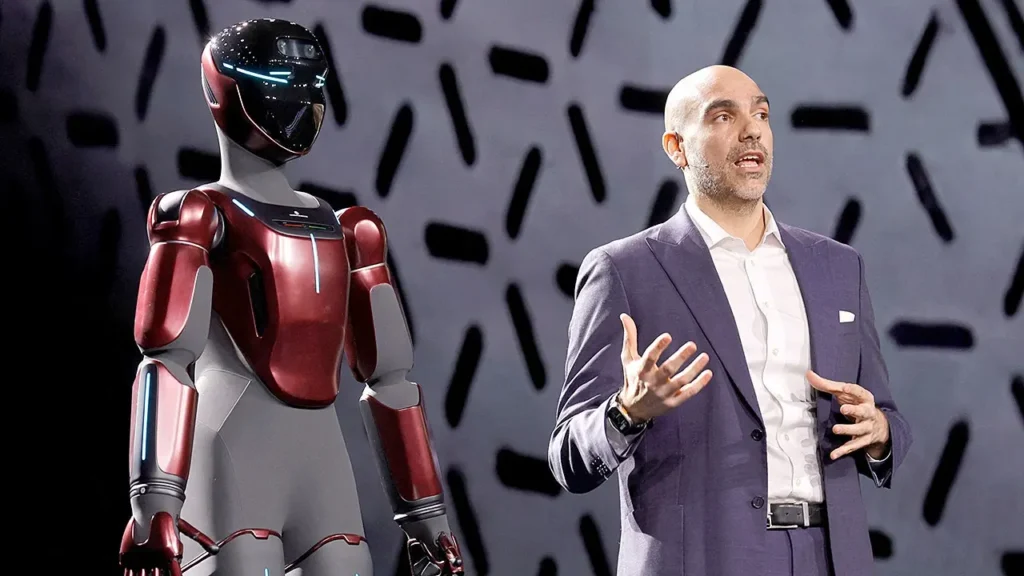
Generative Bionics, an Italian robotics company, has developed Gene.01, a humanoid robot equipped with distributed sensors across its body designed to identify nearby workers before they make physical contact. The sensor-laden skin simultaneously measures touch, temperature, proximity and force, giving the machine’s control system crucial reaction time in workplace environments where humans and robots operate in close proximity. The technology addresses a fundamental challenge in deploying humanoids in industrial settings where traditional barrier-based safety systems are impractical.
The proximity-sensing capability functions similarly to how humans instinctively pull their hand away from heat near a stove, allowing Gene.01 to detect an approaching person and initiate protective responses before any collision occurs. Unlike camera-based vision systems that may lose sight of workers standing too close or obscured by the robot’s body, full-body proximity sensing provides continuous awareness regardless of the robot’s line of sight. This redundant sensory layer enhances safety in factory environments where humanoids must share workspace with human workers.
Gene.01’s sensor network also transforms how workers train the machine to perform tasks. Rather than relying solely on video demonstrations, employees can physically guide the robot’s arms through motions while the system records the force and pressure involved in each action. This tactile learning approach captures nuanced details that video cannot convey, such as the precise grip strength needed for delicate objects versus heavy equipment, making robot training more accessible to experienced workers without programming expertise.
The platform employs Generative Bionics’ proprietary Physical AI methodology, which integrates the robot’s hardware design and software controls as a unified system rather than treating them as separate components. The approach, developed by the company’s founding team at the Istituto Italiano di Tecnologia, underwent peer-reviewed validation when Nature Machine Intelligence published related research on July 13, 2026, focusing on the humanoid ergoCub. Generative Bionics claims Gene.01 represents the first industrial platform applying this human-aware, physics-native methodology to a fully functional sensorized humanoid.
CEO Daniele Pucci stated that the company advanced Gene.01 from concept to operational platform in six months by combining expertise in humanoid robotics, artificial intelligence, biomechanics and industrial design. The modular architecture allows Generative Bionics to customize the robot’s artificial intelligence, exterior design and end effectors—the hands, grippers or specialized tools attached to limbs—for specific industrial applications without redesigning the entire machine.
Generative Bionics identified manufacturing, logistics, inspection, public safety and healthcare as target markets for Gene.01 and its derivative platforms. The company has already begun its first industrial deployment in collaboration with Italian shipbuilding firm Fincantieri, developing a humanoid specialized for welding operations in shipyards where extreme heat, fumes and confined workspaces create hazardous conditions for human workers.
The startup raised $81 million in seed funding led by CDP Venture Capital, with participation from AMD Ventures, Duferco, Eni Next, RoboIT and Tether. The company employs approximately 100 people, with nearly half holding doctoral degrees, drawing on experience from previous humanoid projects including iCub and ergoCub. Generative Bionics formed a strategic partnership with German firm Synapticon to develop Gene.01’s actuation systems—the motorized joints controlling robot movement—with final assembly, calibration and safety testing conducted in Europe to comply with regional standards.
The company released a digital model of Gene.01 on GitHub in Unified Robot Description Format, enabling developers to simulate the robot’s movements and test industry-specific applications in virtual environments before accessing physical prototypes. This open-model approach aims to attract researchers and developers to the platform while accelerating customization for diverse industrial applications.
Despite promising capabilities, Gene.01 remains an early-stage industrial platform requiring validation through real-world workplace testing. Generative Bionics has not yet published detailed performance or safety data from operational settings, meaning the actual effectiveness of the sensor skin and control software under full industrial conditions remains unproven. The partnership with Fincantieri on welding applications will provide a critical test of whether the technology delivers on its safety claims in demanding manufacturing environments.



More Stories
Looney Tunes’ ‘Coyote vs. Acme’ Debuts With $15.5 Million as ‘Spider-Man’ Holds Box Office Crown
Trump Calls NASA to Congratulate Agency on Roman Space Telescope Launch
Meta Ordered to Implement Sweeping Teen Safety Restrictions Under Settlement