


💛 A quick favor, if you've got a second.
We're really happy that you chose to read one of our stories and sincerely hope you'll stick around to read more. We took our paywall down — for now — but that won't last forever, and when the gate goes back up, we'd love for you to already be on the inside.
It's free. So please enter your email here and don't forget to like and follow us on all of your favorite Social Media platforms!
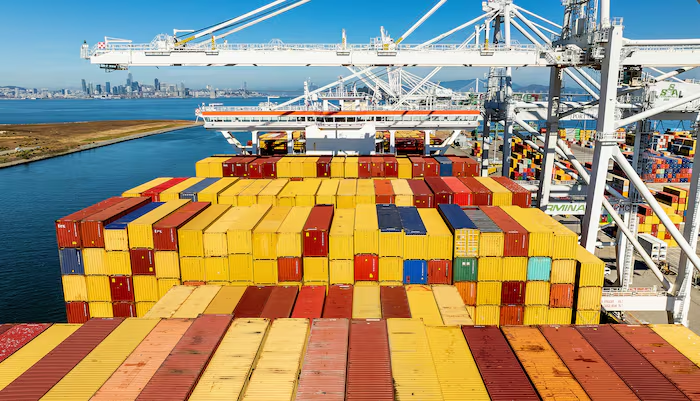
The Trump administration has levied double-digit tariffs against more than 60 nations, relying on legal authority that grants the president power to impose import duties against countries deemed to have engaged in “unjustifiable,” “unreasonable,” or “discriminatory” trade conduct. The recently announced duties take effect following the expiration of temporary 10% global tariffs, with observers questioning whether the action genuinely targets forced-labor violations or primarily serves as a mechanism to reinstate expired trade barriers. The earlier tariffs themselves replaced broader worldwide levies that the Supreme Court invalidated in February.
The administration identified countries as lacking adequate forced-labor import prohibitions or failing to enforce existing bans, with affected nations representing 99% of total U.S. imports. Target countries swiftly rejected the findings, characterizing the determinations as unfounded and capricious, noting that nations with vastly divergent labor-rights records faced identical tariff levels. The U.S. conducted a four-month review but disclosed minimal detail regarding the methodology behind the 10% or 12.5% tariff rates selected.
The levies rest on Section 301 of the Trade Act of 1974, a provision permitting action against countries deemed unfit to “impose and effectively enforce a prohibition on the importation of goods produced with forced labor.” During his initial presidency, Trump invoked Section 301 extensively to impose sweeping tariffs on Chinese imports as part of a broader technological competition with Beijing. The administration continues deploying Section 301 authority to address alleged Chinese unfairness in shipbuilding.
Barry Appleton, a law professor and co-director of New York Law School’s Center for International Law, characterized the approach as deliberately circumventing Congress. “The 301s allow a permanent tariff without going to Congress to settle the dispute,” Appleton stated. “The president doesn’t want to knock on the front door of Congress, so he’s trying every side door and every unlatched window to get in.”
The United States Trade Representative’s office reported consulting with all 60 affected economies, conducting two public hearing rounds, receiving more than 2,100 comments, and engaging trading partners on forced-labor countermeasures. The office withheld specifics of those conversations, citing confidentiality. Experts acknowledged that determining whether a nation possesses a ban is straightforward, but assessing governmental rationale for enforcement failures proves significantly more complex.
Scott Lincicome, vice president for general economics and trade policy at the Cato Institute, questioned the evidentiary foundation. “There’s not a lot of hard evidence there,” Lincicome said, adding that “it’s pretty laughable on its face to think that a country like the ones in Europe or in Norway or Switzerland aren’t doing enough to police forced labor.” Patrick Childress, a partner at Holland & Knight and former trade official, noted that countries must demonstrate enforcement to Washington’s satisfaction before tariff removal—establishing no viable short-term relief pathway.
Brazil, facing a 12.5% tariff, denounced the determination as “arbitrary and unjustified,” accusing the administration of manipulating a critical human-rights issue to target 59 countries and the European Union. Australia similarly contested its tariff classification, with Trade Minister Don Farrell asserting the nation takes modern slavery seriously and will maintain that commitment.
Certain exemptions have triggered industry backlash. The National Council of Textile Organizations protested a mechanism exempting Section 301 tariffs for textile and apparel imports from Bangladesh, Cambodia, Indonesia, and Malaysia based on those countries’ purchases of American cotton and textiles. The organization noted that the domestic textile sector, employing 453,000 workers and having shed 41 plants over roughly two years, has experienced greater forced-labor disadvantage than any other industry.
The U.S. enforces two primary forced-labor-related statutes. The Tariff Act of 1930 authorized Customs and Border Protection to seize suspected forced-labor shipments and block further imports, though it contained a substantial exemption permitting entry when “consumptive demand” existed. The Trade Facilitation and Trade Enforcement Act, effective in 2016, eliminated that loophole. The 2021 Uyghur Forced Labor Prevention Act restricts Xinjiang imports unless businesses demonstrate forced-labor-free production.
Despite these mechanisms, forced-labor goods continue reaching American consumers. A 2015 Associated Press investigation documented slave labor in Southeast Asian fishing operations, with caught seafood entering U.S. supermarkets and pet food supply chains. An AP 2020 investigation of the $65 billion palm oil sector uncovered labor abuses involving millions of workers across Asia, with harvested fruit entering supply chains of major corporations including Unilever, L’Oreal, Nestle, and Procter & Gamble.
Business advocates are calling for more comprehensive enforcement frameworks. Jonathan Gold, National Retail Federation vice president representing the Joint Association Forced Labor Working Group, stated that successful import bans require “clear, measurable benchmarks” tied to tariffs and U.S. assistance in building enforcement infrastructure. Kenya Davis, a Boies Schiller Flexner partner, emphasized that effective prohibition demands transparency regarding investigative scope alongside programs offering countries enforcement support.

More Stories
Federal voting arrest in New Jersey adds new pressure point in Sherrill-Trump standoff
Colombia backs Trump security push while limiting U.S. role in anti-gang operations
Former NFL cheerleader and ex-aide face off in close Rhode Island GOP primary