


💛 A quick favor, if you've got a second.
We're really happy that you chose to read one of our stories and sincerely hope you'll stick around to read more. We took our paywall down — for now — but that won't last forever, and when the gate goes back up, we'd love for you to already be on the inside.
It's free. So please enter your email here and don't forget to like and follow us on all of your favorite Social Media platforms!
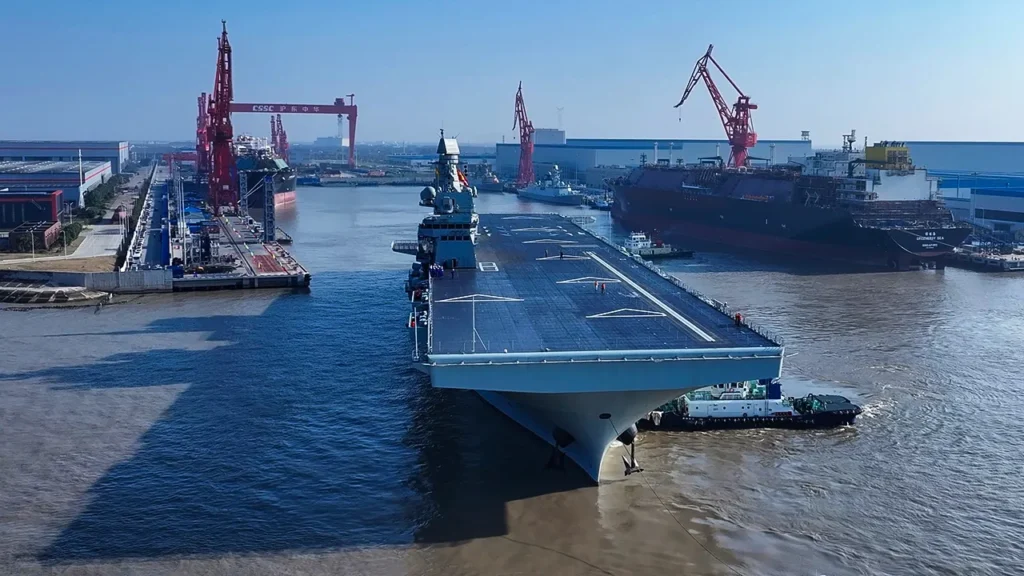
A sprawling warship under construction near Guangzhou represents China’s broader effort to create a military apparatus capable of sustained operations thousands of miles from its shores. The vessel, stretching approximately 885 feet, would rank among the world’s largest dedicated naval replenishment ships if completed as designed, enabling Chinese carrier groups to remain deployed for extended periods without returning home.
Military strategists have long understood that supply chains determine which combatants can endure conflict. China’s new construction aligns with this principle, suggesting Beijing is preparing not merely for a crisis but for a prolonged competition that could extend well beyond initial hostilities. Taiwan remains the most dangerous flashpoint in the region, but Chinese planners appear readying their nation to absorb sanctions, replace destroyed equipment and project force far into the future.
Beijing’s strategic petroleum reserves exceeded 1.2 billion barrels as of late February, providing roughly 109 days of coverage for seaborne oil imports. This stockpile offers protection against supply shocks and demonstrates how China is building economic resilience alongside military capabilities. The country continues expanding a global network of military bases and port access points, recently opening a joint logistics center at Cambodia’s Ream Naval Base in April 2025 while seeking greater control over critical sea routes.
China’s industrial base now dominates global shipbuilding, controlling more than 50 percent of tonnage production in 2023 compared to less than 5 percent in 1999. This manufacturing dominance sustains the workforce, materials suppliers and facilities that simultaneously strengthen China’s navy and commercial economy. Similar patterns emerge in aerospace, with estimates placing production of upgraded J-20 stealth fighters at roughly 120 aircraft annually by late 2025, totaling approximately 500 delivered by mid-2026.
A July 6 ballistic missile test conducted by a Chinese nuclear submarine demonstrated expanded sea-based deterrent capabilities and raised questions about American assumptions regarding regional intervention. The test underscored China’s progress in developing weapons systems that extend Beijing’s reach across vast ocean distances.
Control over critical materials gives China substantial leverage in any prolonged conflict. The International Energy Agency reports that China refines 19 of 20 major strategic minerals tracked, averaging 70 percent global market share. These materials are essential to batteries, power systems, engines and defense applications. Chinese companies have also increased their share of foundational semiconductor production from 19 percent in 2015 to 33 percent in 2023, though these remain less advanced than cutting-edge chips.
Space systems anchor China’s strategic architecture, with Beijing operating more than 1,353 satellites by year-end 2025, including over 510 dedicated to intelligence and surveillance. These capabilities allow Chinese forces to locate American aircraft carriers and support long-range targeting operations. Xi Jinping has additionally promoted Chinese technology standards through artificial intelligence initiatives and a new World Artificial Intelligence Cooperation Organization designed to extend Beijing’s influence across developing nations.
China’s Cross-Border Interbank Payment System now boasts 210 direct participants and 1,619 indirect connections, providing alternative financial channels should Western restrictions interrupt traditional trade mechanisms. Though the renminbi represented only 1.99 percent of global currency reserves in early 2026, the system offers practical protection for essential commerce during crisis periods.
Intelligence operations targeting American officials have intensified, with the Justice Department disabling 13 websites in June allegedly operated by Chinese intelligence services. These sites impersonated consulting firms and specifically targeted current and former American military and government personnel with security clearances, using artificial profiles and professional networking platforms to appear credible.
Despite serious domestic challenges—including a 3.39 million population decline in 2025 and continued property market weakness—Chinese leadership continues methodically reducing vulnerabilities before potential major conflicts arise. The People’s Liberation Army lacks combat experience since 1979 and faces constraints in modernizing its force, yet Beijing’s systematic approach suggests confidence in its long-term strategy.
American policymakers currently fragment response strategies across multiple agencies and commands rather than treating the challenge as a unified competition. Closing the gap requires coordinated action including increased munitions stockpiles, sustained shipbuilding investment, secure supply chains with allied partners and enhanced space security. Deeper coordination with Japan, South Korea, Australia, the Philippines, Taiwan and European nations remains essential.
The construction project near Guangzhou may lack the dramatic headlines of a missile test or fighter jet intrusion, yet it reveals fundamental truths about Chinese strategic intentions. Xi Jinping is constructing a nation capable of fueling its military, replacing combat losses, protecting industrial capacity and projecting power beyond American reach. The central question facing Washington is whether it can match this commitment before the opportunity to respond effectively disappears.

More Stories
Colombia backs Trump security push while limiting U.S. role in anti-gang operations
Chicago Mayor Issues Executive Order Requiring Contractor Diversity Disclosures and ICE Ties Reporting
Federal Prosecutors Convene Special Grand Jury to Investigate D.C. Schools’ Attendance and Graduation Practices