


💛 A quick favor, if you've got a second.
We're really happy that you chose to read one of our stories and sincerely hope you'll stick around to read more. We took our paywall down — for now — but that won't last forever, and when the gate goes back up, we'd love for you to already be on the inside.
It's free. So please enter your email here and don't forget to like and follow us on all of your favorite Social Media platforms!
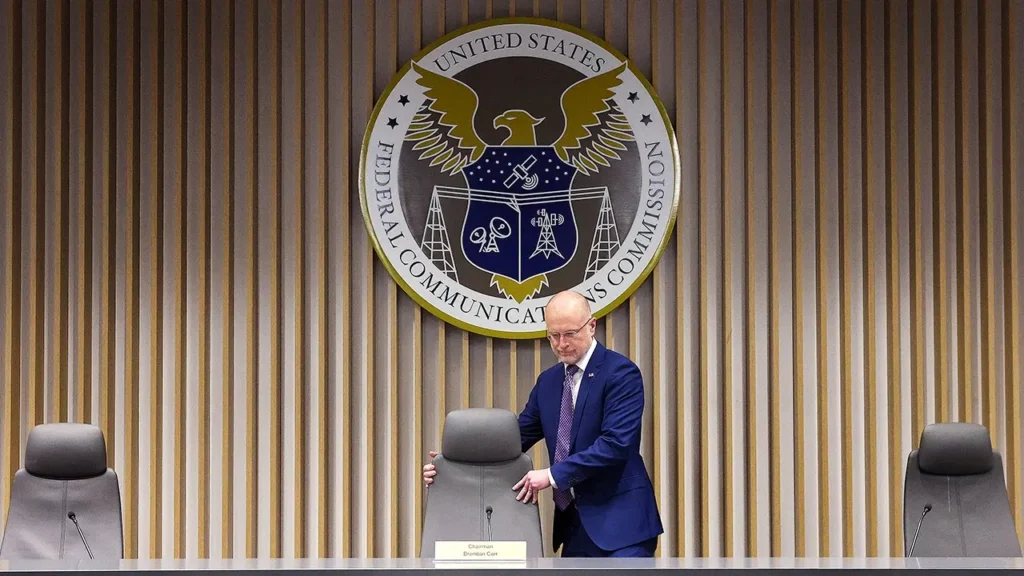
Federal Communications Commission Chairman Brendan Carr’s newly unveiled spectrum auction represents a rare policy achievement that simultaneously bolsters investment, fortifies national security, enhances consumer services and delivers substantial revenue to federal coffers—all without implementing additional taxation. The auction of 160 megahertz of Upper C-band spectrum, combined with airwaves cleared in 2020, creates a contiguous block exceeding 400 megahertz, establishing what may be the world’s most commercially valuable wireless spectrum band.
Though invisible, spectrum ranks among the modern economy’s most critical resources, facilitating phone communications, financial transactions, emergency services, industrial operations and data transfer between connected devices. The FCC exceeded congressional directives by expanding the minimum 100-megahertz requirement with an additional 60 megahertz, marking the first significant federal spectrum auction in five years and representing an accelerated regulatory timeline uncommon for 5G-era proceedings.
The FCC projects this spectrum deployment could contribute as much as $264 billion to gross domestic product, generate 1.5 million jobs and deliver nearly $390 billion in consumer benefits. Historical precedent supports these projections: the inaugural C-band auction in 2000 generated approximately $81 billion for the government while simultaneously encouraging competitive market forces that lowered consumer costs and reduced federal borrowing requirements.
Strategic competition with China underscores the auction’s national security significance. Nations dominating mid-band spectrum development gain decisive advantages in 5G technology, emerging 6G infrastructure and applications spanning artificial intelligence, robotics, transportation and defense systems. Beijing has systematically treated spectrum as a strategic asset, deploying extensive mid-band capacity and subsidizing telecommunications equipment globally, while American regulatory processes have historically operated at comparatively sluggish speeds.
Beyond this single auction, policymakers must establish a comprehensive long-term spectrum strategy with predictable timelines for study, clearance and auctioning phases. Congress should make the FCC’s auction authority permanent rather than dependent on temporary extensions, eliminating uncertainty that deters private investment in wireless infrastructure and technology development.
Government agencies, particularly the Defense Department, control substantial spectrum allocations that warrant efficiency reviews. While national security operations require protection, Congress could incentivize agency spectrum consolidation by allowing them to share savings or auction revenue generated through equipment upgrades or relinquished underused airwaves. The fundamental principle guiding policy should prioritize government’s role in establishing clear rights and enforcing regulations while allowing private capital and American innovation to drive technological dominance in the next era.

More Stories
Federal voting arrest in New Jersey adds new pressure point in Sherrill-Trump standoff
Colombia backs Trump security push while limiting U.S. role in anti-gang operations
Former NFL cheerleader and ex-aide face off in close Rhode Island GOP primary