


💛 A quick favor, if you've got a second.
We're really happy that you chose to read one of our stories and sincerely hope you'll stick around to read more. We took our paywall down — for now — but that won't last forever, and when the gate goes back up, we'd love for you to already be on the inside.
It's free. So please enter your email here and don't forget to like and follow us on all of your favorite Social Media platforms!
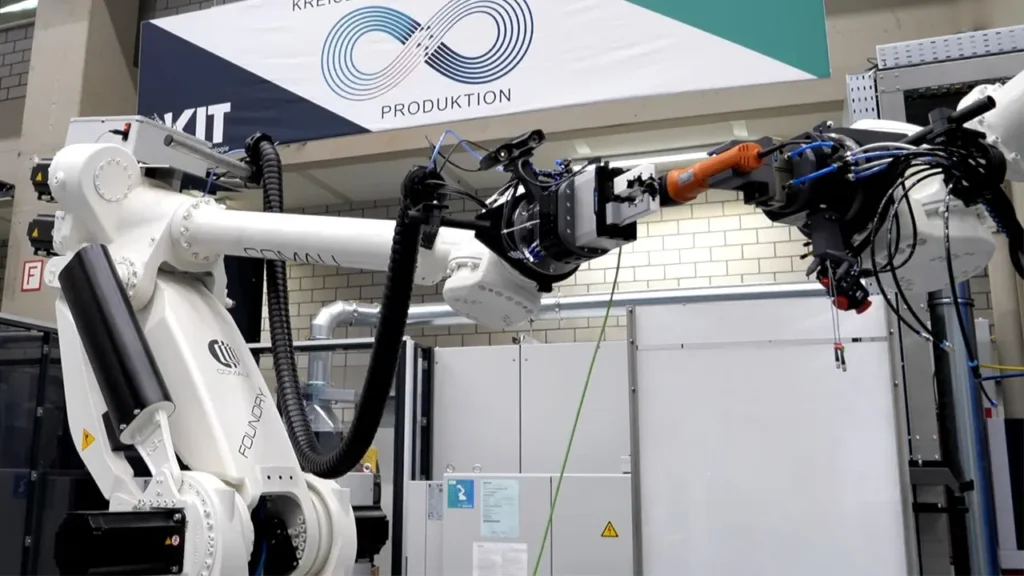
A team of researchers at Germany’s Karlsruhe Institute of Technology has created a robotic system capable of dismantling damaged machinery by recognizing and responding to unforeseen problems. The breakthrough addresses a growing challenge as more than 4.6 million industrial robots operate worldwide, with demand continuing to rise as manufacturers embrace automation across production facilities.
Unlike traditional factory robots that follow rigid, predetermined sequences, this new system accounts for the unpredictable state of aging equipment. Corroded fasteners, missing components, and structural damage from previous repairs all present obstacles that conventional automation cannot easily overcome. Researcher Jan Baumgärtner explains that while assembling new products follows clear, sequential steps, dismantling broken machines requires machines capable of reassessing their understanding of what they encounter.
The technology relies on a probabilistic planning method called a Partially Observable Markov Decision Process, or POMDP, combined with computer-aided design models and real-time sensor inspection. Rather than committing to a single inflexible plan, the robot assigns probabilities to potential problems and continuously updates its assumptions as new information emerges during the disassembly process.
In laboratory tests, the system demonstrated its adaptive capabilities by switching strategies when encountering obstacles. When a stuck screw refused to turn during electric motor disassembly, the robot abandoned that approach and used a milling tool to access the target component instead. In another scenario involving missing fasteners, the system recognized the absence and avoided wasting effort searching for nonexistent parts.
Baumgärtner envisions expanding the technology into facilities with multiple robotic arms equipped with specialized tools, functioning like an assembly line operating in reverse. The long-term goal involves creating a circular economy where manufacturers recover valuable components from older products rather than discarding entire devices.
The research ultimately targets an ambitious economic objective: making automated repair inexpensive enough that fixing electronics costs less than manufacturing replacements. If successful, such systems could reduce electronic waste by recovering high-value components from damaged products and making refurbishment economically viable for manufacturers.
The findings were presented at the 2026 IEEE International Conference on Robotics and Automation in Vienna. While commercial repair stations remain years away, the research demonstrates how robots equipped with adaptive intelligence could transform how manufacturers approach product lifecycle management and component recovery.


More Stories
Looney Tunes’ ‘Coyote vs. Acme’ Debuts With $15.5 Million as ‘Spider-Man’ Holds Box Office Crown
Trump Calls NASA to Congratulate Agency on Roman Space Telescope Launch
Meta Ordered to Implement Sweeping Teen Safety Restrictions Under Settlement