




💛 A quick favor, if you've got a second.
We're really happy that you chose to read one of our stories and sincerely hope you'll stick around to read more. We took our paywall down — for now — but that won't last forever, and when the gate goes back up, we'd love for you to already be on the inside.
It's free. So please enter your email here and don't forget to like and follow us on all of your favorite Social Media platforms!
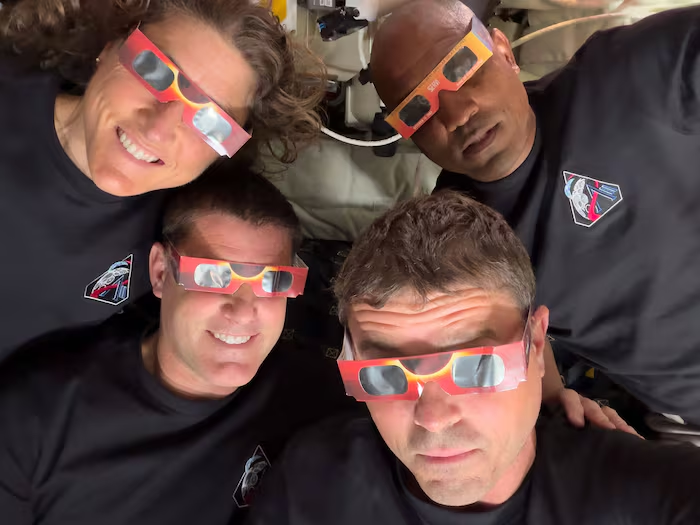
Europe will experience a total solar eclipse Wednesday, marking the continent’s first encounter with totality since 1999. The path of totality will begin near the North Pole and travel southward across Greenland, Iceland, Spain and a small section of Portugal, though the period of daytime darkness will last no more than a couple of minutes at any given location.
Observers across northern regions of the United States and Canada will have the opportunity to witness a partial eclipse if weather conditions permit. While significantly less dramatic than the cross-continental total eclipses North America experienced in 2017 and 2024, the partial eclipse still offers stargazers a chance to see the moon pass in front of the sun.
The 2017 Great American Eclipse delivered more than two minutes of totality stretching from Oregon to South Carolina, while the 2024 eclipse nearly doubled that duration, sweeping diagonally from Mexico’s Pacific coast to Newfoundland. The next total solar eclipse visible from coast to coast in North America will not occur until 2045.
Spain will have a more extended viewing opportunity during a total solar eclipse next August, which will also be visible across North Africa and the Middle East. For Wednesday’s partial eclipse, NASA has provided specific timing and coverage percentages for select North American cities, with northern locations such as Anchorage, Alaska, and St. Johns, Newfoundland and Labrador, positioned for the most substantial views.



More Stories
Archaeologists Unearth 1,300-Year-Old Trading Hub Near Ancient Jaffa in Israel
Month-Long HEPA Use Linked to Faster Cognitive Processing in Middle-Aged Adults
NASA Launches $4.3 Billion Roman Space Telescope to Search for Exoplanets and Dark Energy