




💛 A quick favor, if you've got a second.
We're really happy that you chose to read one of our stories and sincerely hope you'll stick around to read more. We took our paywall down — for now — but that won't last forever, and when the gate goes back up, we'd love for you to already be on the inside.
It's free. So please enter your email here and don't forget to like and follow us on all of your favorite Social Media platforms!
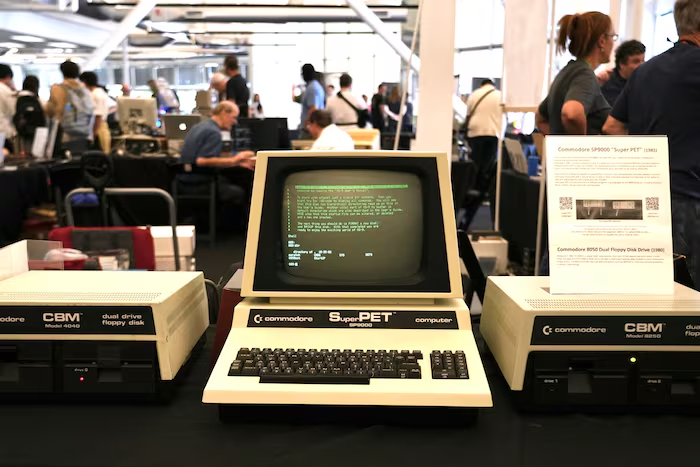
Software engineer Josh Dersch maintains a collection exceeding 200 vintage computers and devices at his Seattle residence, devoting substantial time to restoring machines from decades past to working condition. His passion for understanding technological origins drives his meticulous repair work, allowing him to comprehend complete computer systems from their foundational components to finished products. Dersch represents an expanding cohort of preservationists dedicated to saving the Atari, Commodore and IBM machines that preceded contemporary laptops, wearables and smartphones.
As artificial intelligence dominates Silicon Valley’s focus on the future, hardware collectors view discarded equipment as historically significant artifacts deserving preservation and study. Enthusiasts experience genuine joy operating vintage devices, hearing their distinctive sounds and playing classic games like “Pong” and “Space Invaders” from their youth. The Vintage Computer Federation, led by president Erik Klein, organizes an annual festival at the Computer History Museum in Mountain View to unite collectors and celebrate computing heritage.
The early August Vintage Computer Festival drew more than 3,500 attendees over two days and commemorated Apple’s 50th anniversary since its 1976 founding in Cupertino, California. The event featured Apple co-founders Steve Wozniak and Ronald Wayne discussing the company’s nascent period under late founder Steve Jobs. More than a dozen comparable gatherings have emerged across North America, South America and Europe, reflecting heightened community engagement.
Dersch showcased his restoration of a Xerox Alto, considered “the grandfather of the modern computer” developed at Xerox Palo Alto Research Center during the 1970s. The Alto pioneered graphical user interface innovations including windows, icons and mouse controls that later influenced Jobs and Bill Gates. Original pricing for rare machines like the Apple-1 frequently reaches hundreds of thousands of dollars in online marketplaces.
Klein transitioned from amassing 150 computer systems with complete accessories to organizing festivals and repair workshops as federation president. Sellam Ismail launched the inaugural festival in 1997 with approximately 150 participants and later co-founded the Vintage Computer Federation, which now produces events across multiple countries. Ismail anticipates continued expansion heading toward the festival’s 30th anniversary next year.



More Stories
Modern Science Finally Supports & Strengthens Biblical Account of the Crucifixion of Jesus Christ
Nurse Killed in Hit-and-Run Collision in Brooklyn
Jeff Kent Encourages Barry Bonds to Pursue Hall of Fame Induction During Giants Ceremony