


💛 A quick favor, if you've got a second.
We're really happy that you chose to read one of our stories and sincerely hope you'll stick around to read more. We took our paywall down — for now — but that won't last forever, and when the gate goes back up, we'd love for you to already be on the inside.
It's free. So please enter your email here and don't forget to like and follow us on all of your favorite Social Media platforms!
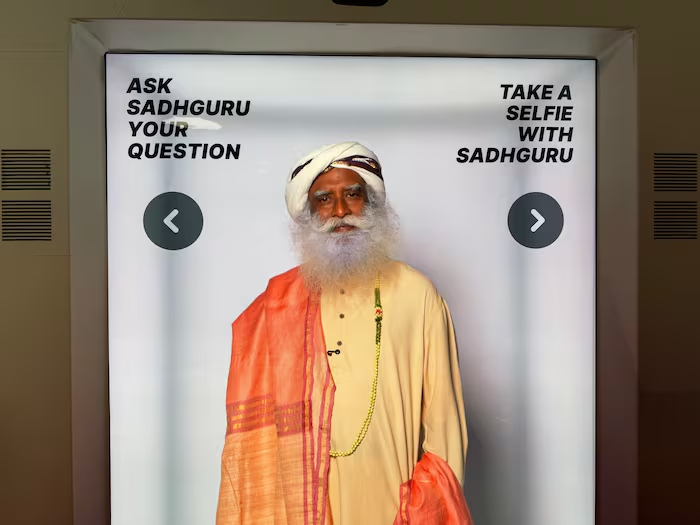
A yoga instructor in Chennai, India, recently watched her grieving sister seek comfort from a prominent spiritual leader after a family tragedy, only to receive what felt like a dismissive response rooted in karma doctrine. Dissatisfied with this encounter, the family discovered an alternative source of solace: artificial intelligence chatbots that offered accessible, judgment-free spiritual counsel at any hour. The shift reflects a broader trend reshaping how people approach questions of faith and meaning in the digital age.
Large language models trained on sacred Hindu texts, including the Bhagavad Gita, now power platforms designed to provide spiritual answers to personal dilemmas and existential questions without the traditional barriers of finding an in-demand guru or paying substantial fees. This unprecedented accessibility has resonated particularly strongly in Hindu communities, where gurus have historically occupied a central role in culture and were considered essential guides toward moksha—spiritual liberation from the cycle of rebirth. The Sanskrit word guru translates to “dispeller of darkness.”
Recognizing AI’s commercial potential, several prominent spiritual teachers have launched their own platforms. Sadhguru, the India-based guru with millions of global followers, introduced the Miracle of the Mind app featuring an interactive AI component drawing from his extensive teachings. California wellness entrepreneur Deepak Chopra created an AI platform called “Digital Deepak” that answers questions based on decades of his recorded talks and published works.
Vikas Sahu, who developed GitaGPT, positions his free platform as an “AI spiritual companion” that places Krishna’s wisdom within reach of those lacking access to human spiritual teachers. The Gurugram-based founder emphasizes that his chatbot serves those in genuine distress who struggle to communicate openly with traditional gurus, though he maintains he would not discourage anyone from pursuing human guidance.
Academic skepticism toward AI-based spiritual guidance remains pronounced among scholars of religion. Liz Bucar, a religion professor at Northeastern University in Boston, argues that sacred texts require interpretive communities and contextual understanding to function authentically, cautioning that a chatbot might simply output responses without genuine wisdom. She also notes that widespread institutional distrust—partly driven by sex abuse scandals within religious hierarchies—has made some people view AI systems as more neutral and trustworthy alternatives.
Noreen Herzfeld, a theology professor at St. John’s School of Theology and Seminary in Minnesota, contends that spiritual awakening demands physical presence between teacher and student. She explains that both Christian and Hindu traditions emphasize eye contact as a soul-level connection impossible to replicate through digital avatars, and that genuine spiritual growth requires a challenging mentor rather than an AI programmed to agree with every user input.
Some spiritual practitioners, however, embrace AI as a complementary tool. Vy Le, a mindfulness instructor in San Diego, views AI platforms as mirrors for intuitive insight, describing experiences of spiritual connection while engaging with these systems. She argues that the traditional guru era has ended and that technology now helps individuals access their own inner wisdom.
Organizations integrating AI and spirituality continue expanding. The Los Angeles-based Self-Realization Fellowship, established in 1920 by Paramahansa Yogananda, is cautiously exploring AI to distribute the late guru’s teachings through safeguarded systems designed to prevent fabricated responses. Brother Govindananda, a monk with the order, maintains that no technology can replicate the profound human and spiritual connection a true guru provides to devoted disciples.

More Stories
Trump Backs Christian-Led Initiative for Expedited U.S. Entry for Canadian Jews Facing Antisemitism
Massachusetts Democrats Split on Age Issue as Moulton Challenges Incumbent Markey in Primary
Justice Department Exposes Chinese Hacking Campaign Targeting NASA, Federal Reserve and US Senate