


💛 A quick favor, if you've got a second.
We're really happy that you chose to read one of our stories and sincerely hope you'll stick around to read more. We took our paywall down — for now — but that won't last forever, and when the gate goes back up, we'd love for you to already be on the inside.
It's free. So please enter your email here and don't forget to like and follow us on all of your favorite Social Media platforms!
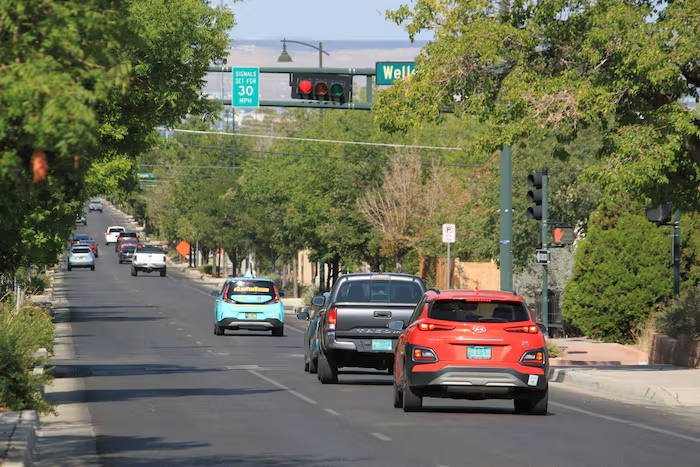
Albuquerque, New Mexico, and Portland, Oregon, have adopted an innovative traffic management strategy that combines traditional “rest in red” signal technology with speed-detection sensors to encourage drivers to obey posted limits. The approach grants drivers traveling at or below the speed limit an expedited green light, while those exceeding it face longer red lights. Officials say the system has produced measurable results in crash and injury reduction along key corridors.
Albuquerque deployed the technology on Lead and Coal avenues, parallel one-way streets that had plagued city officials for years with high-speed collisions despite enforcement efforts. Jennifer Turner, the city’s director of municipal development, credits the system’s effectiveness to its immediate, tangible feedback mechanism. Residents report a noticeable decline in late-night racing and accident-related disturbances since implementation.
Portland recently introduced the concept on Southeast Powell Boulevard, a state highway with a documented history of crashes including fatal incidents. Peter Koonce, who oversees traffic signals and street lighting for the city, termed the approach a “virtual speed bump.” Initial testing at one intersection showed average speeds dropping from 39 mph to the posted 30 mph limit.
Oregon State University researchers are studying Portland’s system performance to ensure that speed compliance improvements do not increase red-light violations or create other safety hazards. David Hurwitz, a transportation engineering professor leading the assessment, cautioned that broader conclusions require additional research before widespread implementation.
Jay Beeber, chief policy officer for the National Motorists Association, expressed skepticism about whether drivers possess sufficient awareness to modify behavior based on signal-speed relationships without comprehensive driver education campaigns. He suggested simpler, less intrusive solutions might achieve comparable safety gains.
A 2023 North Carolina study of five roads found a 43% reduction in total crashes following round-the-clock rest in red implementation, though that system lacked speed sensors. Los Angeles briefly experimented with feedback signs triggering red lights for speeding drivers but discontinued the effort. Boulder, Colorado, and Long Beach, California, have conducted smaller, targeted trials of speed-responsive signals.
Rebecca Sanders, a national safety practice leader at transportation consulting firm Fehr & Peers, noted that the strategy appears most effective on high-capacity roads experiencing off-peak speeding. Despite demonstrated crash reduction benefits, adoption remains limited among U.S. municipalities, with many continuing to rely on traditional speed cameras and enforcement mechanisms.

More Stories
Forest Service Proposes Steep Fee Increases at Lake Tahoe Recreation Sites
Son Discovers Father Missing After Himalayan Disaster in Nepal-Tibet Border Region
Archaeologists Unearth 1,300-Year-Old Trading Hub Near Ancient Jaffa in Israel