


💛 A quick favor, if you've got a second.
We're really happy that you chose to read one of our stories and sincerely hope you'll stick around to read more. We took our paywall down — for now — but that won't last forever, and when the gate goes back up, we'd love for you to already be on the inside.
It's free. So please enter your email here and don't forget to like and follow us on all of your favorite Social Media platforms!
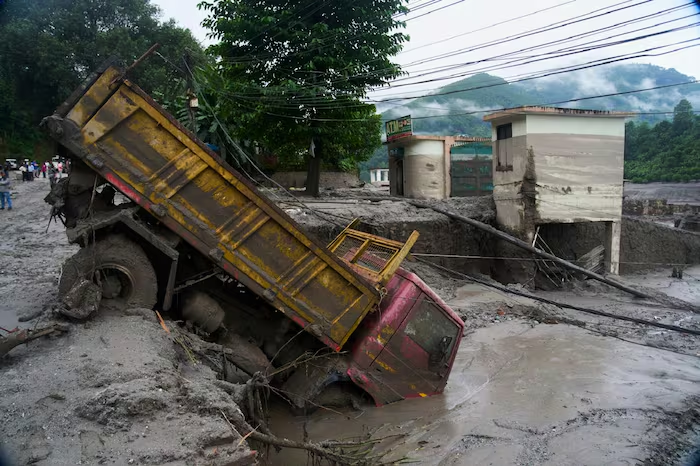
A catastrophic flash flood that swept through Nepal on Wednesday claimed at least 273 lives and left over 1,300 people missing after a massive glacier chunk detached and altered water flow downstream. Preliminary scientific investigations indicate that a large section of glacial ice broke away and temporarily blocked a river, causing backed-up water to surge violently downstream hours later with devastating force.
The U.S. Geological Survey detected a magnitude 5.2 glacier collapse event based on seismic data and satellite imagery. Jakob Steiner, a geoscientist at the University of Graz in Austria working in Bangladesh, described the event as if “someone cut with a huge knife through the whole lower part and it fell off,” suggesting the impact felt like an explosion to affected communities.
Water levels in rivers across the region rose as much as 9 meters in just 30 minutes following the surge. Researchers believe a large volume of ice and rock plunged into the Lhende Khola tributary of the Bhote Koshi River, displacing water and collecting sediment and boulders to create a powerful downstream surge that may have been amplified if debris temporarily dammed the river.
While scientists cautioned against directly attributing this disaster to global warming, they emphasized that rising planetary temperatures increase the likelihood of such catastrophes, particularly in the Hindu Kush Himalaya region, which is warming significantly faster than most other global areas. The area has experienced multiple recent mountain hazards, including glacial lake floods in 2025 and an ice and rock avalanche in 2024.
The Hindu Kush Himalaya contains the world’s largest volume of snow and ice outside polar regions, sustaining 10 major Asian river systems and the food, water and energy security of billions. However, approximately 78% of glacier area at elevations between 4,500 and 6,000 meters faces severe warming exposure.
Between 2000 and 2019, glaciers globally lost 267 gigatons of ice annually, according to United Nations reports. Research from the Kathmandu-based International Centre for Integrated Mountain Development found that Himalayan glaciers are melting at accelerating rates, with ice-loss rates doubling since 2000.
Climate projections indicate potential loss of up to 50% of all glaciers by 2100, even under optimistic warming scenarios of 1.5 degrees Celsius. Current global policies are on track to produce warming of approximately 2.8 degrees Celsius by century’s end, substantially exceeding that threshold.
The disaster destroyed critical infrastructure and left hundreds homeless across the Himalayan region, with approximately 10% of Nepal’s power production capacity located in the affected valley. Scientists stress that stronger early warning systems, enhanced monitoring and faster international information sharing are essential as mountain instability increases.
However, monitoring thousands of glaciers and steep slopes across the sprawling Himalayan arc presents extreme challenges, and cascading disasters may allow only minutes for emergency response. Steiner suggested that certain regions of Nepal have become too hazardous for habitation, yet coordinated governmental action and stakeholder cooperation remain lacking despite repeated disasters.

More Stories
Colombia backs Trump security push while limiting U.S. role in anti-gang operations
Federal Prosecutors Convene Special Grand Jury to Investigate D.C. Schools’ Attendance and Graduation Practices
State Department Reissues Level 3 Travel Advisory for Israel Amid Terrorism and Armed Conflict Concerns