


💛 A quick favor, if you've got a second.
We're really happy that you chose to read one of our stories and sincerely hope you'll stick around to read more. We took our paywall down — for now — but that won't last forever, and when the gate goes back up, we'd love for you to already be on the inside.
It's free. So please enter your email here and don't forget to like and follow us on all of your favorite Social Media platforms!
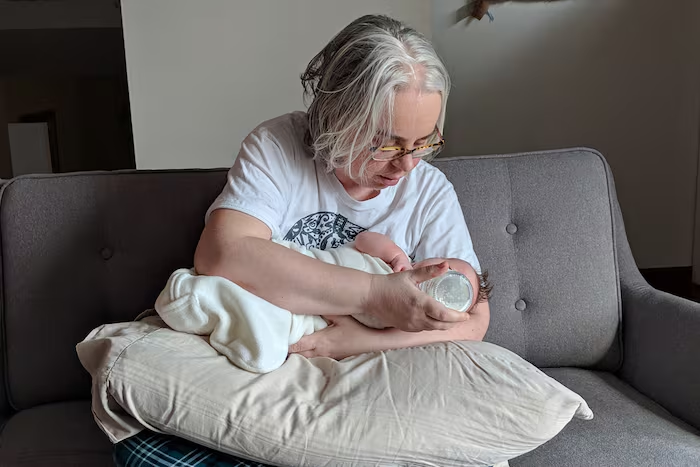
Bridget María Chesterton found herself disoriented and disconnected from reality just two weeks after delivering her daughter in January 2019. Curled on her bathroom floor and later admitted to an emergency room, she repeatedly asked what was happening around her. Medical professionals eventually diagnosed her with postpartum psychosis, a severe psychiatric emergency now drawing renewed public attention due to the case of Massachusetts woman Lindsay Clancy, currently on trial for killing her three children.
Postpartum psychosis strikes between one and two of every 1,000 women after childbirth, according to researchers, making it significantly rarer than postpartum depression, which affects roughly one in seven new mothers. While most women who experience the condition do not harm their children, severe cases can involve self-harm or harm to infants. Symptoms include disorganized thinking, delusions, hallucinations, paranoia, agitation and significant mood fluctuations.
Chesterton, now 52 and a history professor living near Buffalo, New York, bristles at social media commentary dismissing postpartum psychosis as unreal. She has resolved to raise awareness by publicly sharing her experience, with a poem about her ordeal scheduled for publication in a fall journal. “It’s something that we do not talk about as a society,” she said. “I’m not embarrassed about what happened. I want people to know about it.”
Chesterton and her husband James Fitzsimmons had pursued fertility treatments for years before conceiving in her mid-40s. Her pregnancy proved difficult, marked by severe asthma that required hospitalization. She delivered her daughter via cesarean section roughly two months early, with the infant immediately transferred to neonatal intensive care.
Fitzsimmons discovered his wife on the bathroom floor days after returning home from the hospital. She struggled to recall basic biographical information and made nonsensical statements, such as declaring it “meditation day” despite never meditating. Her mother, Maria Chesterton, noted upon arrival at the hospital that her daughter “didn’t even remember having a baby” and recognized family members only vaguely.
Chesterton spent approximately two weeks at BryLin Hospital in Buffalo, a facility specializing in psychiatric crises. Following her initial release, her condition deteriorated rapidly into blank staring and severe disorientation. She was involuntarily hospitalized again for another two-week period, separated from her infant daughter still receiving care in the neonatal unit.
Antipsychotic medications proved essential to Chesterton’s recovery, though she credits her family’s intensive support as equally critical. When her daughter finally came home after nearly two months in the hospital, a support network including her husband, both parents and a postpartum doula facilitated her return to functioning. “She helped me learn how to take care of the baby, remember her — you know, to become a parent again,” Chesterton said.
Dr. Emily Williams, one of Chesterton’s physicians at Buffalo OB/GYN, emphasized that robust family involvement during the postpartum period remains vital regardless of whether complications arise. “The more hands on deck, the better,” Williams said. Postpartum psychosis occurs more frequently in women with existing mental health conditions such as bipolar disorder, though Chesterton had no such history.
Over subsequent months, improvement accumulated gradually. Her mother observed the transformation: “She was taking care of the baby. The glassy-eyed look was gone.” Chesterton remained on antipsychotic medication for approximately one year. By her daughter’s first birthday celebration, she had returned to her baseline state.
Williams commended Chesterton’s family for responding swiftly when symptoms emerged. She cautioned that relatives sometimes minimize or rationalize serious postpartum psychiatric symptoms as mere sleep deprivation or fatigue rather than recognizing signs of genuine medical emergency. Chesterton’s mother urged other families to remain vigilant for warning signs and mobilize support networks immediately. “If my daughter would not have had the support system,” she said, “I don’t know how this would have turned out.”

More Stories
Christa Pike Survives Botched Double Execution Attempt; Tennessee Halts Remaining 2026 Executions
Tennessee’s Lone Death Row Female is Scheduled for Execution Wednesday for 1995 Torture/Murder
Modern Science Finally Supports & Strengthens Biblical Account of the Crucifixion of Jesus Christ