


💛 A quick favor, if you've got a second.
We're really happy that you chose to read one of our stories and sincerely hope you'll stick around to read more. We took our paywall down — for now — but that won't last forever, and when the gate goes back up, we'd love for you to already be on the inside.
It's free. So please enter your email here and don't forget to like and follow us on all of your favorite Social Media platforms!
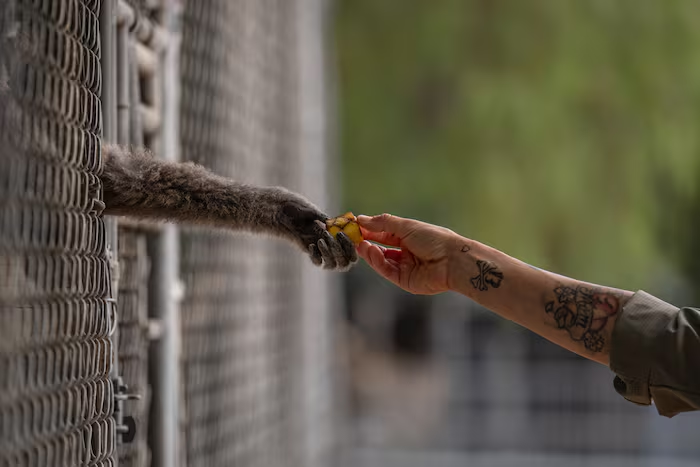
Nestled in the arid hills of Santa Clarita, north of Los Angeles, the Gibbon Conservation Center has emerged as a world-leading facility dedicated exclusively to safeguarding one of Earth’s most endangered primate species. The sanctuary currently houses approximately 40 gibbons representing five distinct species, their distinctive vocalizations—ranging from piercing sirens to low guttural hoots—carrying across the sparse landscape and audible up to a mile away.
Founded by the late primatologist Alan Mootnick, a self-taught expert who simultaneously operated a home painting business, the center has expanded dramatically over its five decades of operation. Mootnick’s pioneering work earned him international recognition, as scientists worldwide sought his guidance on gibbon identification, care protocols, and vocalization analysis by submitting photographs and audio recordings for his expert assessment.
Director Gabi Skollar, who relocated from Hungary in 2005 to study under Mootnick, assumed leadership after his unexpected death from heart surgery complications in 2011. Despite initially planning to pursue further education, Skollar committed to preserving the sanctuary and currently resides on-site with a fellow caretaker, maintaining daily care routines that begin with the primates’ sunrise chorus.
The center has achieved significant breeding successes, including the first-ever successful reproduction of Javan gibbons, an endangered subspecies native solely to Indonesia’s Java island. Some species represented at the facility number fewer than 2,000 individuals in their natural habitats, underscoring the critical importance of the sanctuary’s conservation work and breeding programs designed to maintain genetic diversity.
Caretakers provide five to six daily feeding sessions with fresh produce, mimicking the natural foraging patterns gibbons exhibit in Southeast Asian tropical rainforests. Staff members, including long-term caretaker Jodi Kleier, develop profound bonds with individual animals, with some—like hand-reared gibbon Rocky—becoming central to their personal lives and careers.
Skollar, currently pursuing doctoral studies in gibbon vocalizations at UCLA, emphasizes the sanctuary’s role in advancing global conservation science. Research conducted in captive settings provides invaluable insights shared with field conservationists and rescue sanctuaries combating habitat destruction and illegal wildlife trafficking across Southeast Asia.
Weekend guided tours welcome school groups, tourists, and educational institutions seeking hands-on primate experience, with many visiting students subsequently pursuing careers in animal care. Skollar’s vision includes expanding physical enclosures and constructing a dedicated education center to deepen public engagement with gibbon conservation.
Mootnick’s legacy continues through the sanctuary’s operations and through a gibbon bearing his name, with Skollar crediting his spiritual presence in guiding the facility’s ongoing mission to protect these remarkable primates for future generations.

More Stories
Christa Pike Survives Botched Double Execution Attempt; Tennessee Halts Remaining 2026 Executions
Tennessee’s Lone Death Row Female is Scheduled for Execution Wednesday for 1995 Torture/Murder
Modern Science Finally Supports & Strengthens Biblical Account of the Crucifixion of Jesus Christ