


💛 A quick favor, if you've got a second.
We're really happy that you chose to read one of our stories and sincerely hope you'll stick around to read more. We took our paywall down — for now — but that won't last forever, and when the gate goes back up, we'd love for you to already be on the inside.
It's free. So please enter your email here and don't forget to like and follow us on all of your favorite Social Media platforms!
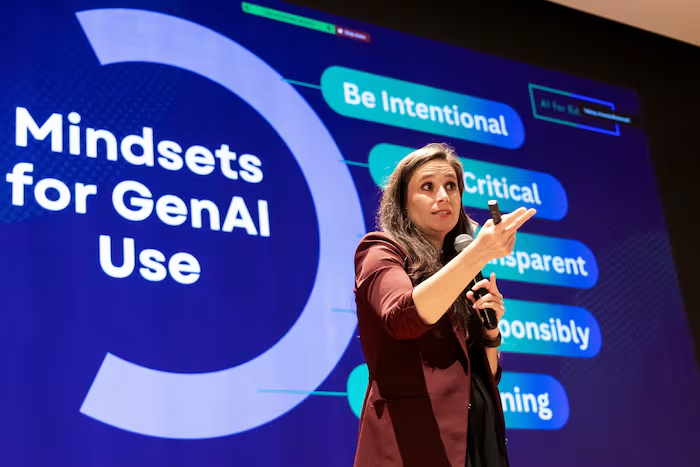
Educators in Charleston, South Carolina gathered at a high school auditorium to explore how artificial intelligence can be integrated into classrooms as the new school year approaches. Rather than continuing to ban AI tools, a growing number of public schools are now embracing classroom experimentation while emphasizing critical evaluation of the technology’s accuracy and limitations. During a demonstration, an AI system tasked with creating a world map produced glaring errors, spelling Mali as “Mail” and Egypt as “Sopth,” prompting the assembled teachers and principals to gasp in disbelief.
Amanda Bickerstaff, founder and CEO of AI For Education, used the flawed map exercise to illustrate why students should question chatbot outputs rather than blindly trust them. Her organization assists school districts in developing AI policies and training programs centered on safe, ethical and responsible technology use. The shift in approach reflects a broader recognition that AI literacy—understanding both the capabilities and dangers of generative AI systems—has become essential for preparing students for an increasingly digital workforce.
Rebecca Winthrop, director of the Center for Universal Education at the Brookings Institution, characterizes comprehensive AI literacy as knowing when not to use these tools, not merely learning how to operate them effectively. Thirty-seven states have now released official AI guidance for schools, though South Carolina remains absent from that list. The Charleston County School District, serving 50,000 students, independently contracted with AI For Education to develop comprehensive guidance similar to programs now operating in Chicago and Houston.
The district began by establishing a foundational AI policy informed by input from teachers, students and parents. Focus groups revealed that student use of AI was widespread but entirely self-directed, with learners and educators navigating the technology independently and requesting clear guidelines. National studies indicate the majority of teenagers and teachers are using AI for schoolwork but have taught themselves through trial and error, with few reporting formal technical training or deep understanding of how the systems function.
As the school year commenced, Charleston County launched Phase 2, deploying both online and in-person training for teachers and middle and high school students. The curriculum uses realistic scenarios, such as requesting chatbot assistance for research papers, to demonstrate how generative AI systems frequently deliver inaccurate information, including fabricated citations and studies, while presenting false data with unwarranted confidence. Students are instructed to independently verify all factual claims obtained from AI tools, particularly for academic work.
High school teacher Ray Knauer attended summer training sessions and plans to use examples of AI bias and hallucinations to spark classroom discussions in his AP Research course. He emphasized the need to balance preparing students to work with AI without encouraging over-reliance on the technology. Knauer stressed that educators must teach students analytical skills and the importance of independent verification rather than accepting AI-generated answers without scrutiny.
Utah emerged as an early leader in statewide AI education policy when the state board of education established a dedicated full-time position in 2024, with Matt Winters named as the AI education specialist. Over the past year, Winters coordinated training for more than 7,000 teachers—roughly one-third of Utah’s public school workforce—and is assisting districts in developing AI policies mandated by state law to be operational by July 2027. Chris Agnew, director of the Generative AI for Education Hub at Stanford University, noted that centralized leadership creates coherence across educational systems when implementing large-scale change.
Maine, West Virginia and Georgia have since established comparable statewide AI specialist positions following Utah’s model. Many other states, however, feature a fragmented approach with varying strategies across individual school districts. Concerns have emerged about whether under-resourced districts will have sufficient funding for comprehensive AI literacy training, potentially creating educational disparities.
Utah’s training regimen begins with fundamental concepts of how AI functions and progresses to topics including algorithmic bias, hallucinations, ethical considerations and data privacy protections. Teachers can subsequently pursue specialized training on particular AI platforms. Emma Moss, who oversees AI at the Canyons School District, led an eight-person team that conducted more than 150 AI literacy trainings across Utah, funded by a $500,000 grant from a local healthcare provider.
Winters negotiated data privacy agreements and secured discounted pricing for AI tools, enabling rural and economically disadvantaged districts to access the technology. He cautioned against universal bans on AI, arguing instead that comprehensive AI literacy encompasses far more than simply prohibiting use. Kristina Yamada, the state Board of Education’s digital technology specialist, emphasized that educators must shift their perspective on student AI use from viewing it as cheating to recognizing it as a skill requiring proper instruction and oversight.

More Stories
Modern Science Finally Supports & Strengthens Biblical Account of the Crucifixion of Jesus Christ
Federal Prosecutors Convene Special Grand Jury to Investigate D.C. Schools’ Attendance and Graduation Practices
Tuskegee University President Defends Dress Code Policy as Pathway to Student Success