


💛 A quick favor, if you've got a second.
We're really happy that you chose to read one of our stories and sincerely hope you'll stick around to read more. We took our paywall down — for now — but that won't last forever, and when the gate goes back up, we'd love for you to already be on the inside.
It's free. So please enter your email here and don't forget to like and follow us on all of your favorite Social Media platforms!
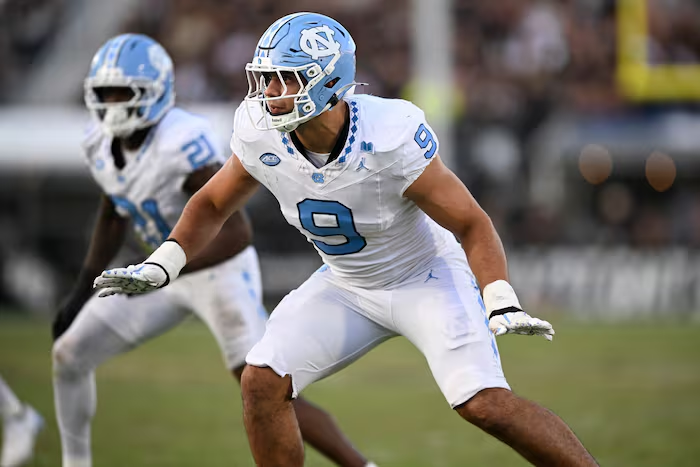
A growing number of states are using public funds to subsidize college athletic departments as universities grapple with escalating costs tied to athlete compensation and facility maintenance. North Carolina, Wisconsin, Connecticut, Louisiana, and New Jersey have recently approved or expanded taxpayer allocations to support sports programs at their flagship institutions, marking a significant shift in how states finance higher education athletics.
The University of North Carolina at Chapel Hill will receive $3 million from state sports betting tax revenue this year, with projections rising to $5.8 million next year. Wisconsin allocated $14.6 million for athletic facility debt at the University of Wisconsin-Madison and $200,000 each for its Milwaukee and Green Bay campuses. Louisiana directed approximately $2.2 million to each of its 11 public universities with Division I football programs following a sports wagering tax increase.
Although state funds do not directly compensate athletes, they effectively free university resources for other uses, including player compensation. Daniel McIntosh, faculty director of the sports business program at Arizona State University, warned that the trend could accelerate as states compete for athletic prominence. “Once one state provides that kind of assistance, schools in competing states can argue that they are being placed at a competitive disadvantage,” McIntosh said.
Athletic spending has surged following major legal and regulatory changes. The NCAA permitted athletes to earn compensation from private entities for their name, image, and likeness beginning in 2021. A legal settlement the following year authorized direct institutional payments to athletes totaling approximately $20.5 million annually, with the cap rising to $21.3 million for the current school year.
Public Division I athletic operating expenses climbed nearly one-third over the past four years, significantly outpacing revenue growth, according to an Associated Press analysis using the Knight-Newhouse College Athletics Database. Many mid-level programs struggle to meet compensation obligations while managing increased costs for coaches’ salaries, facility improvements, and travel expenses related to conference realignments.
The Protect College Sports Act, pending in the U.S. Senate, could intensify spending pressures by raising institutional athlete payment caps to an additional $27.5 million annually, potentially bringing total athlete compensation ceilings close to $50 million. Amy Privette Perko, CEO of the Knight Commission on Intercollegiate Athletics, noted the legislation contains no provisions to restrain state or institutional spending increases on athletics.
Connecticut employed a creative funding mechanism by authorizing the University of Connecticut to issue vouchers providing state tax credits equal to half the value of donations, sponsorships, and licensing endorsements. The program generated $1.7 million within its first four months of operation.
Republican Wisconsin state Representative Alex Dallman, who sponsored his state’s funding legislation, defended the investment as economically and culturally beneficial. “Having a bad football team, having uncompetitive college sports in general, would not be beneficial to our state,” Dallman stated, adding that state support would enable universities to allocate their own resources toward player compensation and competitive recruitment efforts.

More Stories
Federal voting arrest in New Jersey adds new pressure point in Sherrill-Trump standoff
Colombia backs Trump security push while limiting U.S. role in anti-gang operations
Former NFL cheerleader and ex-aide face off in close Rhode Island GOP primary