


💛 A quick favor, if you've got a second.
We're really happy that you chose to read one of our stories and sincerely hope you'll stick around to read more. We took our paywall down — for now — but that won't last forever, and when the gate goes back up, we'd love for you to already be on the inside.
It's free. So please enter your email here and don't forget to like and follow us on all of your favorite Social Media platforms!
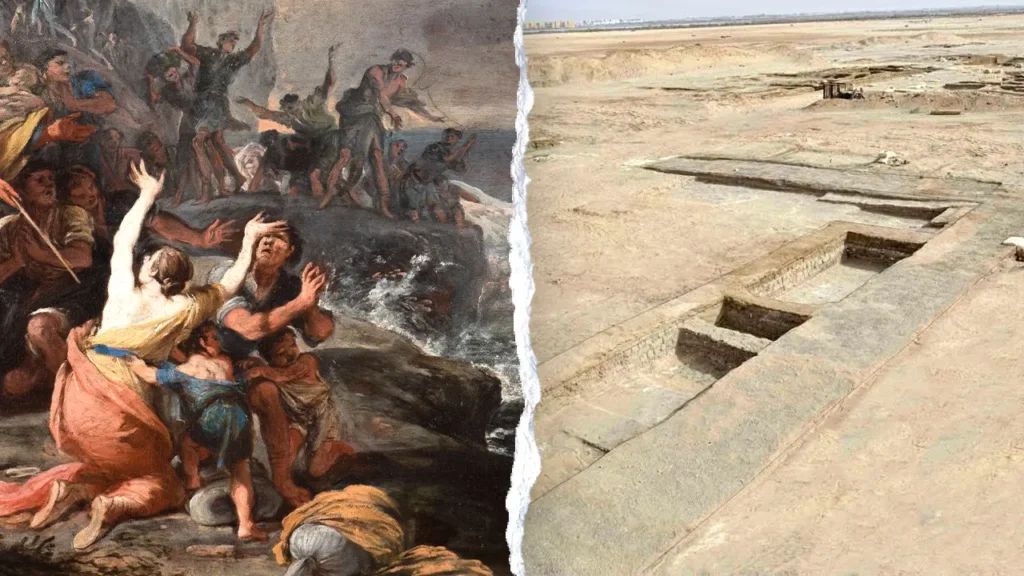
Egyptian authorities announced on August 15 the discovery of archaeological evidence at Tell Abu Seifi, a fortified site in northeastern Egypt near the Sinai Peninsula, that researchers believe may identify the location of Mesen, a long-lost ancient city. The excavation was conducted along what scholars believe was the Horus Military Road, a strategic corridor that once connected Egypt to Sinai and Canaan, potentially corresponding to references in biblical texts.
Among the finds was a large sandstone lintel bearing inscriptions and titles of Ramesses II, the pharaoh often associated with the Moses narrative. The artifact, dated to more than 3,000 years ago based on Ramesses II’s reign from approximately 1303 B.C. to 1213 B.C., features text referencing the restoration of a Horus statue described as “Lord of the City of Mesen.” This inscription provides support for the theory that Tell Abu Seifi represents the archaeological remains of the ancient city.
Excavations also revealed ruins of a fortified temple complex with mudbrick walls, gates, storage rooms, and two ancient stone roads. The Egyptian Ministry of Tourism and Antiquities stated the findings “present a strong archaeological and historical hypothesis linking the site to the ancient Egyptian city of Mesen,” though officials acknowledged that ongoing research is necessary to confirm the identification definitively.
The site’s occupation extended into later periods, with portions converted into a Roman military barracks during the third century A.D. Additional discoveries included fragments of falcon statues and other sculptures. Minister Sherif Fathy characterized the findings as highlighting the region’s strategic importance in protecting Egypt’s eastern borders throughout history.
The discovery adds to several significant archaeological finds from 2024 connected to Ramesses II and biblical narratives, including a large statue at Tel Pharaoh in the Nile Delta and an ancient settlement at Tell el-Koua in Wadi Tumilat, a region long associated with Exodus scholarship debates.

More Stories
Colombia backs Trump security push while limiting U.S. role in anti-gang operations
Modern Science Finally Supports & Strengthens Biblical Account of the Crucifixion of Jesus Christ
Federal Prosecutors Convene Special Grand Jury to Investigate D.C. Schools’ Attendance and Graduation Practices