

💛 A quick favor, if you've got a second.
We're really happy that you chose to read one of our stories and sincerely hope you'll stick around to read more. We took our paywall down — for now — but that won't last forever, and when the gate goes back up, we'd love for you to already be on the inside.
It's free. So please enter your email here and don't forget to like and follow us on all of your favorite Social Media platforms!
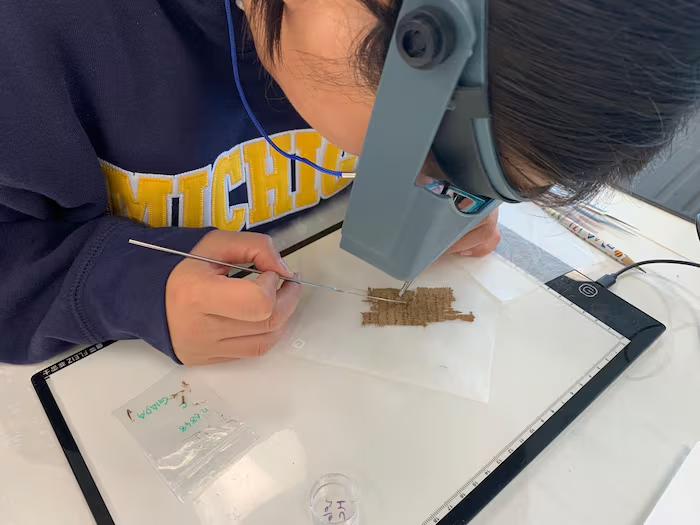
At the University of Michigan, scholar Shijin Jiang positioned a precision magnifying headband over her eyes and leaned inches from an ancient papyrus sheet illuminated on a light board. Working methodically with hand tools, she examined the fragile document—likely untouched for a century and unread for millennia. The inspection required the kind of careful attention that defines the Papyrus Conservation Summer Seminar, an intensive training program that stands alone in the Americas.
The 10-day course represents one of only a handful of such programs globally dedicated to teaching best practices for handling, treating and preserving ancient papyrus texts and manuscripts. Nine scholars from across the world, including participants from Ireland, Italy and China, enrolled in the most recent session to learn conservation methods from experts. Michigan’s Papyrology Collection, which holds texts spanning from 1000 B.C.E. to 1000 C.E., provides the seminar with an unparalleled resource—the largest concentration of papyri on the Western Hemisphere, according to the university.
The collection includes portions of Homer’s epics, writings by philosopher Epicurus and the oldest known copy of Paul’s Epistles. Marieka Kaye, who manages library preservation services for the university’s physical collections, designed the seminar to make the experience welcoming rather than intimidating. Kaye instructed participants in techniques for removing dirt and debris, applying controlled moisture to soften folds and drying papyrus under light weights to prevent damage.
The seminar first convened in 2012 and has been held biennially since, except during 2020. Approximately 50 students have completed the program over its existence. Giuliano Sidro, curator of Michigan’s Papyrology Collection, stressed the urgency of training new generations, warning that without such education “this is a craft that is going to be lost.”
Many papyri in Michigan’s vault remain unexamined, with some acquired through university expeditions to Karanis, Egypt between 1924 and 1935. Latin professor Francis Willey Kelsey, who died in 1927, founded the collection based on his conviction that students of the ancient world required direct access to artifacts, not merely texts. Today the Kelsey Museum of Archaeology houses one of the finest collections of Greco-Roman Egyptian daily-life objects outside Cairo.
Reading ancient papyri demands proficiency in Arabic, ancient Greek, Latin or Egyptian—languages that present significant challenges. Seminar participant Arzak Mohamed, a postdoctoral fellow at Macquarie University in Sydney and native of Fayoum, Egypt, brings Arabic literacy to the program. Mauro Castiello, a papyrology doctoral student based in Milan, translates ancient Greek and Latin texts.
Mohamed expressed enthusiasm about becoming a bridge between conservation traditions, saying she plans to share Michigan’s methods with researchers in Egypt and Australia. She emphasized the importance of transferring preservation knowledge to future generations to ensure these irreplaceable documents survive intact for centuries to come.
More Stories
Christa Pike Survives Botched Double Execution Attempt; Tennessee Halts Remaining 2026 Executions
Tennessee’s Lone Death Row Female is Scheduled for Execution Wednesday for 1995 Torture/Murder
Modern Science Finally Supports & Strengthens Biblical Account of the Crucifixion of Jesus Christ