


💛 A quick favor, if you've got a second.
We're really happy that you chose to read one of our stories and sincerely hope you'll stick around to read more. We took our paywall down — for now — but that won't last forever, and when the gate goes back up, we'd love for you to already be on the inside.
It's free. So please enter your email here and don't forget to like and follow us on all of your favorite Social Media platforms!
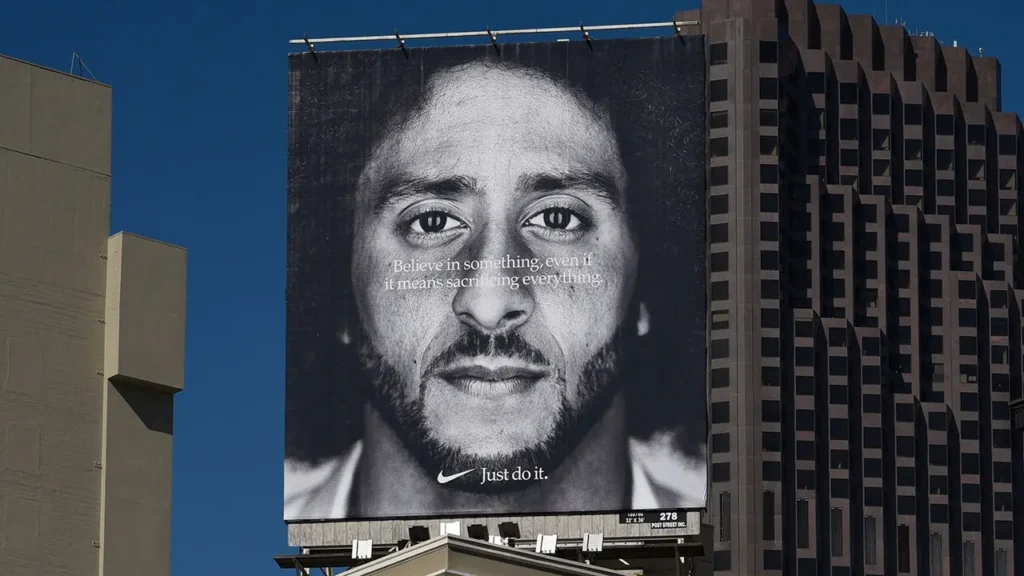
Nike’s stock price fell to its lowest level in 12 years this week, a decline that reflects broader challenges facing the athletic apparel giant beyond its aggressive political positioning. While competition from newer rivals, waning consumer enthusiasm for premium-priced footwear, and lackluster product innovation have all contributed to the company’s struggles, its decade-long embrace of divisive social and political causes has become increasingly difficult to separate from its deteriorating financial performance.
The company’s pivot toward left-wing corporate activism began in earnest in 2018, when Nike elevated Colin Kaepernick, the former NFL quarterback who gained prominence by kneeling during the national anthem, to the centerpiece of its 30th-anniversary “Just Do It” campaign. Kaepernick had become a polarizing national figure after refusing to show respect for the flag, citing police brutality and systemic oppression of Black Americans, and had worn socks depicting police officers as pigs. Nike’s decision to build a major advertising campaign around him, with the tagline “Believe in something. Even if it means sacrificing everything,” represented a deliberate choice to elevate one of sports’ most divisive figures.
The company doubled down on this strategy the following summer by withdrawing a Fourth of July sneaker that featured the Betsy Ross flag after Kaepernick reportedly objected to the design. Nike stated the shoe was halted because it could “unintentionally offend,” a notable decision for a company built on promoting American athletes and celebrating American culture.
Nike’s corporate activism accelerated dramatically in 2020 following George Floyd’s death, when the company launched its “For Once, Don’t Do It” campaign and publicly aligned itself with Black Lives Matter. As the NBA restarted its season in an Orlando bubble with social-justice messaging emblazoned on jerseys and courts, Nike—as the league’s official apparel partner—showed no signs of distancing itself from the political content adorning the uniforms bearing its swoosh logo.
In 2023, the company faced significant backlash after featuring trans-identifying influencer Dylan Mulvaney, a male, in a paid Instagram promotion for women’s sports bras and leggings. This decision came shortly after Bud Light had suffered one of the most damaging corporate boycotts in recent memory following a similar partnership with Mulvaney, making the backlash Nike encountered far from unpredictable.
More serious complications emerged in April 2025 when reporting revealed Nike had allegedly helped fund a study tracking athletic and physiological changes in transgender youth as young as 12 undergoing gender-affirming care. When pressed for details, Nike offered contradictory explanations: a company executive claimed the study “was never initialized,” while a researcher involved said Nike had “pulled out” after public pressure mounted. The company has never clarified which account is accurate, creating a credibility gap.
The contradiction became particularly striking given Nike’s simultaneous investment in promoting women’s sports through its “So Win” Super Bowl campaign, which featured female athletes like Caitlin Clark and highlighted that women are constantly told they “can’t win.” The company appeared unable to coherently explain how it could simultaneously champion women’s athletic opportunities while funding research designed to examine how transgender youth could medically transition to compete in women’s sports.
In February, the Equal Employment Opportunity Commission filed an action to enforce a subpoena against Nike, alleging the company had engaged in systemic discrimination against white employees, job applicants, and training program participants through diversity, equity, and inclusion practices. The EEOC is investigating Nike’s hiring, promotion, layoff, internship, mentorship, and leadership-development decisions, as well as its diversity targets. Nike has denied wrongdoing and stated it is cooperating with the investigation.
The optics of the EEOC action proved particularly damaging for a company that spent years positioning itself as a moral authority on racial justice and fairness. Nike’s 12-year stock low should serve as a wake-up call that consumers increasingly view the company as more interested in impressing activist constituencies than in delivering the products they actually want to purchase at prices they find reasonable.

More Stories
Looney Tunes’ ‘Coyote vs. Acme’ Debuts With $15.5 Million as ‘Spider-Man’ Holds Box Office Crown
Trump Calls NASA to Congratulate Agency on Roman Space Telescope Launch
Meta Ordered to Implement Sweeping Teen Safety Restrictions Under Settlement