


💛 A quick favor, if you've got a second.
We're really happy that you chose to read one of our stories and sincerely hope you'll stick around to read more. We took our paywall down — for now — but that won't last forever, and when the gate goes back up, we'd love for you to already be on the inside.
It's free. So please enter your email here and don't forget to like and follow us on all of your favorite Social Media platforms!
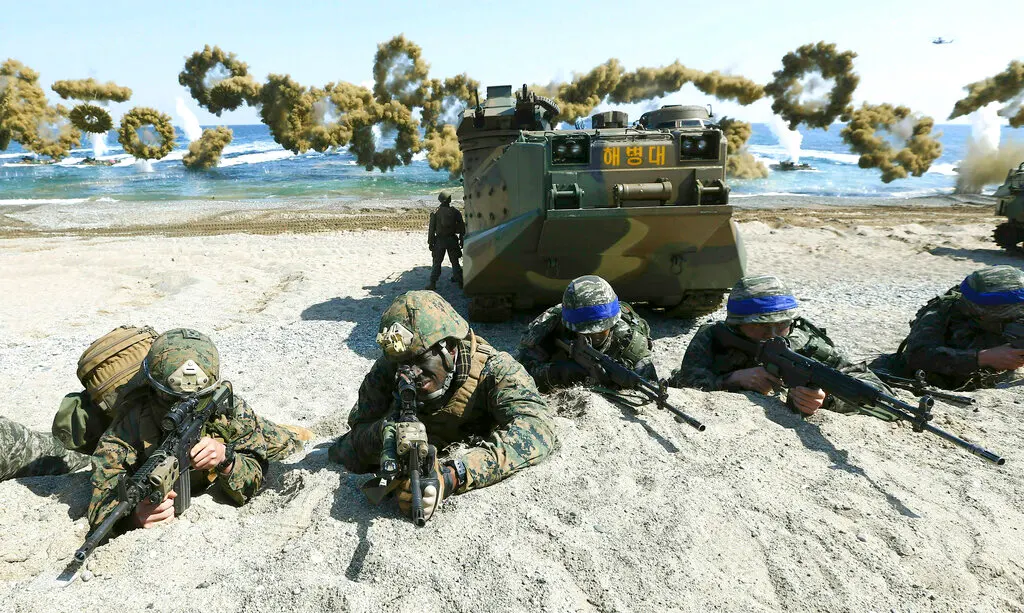
The Trump administration is reducing major joint military exercises with South Korea in response to Seoul’s refusal to back U.S. operations against Iran, marking a sudden reversal just days after the State Department publicly touted the nations’ partnership. Secretary of State Marco Rubio had praised South Korea as an “indispensable partner” and declared the countries had entered a “historic new era” of cooperation following Trump’s state visit to Seoul last autumn, making the abrupt pivot particularly stark.
Underlying tensions between Washington and Seoul have surfaced as Trump grows impatient with the slow implementation of a $350 billion trade and investment framework agreement. Commercial disputes involving American companies and what the administration views as Seoul’s insufficient commitment to U.S. strategic priorities have created friction beneath the surface of official cordiality, according to analysts familiar with the relationship.
Victor Cha, Korea Chair at the Center for Strategic and International Studies, characterized Trump’s decision as a dual-purpose maneuver designed to pressure Seoul into accelerating investments and burden-sharing while simultaneously offering North Korea incentives for renewed diplomatic engagement. The drill reductions represent Trump’s effort to address multiple grievances simultaneously—frustration over the trade deal’s pace and a desire to reset negotiations with Kim Jong-un.
Trump stated that the exercises “send a signal that is totally inappropriate and hostile” toward North Korea, which he claimed “has been unthreatening and respectful” during his current term. The first investments from the trade framework have lagged considerably despite Trump’s earlier threat to impose 25 percent tariffs on South Korean goods, while comparable agreements with Japan are progressing faster.
The move reflects Trump’s renewed focus on diplomacy with North Korea, an unfinished agenda from his first administration. Trump became the first sitting U.S. president to meet a North Korean leader through summits in Singapore in 2018, Hanoi in 2019, and at the Korean demilitarized zone later that year, though these encounters ultimately failed to produce a denuclearization agreement.
The canceled exercises—particularly the Ulchi Freedom Shield drill—serve purposes beyond military posturing, allowing American and South Korean troops to practice coordinated combat operations including force deployment, equipment transport, and joint command structure protocols. This year’s drill was designed to incorporate lessons from the Ukraine war, including drone operations, GPS disruption, and contingency planning for communication breakdowns.
Jenny Town, senior fellow at the Stimson Center and director of 38 North, warned that North Korea has indicated it will not pursue negotiations unless Washington accepts its nuclear weapons status as permanent. While Pyongyang has not completely rejected diplomatic discussions, it has effectively established preconditions that contradict traditional U.S. negotiating positions on denuclearization.
The last-minute nature of Trump’s order has generated concern among alliance observers, with Town noting that the abrupt announcement creates uncertainty and confusion within the U.S.-South Korea partnership. The decision drew sharp bipartisan criticism on Capitol Hill, with lawmakers from both parties questioning the wisdom of reducing military readiness on the peninsula.
Democratic Senator Mark Kelly of Arizona and Republican Senator Thom Tillis of North Carolina both expressed alarm, with Tillis arguing that the pullback “does nothing more than free up thousands of North Korea’s troops to support Putin’s systematic kidnapping, torture, rape, and murder of innocent Ukrainian citizens.” Kelly emphasized that joint exercises are essential for maintaining the alliance’s defensive capabilities against North Korean threats.

More Stories
Federal voting arrest in New Jersey adds new pressure point in Sherrill-Trump standoff
Colombia backs Trump security push while limiting U.S. role in anti-gang operations
Former NFL cheerleader and ex-aide face off in close Rhode Island GOP primary