

💛 A quick favor, if you've got a second.
We're really happy that you chose to read one of our stories and sincerely hope you'll stick around to read more. We took our paywall down — for now — but that won't last forever, and when the gate goes back up, we'd love for you to already be on the inside.
It's free. So please enter your email here and don't forget to like and follow us on all of your favorite Social Media platforms!
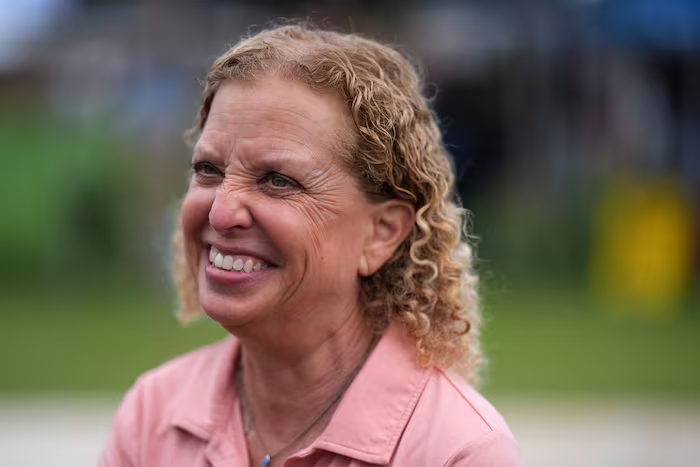
Rep. Debbie Wasserman Schultz is competing for her 12th congressional term in Florida’s primary election Tuesday, though not in the district she previously represented. The veteran Democratic lawmaker shifted to a new seat in Broward County after Republicans redrew the state’s congressional map earlier this year, a move that positioned her as the sole white candidate vying to represent an area that has elected Black Democrats to Congress since 1992.
Wasserman Schultz’s decision to run in the newly configured 20th District—which is 42 percent Black with a significant Caribbean American population—has sparked controversy among progressive candidates and community leaders. Former Representative Sheila Cherfilus-McCormick, who resigned from the seat in April while facing an ethics investigation, characterized Wasserman Schultz’s candidacy as an erasure of Black political power. “For her to come in like this is just another Broward seat, it’s a complete erasure of our history, our fight for Black access,” said Cherfilus-McCormick, 47.
Progressive organizer and substitute teacher Elijah Manley, 27, acknowledged that Republican redistricting caused the situation but argued Wasserman Schultz “had other options.” He contended she could have run in her newly drawn home district on the more conservative Gulf coast instead. “She stabbed us in the back, trying to take away Black representation,” Manley said, citing Congressional Black Caucus warnings that the group could lose more than a quarter of its 60-plus members following redistricting efforts nationwide.
The race reflects a broader national pattern. An Associated Press analysis determined that Wasserman Schultz is the only white Democrat positioned to represent any remaining districts with a Black majority or plurality following redistricting. White lawmakers typically hold roughly 115-plus House seats where the voting-age population is majority non-white, but such representation is rare in districts with Black plurality populations.
At 59, Wasserman Schultz significantly outpaces her Democratic rivals in fundraising and benefits from Florida rules that do not require a primary majority to win. The field includes Cherfilus-McCormick, Manley, former 2 Live Crew rapper Luther Campbell, and real estate broker Dale Holness. A Wasserman Schultz victory would mark an unusual outcome for a white candidate in such a district.
Wasserman Schultz defended her candidacy by emphasizing her three decades of legislative experience representing diverse Broward County communities. She argued her Appropriations Committee seat and track record of funding programs benefiting Black communities qualified her to serve the district effectively. “I’m not air dropping myself into this district,” she told the Associated Press, noting she spent six years learning Spanish to better connect with Hispanic constituents.
The congresswoman suggested that “lived experience matters, but experience broadly matters” as well. She contended voters could consider multiple qualities when casting ballots, referencing language from the now-weakened Voting Rights Act after the Supreme Court gutted key provisions that had protected minority voting strength.
Broward NAACP President Marsha Ellison offered a sharp counterpoint without endorsing a specific candidate. “The whole mission was to take away Black power, so we don’t have representation to understand our lived experience,” Ellison said. “That may not be important to Debbie, but it’s certainly important to us.”
The redistricting controversy stems from efforts by President Donald Trump and Republican-controlled states to redraw House boundaries. Florida Governor Ron DeSantis responded with a plan clustering southeast Florida Democrats together, reducing five Democratic seats to three. The changes directly resulted from the Supreme Court decision weakening Voting Rights Act provisions that previously undergirded minority voting strength protections.
Wasserman Schultz remained unapologetic about her decision to enter the race. “Trump and DeSantis did this to our community,” she stated. “I’ll be damned if I’m going to let them steal Broward’s political power, de-unify us and prevent us from standing up for our community’s values.”
More Stories
Federal voting arrest in New Jersey adds new pressure point in Sherrill-Trump standoff
Colombia backs Trump security push while limiting U.S. role in anti-gang operations
Former NFL cheerleader and ex-aide face off in close Rhode Island GOP primary