


💛 A quick favor, if you've got a second.
We're really happy that you chose to read one of our stories and sincerely hope you'll stick around to read more. We took our paywall down — for now — but that won't last forever, and when the gate goes back up, we'd love for you to already be on the inside.
It's free. So please enter your email here and don't forget to like and follow us on all of your favorite Social Media platforms!
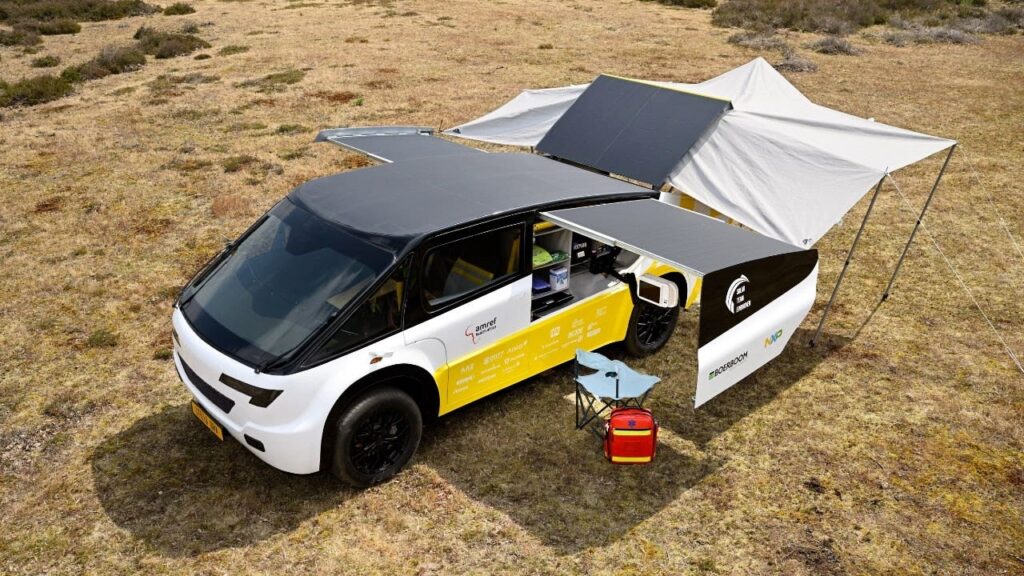
A team of 23 students at Eindhoven University of Technology has created Stella Juva, which they describe as the world’s first solar-powered ambulance. Rather than transporting patients to distant hospitals, the vehicle functions as a mobile clinic, bringing healthcare directly to underserved communities in regions where fuel supplies are limited and electricity infrastructure is unreliable.
According to the World Health Organization, approximately 1 billion people worldwide rely on healthcare facilities that lack dependable electricity or have no electrical access whatsoever. This challenge fundamentally undermines the delivery of even basic medical services. Stella Juva addresses this gap by generating its own power through rooftop solar cells, eliminating dependence on external charging infrastructure or electrical grids.
The vehicle is equipped with high-efficiency solar panels manufactured by AIKO using All Back Contact technology, which relocates electrical contacts to the rear of each cell to maximize sunlight exposure. A 50-kilowatt-hour lithium-based battery pack stores generated energy, powering both the vehicle’s motor and medical equipment during periods of limited or absent sunlight. Under optimal solar conditions, the team projects the ambulance can travel up to 715 kilometers, or approximately 444 miles, in a single day with a top speed near 75 miles per hour.
Engineers designed a dual electrical system that prioritizes medical equipment power over driving capability if battery levels become critically low. Pure sine wave inverters ensure stable electricity for sensitive diagnostic and treatment tools, reducing risks from voltage fluctuations. The vehicle weighs approximately 1,350 kilograms, or roughly 3,000 pounds, significantly lighter than conventional ambulances, thanks to carbon-fiber composite construction and an aerodynamic teardrop shape that reduces wind resistance.
The climate-controlled medical cabin supports tuberculosis screening, pregnancy ultrasounds, malaria testing, vaccinations, and emergency defibrillation capabilities. Refrigeration units maintain proper temperatures for vaccines and medications despite exterior heat conditions. Solar panels mounted on the roof continue supplying power to these medical systems after the vehicle stops moving, distinguishing this design from traditional transportation applications.
AIKO’s solar cells feature copper interconnections engineered to withstand vibration from rough terrain and resist microcracks from challenging environmental conditions. This durability focus reflects the reality that mobile clinics operating far from repair facilities must complete repeated journeys reliably, not merely demonstrate performance on a single test run.
Solar Team Eindhoven plans to deploy Stella Juva to Kenya in August for field testing in partnership with Amref Health Africa. The team will conduct tuberculosis care simulations at two locations to evaluate vehicle performance under real-world conditions rather than controlled laboratory settings. This validation phase will demonstrate whether the ambulance can deliver consistent medical support after extended travel across rough terrain.
The student organization has a track record with solar vehicle engineering, having won the World Solar Challenge in Australia four consecutive times in the family car class. Previous projects included Stella Vita, a solar-powered camper for off-grid travel, and Stella Terra, an off-road vehicle that traveled more than 600 miles through Morocco toward the Sahara in 2023. Stella Juva represents the team’s first application of this expertise specifically toward healthcare delivery.
While Stella Juva remains a university research prototype rather than a commercially available product, the project aims to demonstrate technological feasibility and inspire larger manufacturers and healthcare organizations to develop similar systems at scale. The team has published its engineering approach openly to facilitate broader adoption and refinement across the industry.
Applications could extend beyond remote international communities. Natural disasters that disable electrical grids, wildfires and hurricanes that isolate regions from standard services, and rural areas with limited access to specialized medical facilities represent potential use cases. As solar cell efficiency improves and battery technology advances, mobile medical units capable of generating independent power could become increasingly viable for disaster response and temporary clinics.
The project still faces substantial challenges before widespread deployment becomes feasible. Cost, maintenance requirements, and strict regulatory standards for medical equipment present significant hurdles. Nevertheless, Stella Juva demonstrates that advanced medical care may eventually be brought to patients rather than requiring patients to travel to hospitals, fundamentally reimagining healthcare delivery in underserved regions.


More Stories
Tennessee’s Lone Death Row Female is Scheduled for Execution Wednesday for 1995 Torture/Murder
Modern Science Finally Supports & Strengthens Biblical Account of the Crucifixion of Jesus Christ
Nurse Killed in Hit-and-Run Collision in Brooklyn