


💛 A quick favor, if you've got a second.
We're really happy that you chose to read one of our stories and sincerely hope you'll stick around to read more. We took our paywall down — for now — but that won't last forever, and when the gate goes back up, we'd love for you to already be on the inside.
It's free. So please enter your email here and don't forget to like and follow us on all of your favorite Social Media platforms!
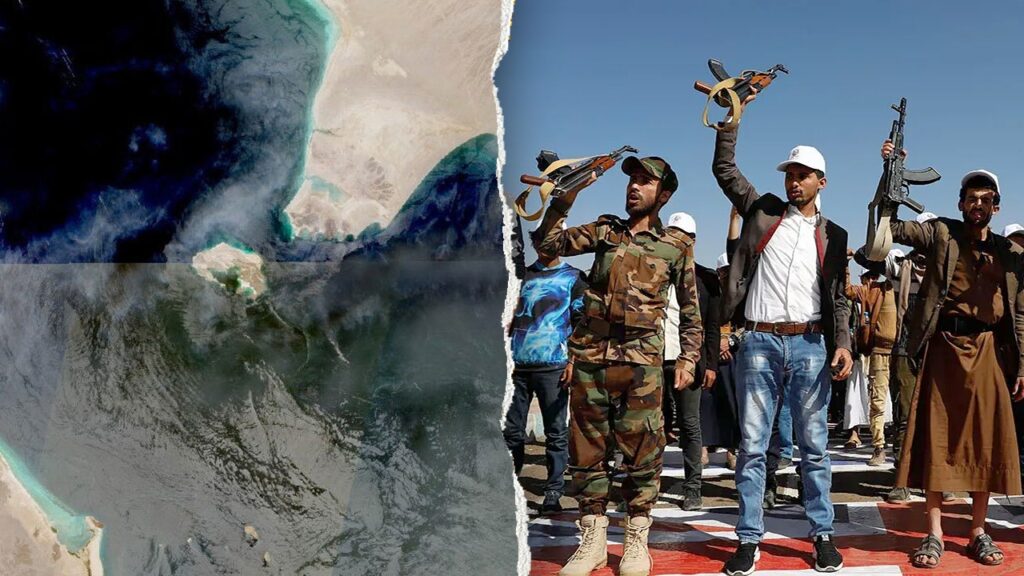
Intensifying assaults by Iran-backed Houthi forces on commercial vessels transiting the Bab el-Mandeb Strait have sparked alarm among security analysts about whether the crucial waterway could develop into a chokepoint comparable to the Strait of Hormuz. The geographic and political realities differ significantly, however, with Yemen’s fractured state and Tehran’s reliance on proxy forces complicating any direct comparison to the Persian Gulf passage.
A deadly attack Tuesday on the Egyptian-owned cargo vessel Tihamah illustrated the mounting dangers. Four crew members—three from Pakistan and one from Indonesia—were killed in the initial strike, while two Yemeni coast guard rescuers died when Houthis attacked again as rescue operations were underway, according to officials. The incident marked the first confirmed fatalities from a Houthi maritime attack since the broader U.S.-Iran conflict escalated on February 28.
The Bab el-Mandeb Strait sits between Yemen and the Horn of Africa, forming a critical link between the Arabian Sea and Red Sea en route to the Suez Canal and Mediterranean. The waterway handles vast quantities of energy shipments and commercial cargo, making its security vital to global trade flows and regional stability.
Yemen’s civil conflict since 2014, intensified by Saudi-led military intervention beginning in 2015, has created a fragmented landscape where the Houthis command Sanaa and northern territories while competing factions—including the Saudi-backed government and the UAE-supported Southern Transitional Council—control other regions. This division directly impacts maritime security, as experts stress that naval patrols alone cannot eliminate threats emanating from Houthi-controlled land.
Amr Al Bidh, the Southern Transitional Council’s foreign affairs chief, told Fox News Digital that maritime forces can protect individual ships but cannot address the underlying challenge. “Naval presence protects individual ships. It does not take away Houthi launch sites, it does not interdict the smuggling routes that resupply them and it does not hold terrain,” Al Bidh stated, emphasizing that ground operations prove essential for lasting security.
A July 20 Houthi declaration of a naval blockade targeting Saudi Arabia-bound vessels has already produced measurable economic impacts. Data from the Joint Maritime Information Center, cited by United Against Nuclear Iran, shows tanker transits have declined approximately 40 percent since the blockade announcement. Vessel operators have adopted defensive measures, broadcasting messages such as “CHINESE OWNER” and “ARMED GUARD ON BOARD” via tracking systems to reduce targeting risk.
China has negotiated directly with Houthis over safe passage for its ships, according to a July 28 Reuters report. Four China-bound tankers successfully crossed Bab el-Mandeb following Beijing’s efforts to secure assurances for its maritime commerce, demonstrating how the threat extends beyond Middle Eastern nations to major world powers.
Saudi Arabia’s growing reliance on Red Sea export infrastructure, driven by shipping disruptions at the Strait of Hormuz caused by U.S.-Iran tensions, has elevated the strategic importance of the Bab el-Mandeb passage. The waterway now functions simultaneously as an alternative to Hormuz and as a potential additional pressure point for regional and international commerce.
U.N. Special Envoy Hans Grundberg warned the Security Council on Thursday that Yemen faces its gravest threat of renewed large-scale warfare since a UN-brokered ceasefire took effect in 2022. That truce substantially reduced combat following years of conflict, though major hostilities remained limited even after the formal truce expired in October 2022. Renewed Houthi maritime attacks risk escalating Yemen’s internal conflict into a broader regional confrontation.
Tawakkol Karman, Yemen’s Nobel Peace Prize laureate, cautioned the United Nations that Yemen’s deteriorating state now threatens interests extending far beyond its borders. “This is no longer a Yemeni crisis alone,” Karman told reporters outside the Security Council chamber after Denmark blocked her scheduled briefing. She warned that continued state collapse threatens international navigation, energy security, global supply chains, and broader regional peace.
Experts caution against treating Bab el-Mandeb as a simple replica of Hormuz. Richard Goldberg, senior adviser at the Foundation for Defense of Democracies and former National Security Council official, noted that Iran lacks direct control over the waterway comparable to its position at Hormuz. “Iran doesn’t have the same direct influence on flows through the Bab al-Mandeb as it does for the Strait of Hormuz,” Goldberg told Fox News Digital, noting instead that strategy relies heavily on proxy forces.
Goldberg identified critical distinctions limiting the threat potential. Houthis demonstrate greater independence than in previous years and have not shown willingness to wage war against the global community—only against Saudi Arabia. Furthermore, shippers unable to safely navigate Bab el-Mandeb can circumvent the Red Sea entirely by sailing around Africa, unlike Hormuz where no practical alternative exists. “It adds cost and time but it’s not a single point of failure like Hormuz,” Goldberg said.
Saudi Arabia has begun constructing multilayered regional security arrangements to address mounting threats. On August 7, Saudi Arabia, Turkey, and Pakistan signed the Mecca Joint Defense Agreement, establishing a mutual-defense framework requiring high-level political and military coordination, joint exercises, and expanded defense-industry cooperation. Turkish officials emphasized the pact’s defensive character, declining to identify Iran or any specific nation as an adversary.
Dr. Aziz Alghashian, a Saudi foreign-policy researcher and senior non-resident fellow at Gulf International Forum, predicted the agreement could facilitate greater trilateral coordination against Iran-backed groups, particularly in the maritime sphere near the Saudi-Yemeni border. The framework may enable Riyadh to adopt a firmer collective posture toward Iranian-backed militias while maintaining diplomatic channels with Tehran itself.
The Saudi Defense Ministry announced July 30 plans for a multinational maritime-defense coalition focused specifically on protecting navigation and commercial routes through Bab el-Mandeb, the Red Sea, and the Gulf of Aden. Fourteen nations, including Turkey, Pakistan, Egypt, Sudan, and Djibouti, initially endorsed the initiative. Turkey’s Defense Ministry confirmed Thursday that Ankara participates in coalition-formation meetings occurring in Jeddah.
A State Department spokesperson told Fox News Digital that protecting commercial shipping through both the Red Sea and Strait of Hormuz remains a “top priority” for the Trump administration. The administration intends to continue working with international partners to deter attacks, ensure commerce flows freely, and hold accountable those endangering shipping lanes. Officials stated Washington will disrupt Iranian funding and weapons supplies to Houthis, noting more than 200 entities associated with the group have been sanctioned.
“The United States stands firmly with the Kingdom of Saudi Arabia and the internationally recognized government of Yemen against Houthi terrorism,” the State Department spokesperson said, pledging continued close consultation with regional partners and commitment to their security.


More Stories
Federal voting arrest in New Jersey adds new pressure point in Sherrill-Trump standoff
Colombia backs Trump security push while limiting U.S. role in anti-gang operations
Former NFL cheerleader and ex-aide face off in close Rhode Island GOP primary