


💛 A quick favor, if you've got a second.
We're really happy that you chose to read one of our stories and sincerely hope you'll stick around to read more. We took our paywall down — for now — but that won't last forever, and when the gate goes back up, we'd love for you to already be on the inside.
It's free. So please enter your email here and don't forget to like and follow us on all of your favorite Social Media platforms!
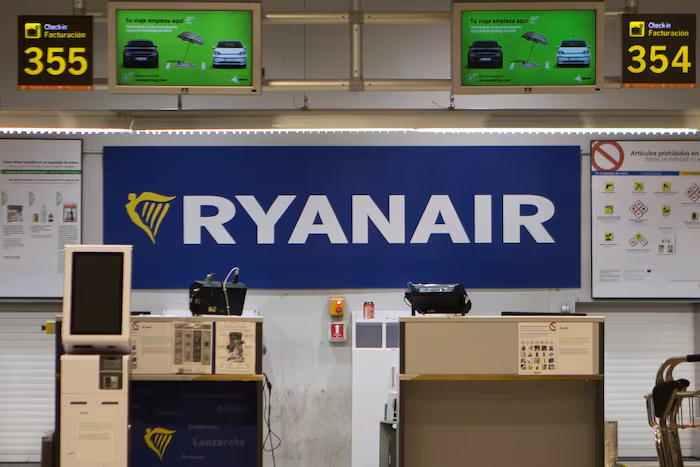
A fractured engine fan blade triggered a catastrophic chain of events aboard a Ryanair Boeing 737-800 departing Greece last month, with debris from the engine striking and shattering a cabin window, according to findings released Thursday by the National Transportation Safety Board. The damaged fuselage also sustained additional impact points from the ejected engine components, investigators determined in their formal report.
The incident unfolded shortly after the aircraft lifted off from Thessaloniki in northern Greece on July 10. A 61-year-old passenger seated at a window in row 11 was partially pulled through the shattered opening before other travelers managed to drag him back into the cabin, where he sustained neck and shoulder injuries along with friction burns. The NTSB’s investigation uncovered bird remains lodged inside the engine, indicating a probable bird strike during the initial ascent.
Flight attendants reported experiencing intense vibrations and observing smoke or vapor throughout the cabin immediately before oxygen masks automatically deployed. Upon discovering the passenger partially ejected through the compromised window, other travelers and crew members worked to secure the opening using a metal container while the pilots diverted the aircraft back to Thessaloniki. A physician among the passengers provided medical attention to the injured man in row 12.
Engine maintenance records documented ultrasonic inspections of the failed right engine in May 2026 and November 2025 with no detected damage, though flight crews had reported four suspected bird strikes to the same engine over the preceding year. The NTSB publicly rebuked Ryanair CEO Michael O’Leary for prematurely characterizing the investigation’s focus as foreign object damage rather than permitting a comprehensive inquiry into aircraft age and maintenance protocols.
The aircraft, a 189-seat narrow-body jet delivered to Ryanair in 2008, climbed to approximately 15,000 feet six minutes after departure before descending to 6,000 feet to burn excess fuel before returning safely to the Greek airport about an hour later. Malta Air, a Ryanair subsidiary, operated the flight, and all passengers disembarked normally at the terminal with one receiving ground-based medical care.


More Stories
South African Rugby Match Features Extraordinarily Low Passenger Jet Flyover
Tractor-Trailer Hangs Off Bridge After Solo Crash on I-80 at California-Nevada Border
Firefighter Executes Dramatic Rescue of Stranded Free Climber on Georgia Mountain