

💛 A quick favor, if you've got a second.
We're really happy that you chose to read one of our stories and sincerely hope you'll stick around to read more. We took our paywall down — for now — but that won't last forever, and when the gate goes back up, we'd love for you to already be on the inside.
It's free. So please enter your email here and don't forget to like and follow us on all of your favorite Social Media platforms!
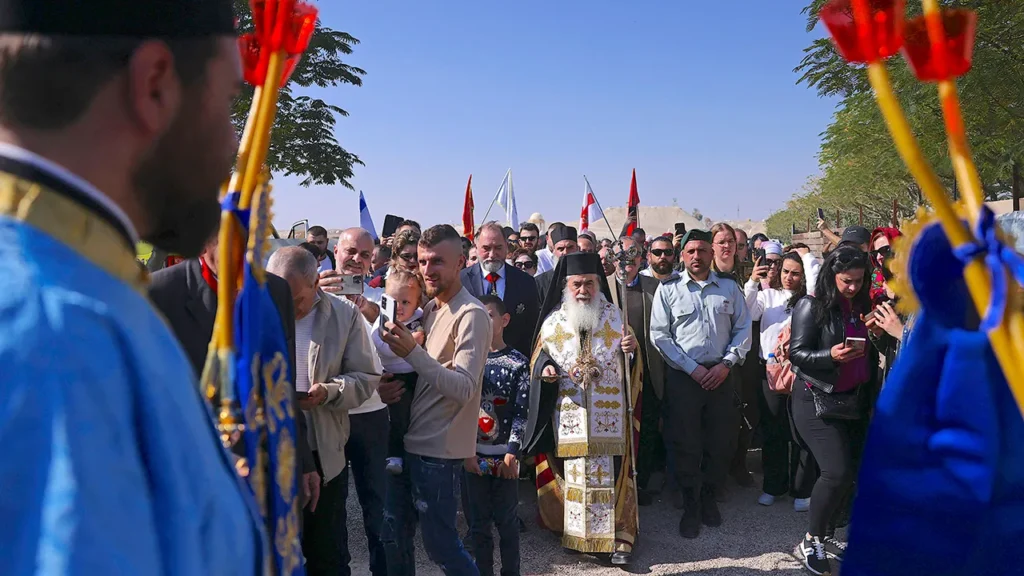
George Deek, Israel’s special envoy to the Christian World, grew up in Jaffa attending Greek Orthodox services with his father and participating in Christian Scouts. His childhood in a mixed Arab, Muslim and Jewish community shaped his perspective on religious coexistence in the region, a view he says current coverage of Israel fails to capture accurately.
Deek acknowledges that isolated incidents of religious extremism—including cases where radicals have spat at clergy and vandalized Christian property—are genuinely disgraceful and warrant strong law enforcement and educational responses. However, he contends that isolated extremists should not be allowed to define an entire nation’s character or policies.
Drawing comparative examples, Deek points to 2025 data showing 6,274 antisemitic incidents in the United States and a 23.6% rise in hate crimes in Spain, yet notes that no one concludes these countries are fundamentally hostile to Jews. He argues that applying a different standard to Israel constitutes a double standard in international analysis and reporting.
The Christian population in Israel has grown substantially since the nation’s founding, increasing from approximately 34,000 in 1950 to about 184,000 today. Deek cites the career of former Supreme Court Justice Salim Joubran, an Arab Christian who convicted a former Israeli president, as evidence of Christian integration within Israeli institutions.
Deek himself represents this integration—becoming the first Christian appointed as an Israeli ambassador and later designated to deepen relations with Christian communities worldwide. Christians in Israel work as physicians, academics, business leaders, municipal officials and military personnel across various sectors of society.
Israel formally recognized Aramean nationality in 2014, granting official status to ancient Syriac and Aramaic Christian traditions. The government is also investing in archaeological efforts that uncover Christianity’s historical roots, including excavations at Bethsaida on the Sea of Galilee where the Apostles Peter and Andrew likely lived.
Israel is preparing to host massive Christian pilgrimages in 2030 commemorating 2,000 years since the baptism of Jesus. Additionally, polling in Lebanon shows 77% support among Maronite Christians and 72% among Orthodox Christians for peace with Israel, suggesting regional Christian perspectives may be shifting.
Deek emphasizes that the broader context matters: ancient Christian communities across the Middle East have experienced catastrophic decline. Syria’s Christian population fell from over two million before its civil war to several hundred thousand, while Iraq’s Christian community dropped from more than 1.5 million before 2003 to fewer than 200,000.
He argues that the critical question is not whether Israel contains extremists—all democracies do—but rather where Christians will continue to live, worship and build futures across the Middle East in fifty years. Deek insists that Israeli Christians remain not as victims or historical artifacts but as active members of society shaping the nation’s future.

More Stories
Tennessee’s Lone Death Row Female is Scheduled for Execution Wednesday for 1995 Torture/Murder
Colombia backs Trump security push while limiting U.S. role in anti-gang operations
Modern Science Finally Supports & Strengthens Biblical Account of the Crucifixion of Jesus Christ