



💛 A quick favor, if you've got a second.
We're really happy that you chose to read one of our stories and sincerely hope you'll stick around to read more. We took our paywall down — for now — but that won't last forever, and when the gate goes back up, we'd love for you to already be on the inside.
It's free. So please enter your email here and don't forget to like and follow us on all of your favorite Social Media platforms!
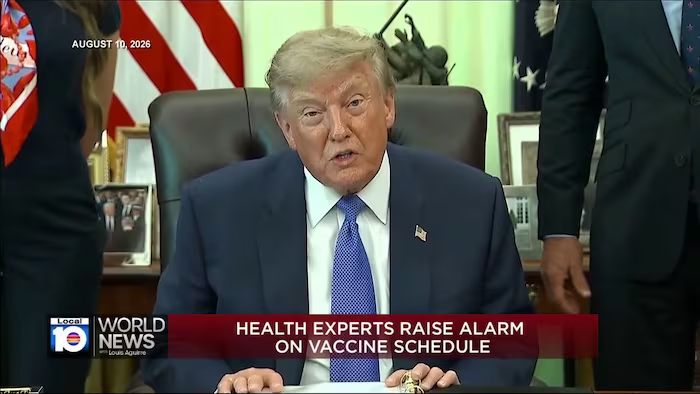
President Donald Trump signed an executive order Monday that would fundamentally reshape how childhood vaccines are administered in the United States, endorsing a long-standing but scientifically discredited belief that immunizations should be spaced into separate appointments. The directive specifically calls for breaking the measles, mumps and rubella combination vaccine into three individual shots and spacing out all childhood vaccinations whenever feasible. The order also instructs the Department of Health and Human Services to develop a research plan for single-disease measles, mumps and rubella vaccines, which are not currently available as separate options for American children.
Trump characterized the order as a landmark achievement for parental rights and constitutional freedoms, repeatedly suggesting during remarks at the Oval Office that vaccine timing or quantity could contribute to rising autism spectrum disorder diagnoses. Decades of rigorous scientific research and medical consensus have conclusively established no connection between childhood vaccines and autism, yet the president renewed this debunked claim without presenting supporting evidence.
The American Academy of Pediatrics swiftly condemned the announcement, with President Dr. Andrew Racine warning that it spreads unfounded fear and uncertainty about interventions that have undergone extensive safety testing and monitoring. Sen. Bill Cassidy, a Louisiana Republican and physician who chairs the Senate health committee, publicly denounced the order on social media, stating that vaccines do not cause autism and asserting the president lacks the medical expertise for such policy decisions.
Public health researchers have cautioned that spacing vaccines as Trump proposes increases the risk that children will contract preventable diseases before receiving subsequent doses. Studies of American infants and toddlers demonstrate that combination vaccine shots rather than individual ones improve completion rates of all recommended vaccinations by age two, potentially leaving children vulnerable during longer intervals between appointments.
While the executive order directs federal vaccine policy changes, states retain authority to mandate school vaccinations for children. The White House fact sheet indicates the administration will urge states to update school vaccine requirements to align with its recommended schedule. This development comes after Trump ordered the Health and Human Services Department last December to review international vaccination approaches and reconsider federal guidance, resulting in reduced vaccine recommendations that a federal court subsequently blocked.
Health Secretary Robert F. Kennedy Jr., who previously led anti-vaccine advocacy efforts before entering politics, has already moved to reshape immunization policy during Trump’s term. Kennedy dismissed an entire 17-member vaccine advisory committee and replaced members with those supporting more restrictive recommendations, a decision a federal judge has halted. He also unilaterally directed the CDC to reverse its established position that vaccines do not cause autism without introducing new scientific evidence supporting the reversal.
Legal experts suggest that recent Supreme Court interpretations of presidential authority could potentially enable Trump to override CDC Director Dr. Erica Schwartz if she refuses to adopt his recommended changes. Schwartz, recently confirmed by the Senate, previously oversaw policies promoting military service member vaccination during her tenure with the U.S. Coast Guard. Georgetown University public health law professor Lawrence Gostin characterized the situation as placing Schwartz in an impossible position regarding her professional obligations and presidential directives.
The White House could not produce studies substantiating the decision to divide MMR into individual vaccines when questioned by reporters. Officials acknowledged the position reflects Trump’s longstanding personal belief and noted that certain countries provide single measles vaccines under specific circumstances. A Trump spokesperson contended the plan would grant parents greater options regarding vaccination timing and frequency, though research indicates such flexibility actually reduces vaccination completion rates among young children.
The order arrives as American students return to classrooms and the nation grapples with a measles outbreak that public health officials warn could strip the United States of its measles elimination status. Federal data reveal that kindergarten vaccination rates have declined, with the proportion of children receiving exemptions reaching record levels during the 2024-25 school year. Medical professionals have expressed alarm that the president’s vaccine misinformation could further discourage immunization uptake among vulnerable populations.

More Stories
Federal voting arrest in New Jersey adds new pressure point in Sherrill-Trump standoff
Colombia backs Trump security push while limiting U.S. role in anti-gang operations
Former NFL cheerleader and ex-aide face off in close Rhode Island GOP primary