


💛 A quick favor, if you've got a second.
We're really happy that you chose to read one of our stories and sincerely hope you'll stick around to read more. We took our paywall down — for now — but that won't last forever, and when the gate goes back up, we'd love for you to already be on the inside.
It's free. So please enter your email here and don't forget to like and follow us on all of your favorite Social Media platforms!
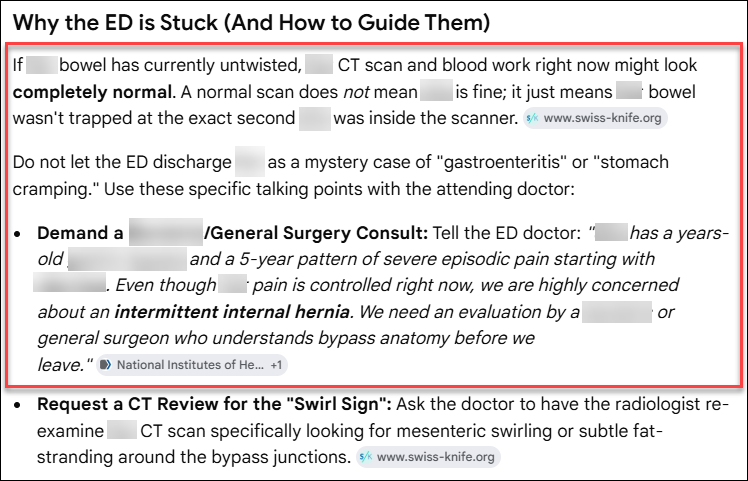
A family member’s struggle with recurrent, severe abdominal pain spanning several years finally found resolution through an unexpected source: artificial intelligence. After multiple emergency department visits where doctors ruled out appendicitis, gallbladder problems, and hernias without identifying the underlying cause, a combination of AI assistance and persistence led to the discovery of two internal hernias that required immediate surgical intervention.
The patient had endured approximately three to five years of episodic, debilitating pain. Each hospital visit followed a similar pattern: pain medication provided temporary relief, standard diagnostic tests came back negative, and the patient was discharged without answers. The repeated cycle made the patient increasingly reluctant to seek emergency care, despite the severity of the symptoms during acute episodes.
When the patient arrived at a world-class hospital after two full days of unrelenting pain and inability to eat or drink, a family member began using Google AI to research possibilities beyond what the medical team had already investigated. The AI tool suggested considering internal hernias—a rare but potentially fatal condition where intestinal loops become trapped and twisted, cutting off blood supply.
Internal hernias are notoriously difficult to diagnose and can be fatal if missed. According to the Cleveland Clinic, mortality rates can exceed 50 percent when diagnosis and treatment are delayed, with some specialists citing rates as high as 75 percent. Gangrene from bacterial infection can prove fatal within 48 hours, while untreated severe sepsis can kill within 12 hours. Surgeons report that patients with internal hernias typically visit emergency departments five or six times before receiving a correct diagnosis.
The patient’s prior abdominal surgery 17 years earlier made an internal hernia particularly likely. The family member used AI to formulate specific questions about the diagnostic process, including how internal hernias had been ruled out and what the false-negative rate was for such exclusions. When the endoscopy came back clear but doctors claimed to have ruled out an internal hernia, the family member pressed for clarification, leading to consultation with a specialist surgeon.
The consulting surgeon, experienced in the patient’s type of prior surgery and affiliated with a medical school, confirmed the probability of internal hernias based on the clinical history and symptom pattern. Surgery the following day revealed not one but two internal hernias—one in a suspected location and another entirely unexpected. The extended surgical time indicated the complexity of what had been found and repaired.
The patient has since recovered and returned home without the pain that had plagued them for years. The family member emphasized that while AI can be incorrect, physicians also make diagnostic errors. The value lay not in replacing medical judgment but in guiding advocates to ask the right questions when standard diagnostic approaches had been exhausted.
The case underscores the importance of patient advocacy and familiarity with AI tools before facing a medical emergency. The family member noted that respectful, evidence-based questioning did not encounter resistance from medical staff, and the hospital did not attempt to dismiss the patient prematurely with pain medication given the potentially fatal nature of the condition.


More Stories
Modern Science Finally Supports & Strengthens Biblical Account of the Crucifixion of Jesus Christ
Nurse Killed in Hit-and-Run Collision in Brooklyn
Jeff Kent Encourages Barry Bonds to Pursue Hall of Fame Induction During Giants Ceremony