



💛 A quick favor, if you've got a second.
We're really happy that you chose to read one of our stories and sincerely hope you'll stick around to read more. We took our paywall down — for now — but that won't last forever, and when the gate goes back up, we'd love for you to already be on the inside.
It's free. So please enter your email here and don't forget to like and follow us on all of your favorite Social Media platforms!
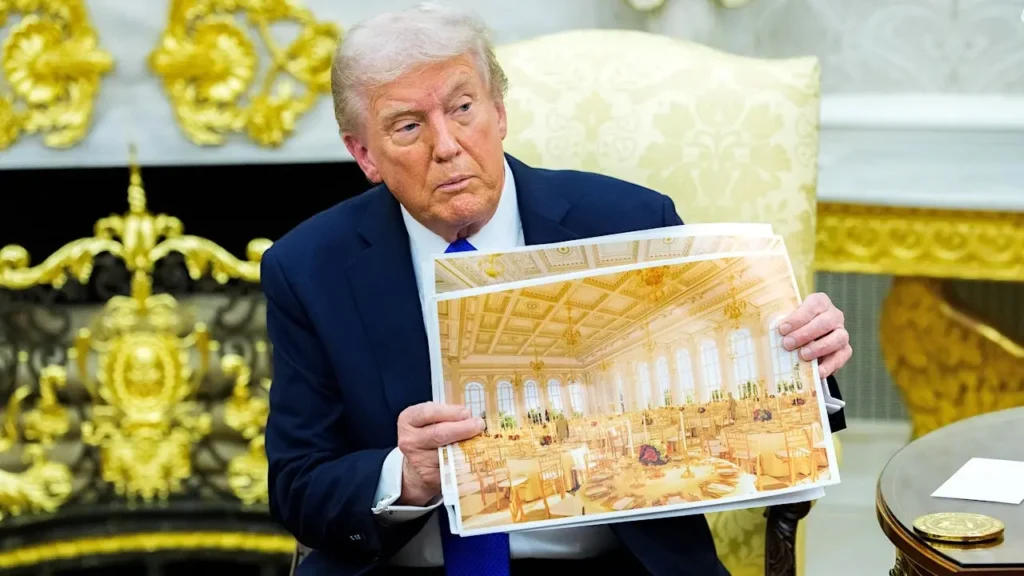
Two legal experts believe President Donald Trump stands positioned to win a forthcoming Supreme Court battle over a planned White House ballroom, potentially without the justices ruling on the project’s underlying constitutional merits. The assessment comes after Trump announced Friday he would escalate his fight to the Supreme Court following a D.C. Circuit Court decision that upheld a lower court order halting above-ground construction on the proposed facility.
The appeals court, voting 2-1, determined that Congressional approval is required before the project can advance. Trump highlighted a dissenting opinion from Judge Neomi Rao, whom he appointed during his first term, as the basis for his Supreme Court appeal. Rao contended that the National Trust for Historic Preservation, the organization challenging the project, lacks legal standing to bring the lawsuit.
The National Trust built its standing argument around Alison Hoagland, a member who resides near the White House and visits President’s Park approximately once monthly. Hoagland asserted that the ballroom’s proposed dimensions and design would diminish her enjoyment of the area by overshadowing the White House and damaging its visual character. However, Rao argued the organization failed to demonstrate the type of injury required to grant courts authority to block the project.
Former Justice Department attorney Abhishek Kambli told Fox News Digital that the National Trust faces substantial difficulty establishing standing at the Supreme Court level. He noted that while Congress founded the organization, the group must show the lawsuit directly relates to its institutional interests. “The President’s Park, where the White House East Ballroom is located, is not among the properties the National Trust owns,” Kambli explained, adding that the Supreme Court’s conservative majority will likely align with Rao’s reasoning.
Kambli further observed that the National Trust confronts a formidable obstacle in proving standing based on aesthetic harm, as such claims typically require demonstrating actual use of the affected space. A bystander claiming visual injury provides weaker grounds than someone with direct involvement in the location, he noted. A similar standing question surfaced in July when U.S. District Judge Amit Mehta rejected a separate lawsuit challenging a UFC event at the White House, ruling plaintiffs had not met the aesthetic harm standard.
Hans von Spakovsky, a senior legal fellow at Advancing American Freedom, predicted Trump will prevail on appeal based on the standing deficiency. Supreme Court precedent requires plaintiffs to demonstrate concrete, demonstrable injury before pursuing claims, he stressed. Von Spakovsky characterized the claim that a passerby suffers actual injury from visual changes at the White House as contradicting established legal doctrine.
Should the Supreme Court accept the case, it could dismiss it on standing grounds without addressing whether the administration possesses legal authority to construct the ballroom. “The Supreme Court won’t rule on the substantive issue if it can dismiss the case based on a lack of standing by the plaintiffs,” von Spakovsky stated. He added that identifying other parties with standing to challenge the project would prove extraordinarily difficult, noting that only Congress could plausibly assert such standing—an outcome unlikely given partisan divisions.
The National Trust has argued that federal law mandates Congressional approval for new construction on federal property in Washington, D.C., while the administration contends existing statutes already authorize the president to make alterations and improvements to federal property, including the White House. Kambli agreed with Rao’s interpretation that the terms “alteration” and “improvement” should reflect standard real-property definitions, where expansions or modifications to a structure do not constitute an entirely new building.



More Stories
Federal voting arrest in New Jersey adds new pressure point in Sherrill-Trump standoff
Colombia backs Trump security push while limiting U.S. role in anti-gang operations
Former NFL cheerleader and ex-aide face off in close Rhode Island GOP primary