


💛 A quick favor, if you've got a second.
We're really happy that you chose to read one of our stories and sincerely hope you'll stick around to read more. We took our paywall down — for now — but that won't last forever, and when the gate goes back up, we'd love for you to already be on the inside.
It's free. So please enter your email here and don't forget to like and follow us on all of your favorite Social Media platforms!
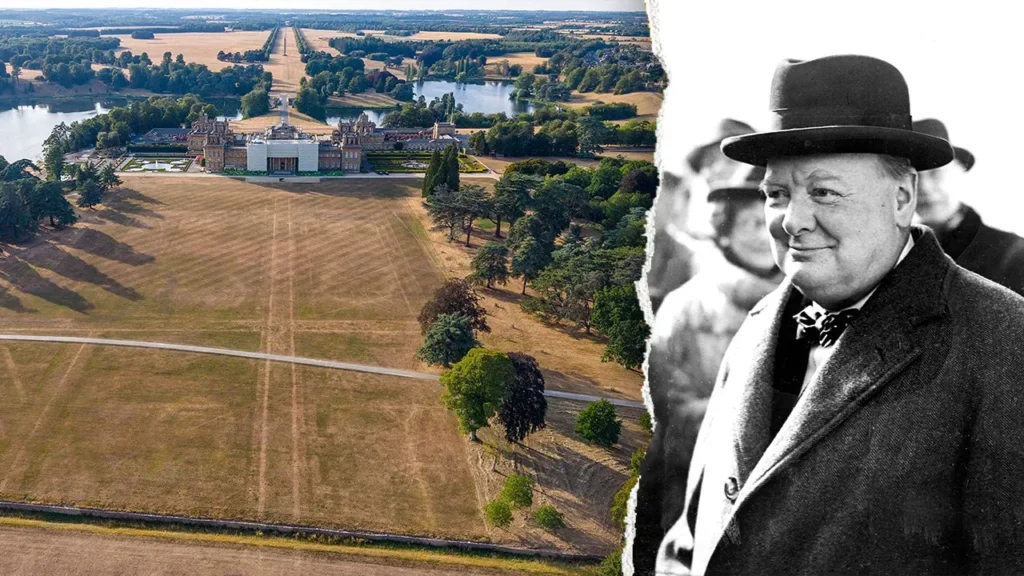
An extended heat wave across the United Kingdom has inadvertently uncovered archaeological evidence of a historic landscape feature at one of Britain’s most celebrated estates. Aerial photographs captured the distinctive outline of a formal garden dating to the 18th century at Blenheim Palace, located approximately eight miles northwest of Oxford, England. The UNESCO World Heritage Site, constructed between 1705 and 1722, served as the birthplace of Sir Winston Churchill and remains the ancestral seat of the Dukes of Marlborough.
The garden’s shadowy impression became visible as prolonged dry conditions created differential browning patterns across the palace grounds during summer months. These parch marks—areas where shallow-rooted grass yellowed faster than surrounding vegetation—revealed the geometric footprint of the original landscaping design. A Blenheim Palace representative indicated the marks would persist through the foreseeable future given forecasted dry conditions for the coming weeks.
Royal gardener Henry Wise originally designed and constructed the formal garden in 1705, featuring symmetrical flower beds and pathways in a style known as a parterre—a term derived from French meaning “on the ground.” The elaborate layout remained intact until the 1760s, when renowned landscape architect Lancelot “Capability” Brown completely restructured the palace grounds according to contemporary aesthetic preferences. The original design thus remained hidden beneath successive layers of horticultural development for more than two and a half centuries.
Andy Mills, the palace’s head gardener, described the dry-weather discovery as an invaluable opportunity to study the original garden’s intricacy and proportions. The aerial perspective provided by the parch marks illuminated architectural details otherwise lost to time, Mills noted, while highlighting the complex historical strata underlying the modern landscape. Blenheim Palace attracted nearly 981,000 visitors during 2025, drawn by its opulent interiors, expansive grounds, and connection to Churchill’s early life.



More Stories
Colombia backs Trump security push while limiting U.S. role in anti-gang operations
Modern Science Finally Supports & Strengthens Biblical Account of the Crucifixion of Jesus Christ
Federal Prosecutors Convene Special Grand Jury to Investigate D.C. Schools’ Attendance and Graduation Practices