




💛 A quick favor, if you've got a second.
We're really happy that you chose to read one of our stories and sincerely hope you'll stick around to read more. We took our paywall down — for now — but that won't last forever, and when the gate goes back up, we'd love for you to already be on the inside.
It's free. So please enter your email here and don't forget to like and follow us on all of your favorite Social Media platforms!
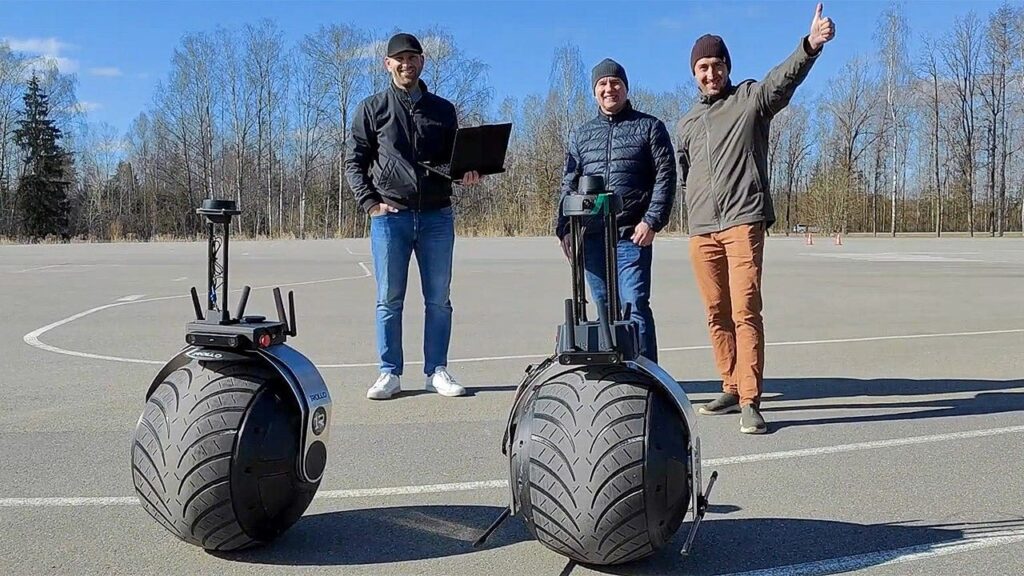
Rollo Robotics, an Estonian startup, has designed 1Rollo, a one-wheeled autonomous security robot intended to reduce patrol costs for large properties and industrial facilities. The machine uses artificial intelligence to detect unusual activity while navigating mapped routes, alerting human operators who can then assess situations and dispatch security personnel if necessary. The company plans to bring the robot to market in 2027, though design elements and specifications may evolve before commercial availability.
The robot’s narrow profile represents its primary structural advantage, allowing it to navigate spaces where conventional security vehicles cannot fit. A vertically positioned spinning flywheel inside the machine maintains balance on a single wheel, with patent-pending technology enabling the system to tilt the flywheel for directional changes. Standing approximately 43 inches tall with a 24-inch wheel, 1Rollo weighs about 100 pounds and reaches maximum speeds of 19 mph—substantially faster than many existing security robots.
1Rollo relies on 360-degree computer vision and Real-Time Kinematic Global Navigation Satellite System positioning to monitor its surroundings and maintain route accuracy. Its cameras and sensors detect obstacles and adjust the patrol path automatically to prevent collisions. When the AI identifies anomalies, it sends alerts through Wi-Fi or 4G and 5G connections, allowing operators to review live feeds and communicate with individuals near the robot via integrated microphone and speaker systems.
The robot operates on battery power for up to eight hours per charge and supports autonomous wireless charging. Rollo Robotics designed the platform for customization, accommodating thermal cameras, pan-tilt-zoom optics, night vision, RFID systems and other equipment tailored to specific property requirements. A cloud-based management platform would enable operators to monitor multiple robots simultaneously and define patrol routes from a centralized location.
Rather than selling robots outright, Rollo Robotics plans a Robotics-as-a-Service subscription model, according to CEO and co-founder Sander Sebastian Agur. The subscription would provide access to current hardware, software updates and ongoing support, potentially reducing upfront capital expenses and simplifying maintenance and future upgrades. The company has not yet announced pricing for the service.
Security experts and potential customers should examine cybersecurity implications before deployment. Connected robots transmit wireless data and rely on cloud platforms, requiring clear policies regarding camera feed encryption, operator account protection and video storage. Customers should understand how the company handles security updates and maintains robot functionality during internet outages. A compromised patrol robot could expose video footage or grant unauthorized access to controls.
Federal lawmakers have already raised concerns about autonomous machines, proposing legislation to restrict government use of certain foreign robots over national security concerns. Though Rollo Robotics operates in Estonia, every connected security robot warrants comprehensive cybersecurity review before institutional adoption.
Businesses may deploy 1Rollo around warehouses, office campuses and large private properties to cover areas requiring continuous monitoring. The robot’s ability to handle repetitive patrols while keeping human security personnel away from hazardous areas until threats are assessed represents a potential operational advantage. However, employee and visitor privacy concerns remain, necessitating transparency about recording practices, footage access and retention policies.
A cautionary precedent exists: Dublin, Ohio, retired an AI robot cop that made no arrests during its parking garage pilot program. While this case does not predict 1Rollo’s performance, it underscores the importance of establishing measurable security objectives before deploying autonomous systems. Rollo Robotics must still demonstrate that 1Rollo performs effectively across varying weather conditions, crowded environments and extended operational periods. The subscription pricing model will ultimately determine whether businesses adopt the technology as a cost-effective alternative to traditional security approaches.



More Stories
Looney Tunes’ ‘Coyote vs. Acme’ Debuts With $15.5 Million as ‘Spider-Man’ Holds Box Office Crown
Trump Calls NASA to Congratulate Agency on Roman Space Telescope Launch
Meta Ordered to Implement Sweeping Teen Safety Restrictions Under Settlement