

💛 A quick favor, if you've got a second.
We're really happy that you chose to read one of our stories and sincerely hope you'll stick around to read more. We took our paywall down — for now — but that won't last forever, and when the gate goes back up, we'd love for you to already be on the inside.
It's free. So please enter your email here and don't forget to like and follow us on all of your favorite Social Media platforms!
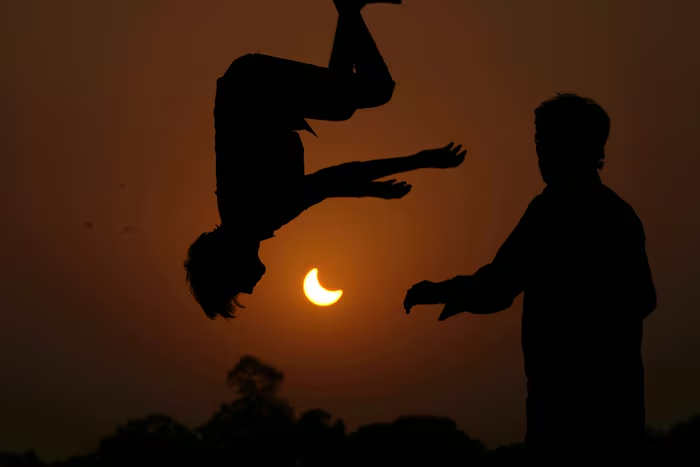
A total solar eclipse will traverse parts of Europe on August 12, with Spain’s northern regions positioned directly in the path of totality. The phenomenon is expected to draw eclipse enthusiasts from around the world, with eclipse cruises in the North Atlantic and extended viewing opportunities across Greenland, western Iceland, and a corner of Portugal. Much of the northern hemisphere will witness a partial eclipse, though Spain represents the prime destination for those seeking the complete experience.
Following the widespread documentation of 2024’s North American eclipse, millions of people are expected to record this year’s European event using smartphones and cameras. The event presents particular technical challenges for mobile photographers, primarily due to rapidly shifting light conditions and the difficulty of capturing distant celestial objects with devices designed for terrestrial imagery.
Success begins with selecting the optimal viewing location. Those traveling for the eclipse should position themselves as close as possible to the path of totality, with the European Space Agency offering maps detailing totality duration across Spanish regions. Xavier Jubier’s website provides more granular detail by overlaying the eclipse path on Google Maps at street level. Since the eclipse will occur near sunset across most of Europe, seekers should identify elevated positions with unobstructed western horizons.
Weather forecasting applications such as Astrospheric can help identify locations with the clearest skies. The American Astronomical Society maintains a curated list of iOS and Android applications capable of simulating eclipse appearance from specific positions and providing audio countdowns to totality.
While digital SLR cameras remain optimal for detailed lunar photography, modern smartphones equipped with sophisticated sensors, multiple lenses, and image stabilization offer viable alternatives. Exposure controls on newer devices allow photographers to adjust for eclipse lighting conditions, though the devices’ tendency to overexpose bright objects like the moon and inner solar corona presents challenges. Zooming increases subject size and improves detail capture, but flash use should be avoided entirely.
Photographers should not limit their focus exclusively to the sky. As the moon passes before the sun, the surrounding landscape undergoes dramatic transformation, with tree leaves creating natural pinhole projections of miniature eclipses on the ground. Wide-angle compositions can capture the broader eclipse experience and unusual atmospheric effects.
Protection for both eyes and camera equipment is essential. During partial eclipse phases, smartphone lenses require special solar filters certified to the international ISO 12312-2 standard. The Solar Snap filter represents the only smartphone-specific option meeting this certification. Eclipse glasses positioned over the lens offer a low-cost alternative successfully employed by millions during recent 2023 and 2024 eclipses. The American Astronomical Society and Eclipse Seguro list vetted eyeglass models, as online marketplaces currently contain counterfeit glasses bearing fake ISO certifications that can cause permanent vision damage.
Observers should wear eclipse glasses whenever looking toward the sun while positioning shots. Tripods stabilize devices during extended shooting periods and prevent motion blur. A white towel draped over equipment prevents overheating while waiting for totality.
Eclipse selfies and TikTok-style videos remain tempting but pose eye safety risks. Phone screens can reflect harmful ultraviolet light even when the user believes they are not directly viewing the sun, according to eye health experts.

More Stories
Trump Threatens FCC Action Against NBC’s Welker Over Endorsement Coverage
State Department Reissues Level 3 Travel Advisory for Israel Amid Terrorism and Armed Conflict Concerns
Forest Service Proposes Steep Fee Increases at Lake Tahoe Recreation Sites