



💛 A quick favor, if you've got a second.
We're really happy that you chose to read one of our stories and sincerely hope you'll stick around to read more. We took our paywall down — for now — but that won't last forever, and when the gate goes back up, we'd love for you to already be on the inside.
It's free. So please enter your email here and don't forget to like and follow us on all of your favorite Social Media platforms!
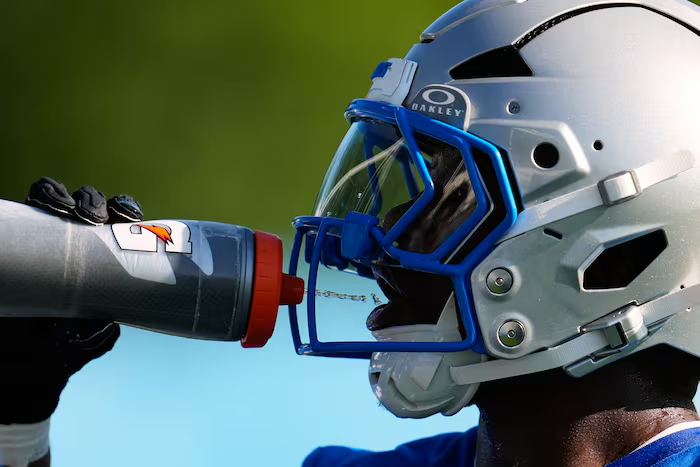
The 2001 death of Minnesota Vikings offensive tackle Korey Stringer from exertional heat stroke during training camp in Mankato, Minnesota, fundamentally reshaped safety standards across professional football and beyond. Stringer remains the only known NFL player to die from heat-related illness after collapsing during a blocking drill, with nearly 90 minutes elapsing before he reached a hospital with a core body temperature of 108.8 degrees Fahrenheit. His passing prompted sweeping protocol changes throughout sports, with one principle emerging as paramount: immediate cooling takes precedence over transport to medical facilities.
Douglas Casa, executive director of the Korey Stringer Institute at the University of Connecticut, has served as an expert witness in 85 heat stroke fatality cases and maintains that proper cooling treatment could have prevented every death he has examined. The institute, established in 2010 through a settlement of the wrongful death lawsuit filed by Stringer’s family against the NFL, emerged from Casa’s collaboration with widow Kelci Stringer and agent Jimmy Gould. Casa emphasized that a basic $150 cold water immersion tub could have saved lives in each case, including Stringer’s, who died approximately 15 hours after his collapse despite being moved to an air-conditioned trailer.
Casa’s commitment to heat safety stems from his own near-fatal experience at age 16 during a 10-kilometer race at the Empire State Games in New York, where he collapsed with 80 meters remaining and lost consciousness for two hours. Quick intervention by a physician using cold water immersion gave Casa the chance to survive, a lesson that informed his later work advising the NFL’s general medical committee on player safety matters. Today, every NFL team maintains mandatory cold water immersion tubs adjacent to practice fields, one of numerous protective measures implemented over the past 25 years in Stringer’s memory.
Kelci Stringer reflected on how transforming her husband’s tragedy into tangible safety improvements has shifted the narrative from loss to meaningful action. The presence of these life-saving tubs at every practice facility represents a concrete legacy, demonstrating how institutional change can prevent future deaths and honor those lost to preventable medical emergencies.



More Stories
Packers Running Back Josh Jacobs Placed on NFL Commissioner’s Exempt List Following Domestic Arrest
Packers Running Back Josh Jacobs Placed on Commissioner Exempt List Pending Misdemeanor Charges
Denver Broncos Linebacker Jonathon Cooper Placed on Commissioner’s Exempt List Amid Domestic Violence Charges