


💛 A quick favor, if you've got a second.
We're really happy that you chose to read one of our stories and sincerely hope you'll stick around to read more. We took our paywall down — for now — but that won't last forever, and when the gate goes back up, we'd love for you to already be on the inside.
It's free. So please enter your email here and don't forget to like and follow us on all of your favorite Social Media platforms!
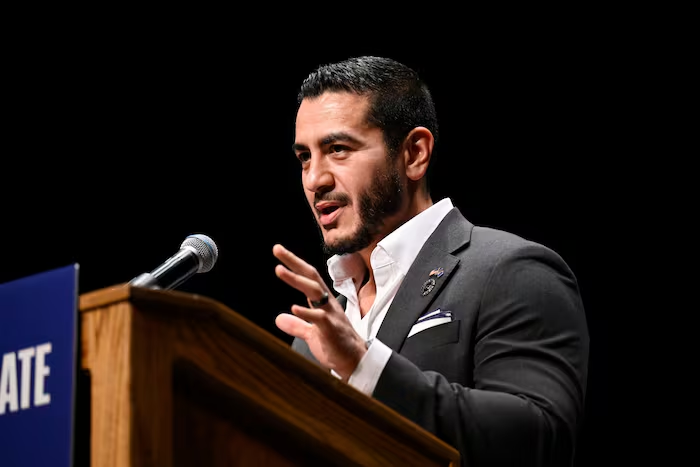
A diverse gathering of progressive clergy and faith leaders convened in Detroit this week to discuss how religious conviction informs left-leaning political positions, as Abdul El-Sayed, a former gubernatorial candidate, makes his case for a U.S. Senate seat in Michigan. The public health researcher and Muslim Democrat posed fundamental questions to the interfaith group about moral accountability ahead of Tuesday’s primary election, framing progressive economics through a spiritual lens.
El-Sayed’s campaign centers on “Medicare for All” and economic justice, positioning him against moderate Rep. Haley Stevens in what has become a closely watched Democratic primary in the swing state. If elected in November, he would become the first Muslim senator in American history, though he faces criticism from Republicans and centrist Democrats who argue his positions are too far left for Michigan voters.
Progressive Democrats across the country have gained electoral momentum in recent months by tapping into voter concerns about inequality, cost of living, and economic disruption from artificial intelligence. Many candidates and supporters are grounding their economic arguments in religious tradition, particularly teachings from Christian, Muslim, and Jewish faith sources about obligations to the poor and redistribution of wealth.
Historical religious movements have long supported labor organizing and economic reform, yet modern associations between faith and progressive politics remain contentious. Megan Romer, a Democratic Socialists of America co-chair and ordained Presbyterian elder, acknowledged that socialism carries negative connotations among older believers shaped by Cold War rhetoric linking communism to atheism.
Younger Americans appear more receptive to connecting faith-based morality with socialist economics, citing figures like Martin Luther King Jr. and Malcolm X as models for religiously motivated economic critique. Rev. Andrew Wilkes of New York recounted how presiding over a funeral for someone denied critical care by insurance prompted his embrace of democratic socialism, viewing healthcare denial as a moral failure of capitalism itself.
Support for capitalism among U.S. adults has declined significantly, with Gallup data showing just under 50 percent holding favorable views in recent polling, down from 61 percent a decade ago. The shift appears driven by Democratic voters and independents questioning whether market systems serve ordinary people’s needs for affordable housing, healthcare, and employment security.
Faith-based organizations like Clergy and Laity United for Economic Justice are mobilizing congregations to support worker unionization efforts, framing labor rights as religious imperatives. At one California church, a grocery store employee appealed to parishioners for backing, invoking Jesus’s teachings about wealth as justification for collective action.
Republicans counter that progressive economics fundamentally contradict religious values rooted in individual liberty and divine natural rights. President Donald Trump recently described progressive Democrats as “godless communists,” echoing conservative messaging that socialism requires rejecting religious faith.

More Stories
Former NFL cheerleader and ex-aide face off in close Rhode Island GOP primary
Trump Threatens FCC Action Against NBC’s Welker Over Endorsement Coverage
Chicago Mayor Issues Executive Order Requiring Contractor Diversity Disclosures and ICE Ties Reporting