



💛 A quick favor, if you've got a second.
We're really happy that you chose to read one of our stories and sincerely hope you'll stick around to read more. We took our paywall down — for now — but that won't last forever, and when the gate goes back up, we'd love for you to already be on the inside.
It's free. So please enter your email here and don't forget to like and follow us on all of your favorite Social Media platforms!
Artificial intelligence has moved beyond consumer gadgets and social media algorithms into the clinical setting, where healthcare facilities are adopting the technology to reshape how doctors interact with patients and manage medical records. Memorial Healthcare is among the institutions capitalizing on AI tools to modernize patient experiences and streamline administrative tasks in the exam room.
Dr. Jennifer Goldman, chief medical information officer and primary care physician at Memorial Healthcare, credits AI with making clinical practice more patient-centered. By using voice transcription and automated documentation systems, Goldman can focus on listening to patients rather than splitting attention between a computer screen and direct conversation during appointments.
The technology streamlines coordination among medical specialists as well. Patient Alexandra Tuduce Sanchez noted that when she requires consultations with neurologists or gastroenterologists, comprehensive medical histories and medication records are instantly available to all providers involved in her care, eliminating communication gaps that could complicate diagnosis.
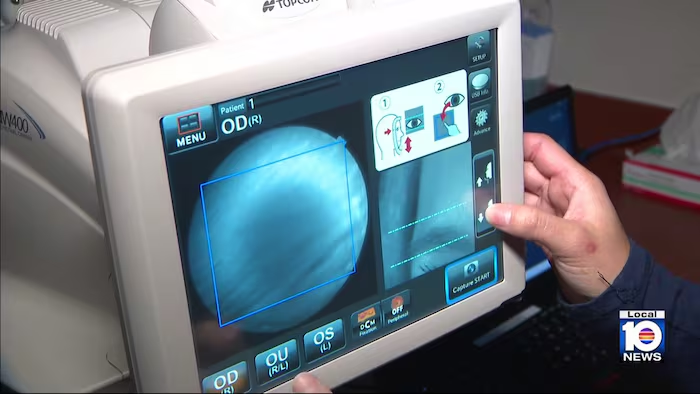
AI algorithms excel at identifying patterns in medical imaging that might escape human observation, flagging subtle fractures, microscopic tumors, and early brain lesions on diagnostic scans. The systems can also detect conditions like diabetic retinopathy at earlier stages than traditional screening methods allow.
Memorial Healthcare has been rolling out AI capabilities over the past two years, with Goldman noting that adoption is still in its early phases. Research demonstrates that AI-powered scribes and automated note-taking substantially reduce the time physicians spend on documentation, a significant factor in mitigating professional burnout across the healthcare sector.


More Stories
Looney Tunes’ ‘Coyote vs. Acme’ Debuts With $15.5 Million as ‘Spider-Man’ Holds Box Office Crown
Trump Calls NASA to Congratulate Agency on Roman Space Telescope Launch
Meta Ordered to Implement Sweeping Teen Safety Restrictions Under Settlement