



💛 A quick favor, if you've got a second.
We're really happy that you chose to read one of our stories and sincerely hope you'll stick around to read more. We took our paywall down — for now — but that won't last forever, and when the gate goes back up, we'd love for you to already be on the inside.
It's free. So please enter your email here and don't forget to like and follow us on all of your favorite Social Media platforms!
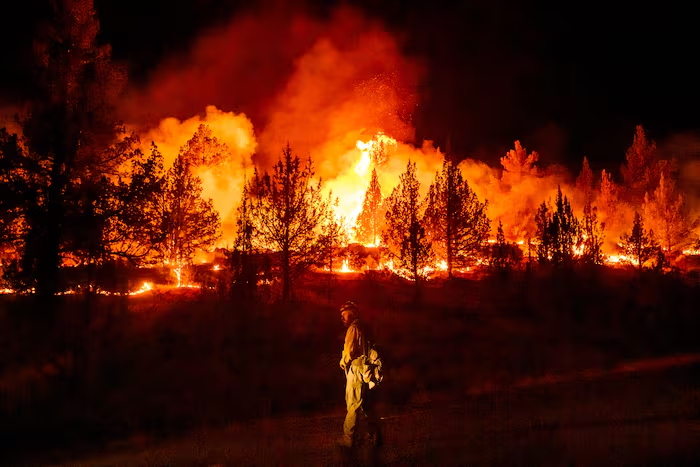
A striking contradiction is unfolding in global fire activity this summer: wildfires are becoming increasingly severe and widespread across Europe and North America, even as worldwide carbon emissions from burning reach their lowest point in nearly 25 years. Scientists attribute this paradox to fundamental shifts in how humans are using land across different continents, creating divergent fire trends that simultaneously reflect both climate change impacts and changing human behavior.
Spain is grappling with its largest recorded wildfire, scorching more than 193 square miles, while European wildfires overall have nearly reached the all-time high set in 2025. In Canada and the United States, wildfire-burned acreage this summer exceeds the 10-year average by at least 25 percent and has more than doubled since decades past, according to national wildfire monitoring agencies. The smoke has blanketed vast regions of the continent, degrading air quality to hazardous levels across multiple areas.
Fire scientists point to climate change as the primary driver behind the escalating severity of North American and European blazes. Rising temperatures create optimal conditions for wildfires by increasing heat and dryness, while also extending the fire season and preventing adequate recovery during cooler nights. Jennifer Balch, a fire scientist at the University of Colorado, emphasized that extreme wildfires are accelerating globally, describing the situation as deeply concerning for disaster preparedness.
The global picture presents a starkly different story. By July, the planet had recorded the lowest emissions from burning fires since satellite measurements began approximately 25 years ago—roughly half the levels observed in the early 2000s, according to the European climate center Copernicus. This dramatic decline stems primarily from reduced fire activity in Africa and Asia, where agricultural practices, improved fire management, and population redistribution have substantially decreased burning.
Africa accounts for more than three-quarters of global plant-burning emissions, making continental trends there essential to worldwide fire statistics. Over the past 25 years, sub-Saharan African fire activity has declined significantly as expanding agricultural and residential development limits traditional savanna grassland fires that once burned annually. Mark Parrington, a senior scientist at Copernicus, noted that changing land use and fire management strategies have fundamentally altered the regional fire landscape.
In Asia, fires deliberately set to clear land for agriculture have also diminished through improved management practices. Park Williams, a water and fire scientist at UCLA, stressed that human demographic shifts and land-use changes—rather than weather patterns alone—are driving the reduction in Asian fire activity. North America and Europe combined account for less than one-eighth of global emissions from burning vegetation.
Climate change is intensifying fire conditions across developed regions through multiple mechanisms. Warmer temperatures increase atmospheric moisture demand, drying vegetation and soil more rapidly. Simultaneously, shorter nighttime recovery periods prevent forests and firefighting crews from building resilience before the next burning day. Extended fire seasons in northern forests have dramatically increased the number of days when weather conditions favor ignition and spread.
Fire suppression capabilities that North America has historically relied upon are becoming insufficient as climate-driven intensity and frequency increase. Mike Flannigan, a fire scientist at Thompson Rivers University in Canada, explained that hotter conditions in populous regions lead to greater property damage, while traditional suppression methods prove inadequate against increasingly extreme fires.
An intensifying El Niño weather pattern threatens to worsen fire activity in coming months, particularly across tropical regions. Scientists predict increased forest fires in the Amazon, Southeast Asia, and the Western Pacific, though paradoxically more rainfall could reduce forest fire risk in parts of the U.S. West. That additional moisture may, however, fuel grass growth in arid regions, creating fuel loads for subsequent grass fires similar to the destructive Los Angeles fires in 2025 and Hawaiian blazes in 2023.
Experts warn that North America and Europe must strengthen long-term planning and adaptation strategies to manage increasingly severe wildfires. Prescribed burns designed to reduce excess vegetation and forest density represent a critical prevention tool. Scientists emphasized that the fundamental question facing communities is not whether landscapes will burn, but when they will do so.


More Stories
Forest Service Proposes Steep Fee Increases at Lake Tahoe Recreation Sites
Son Discovers Father Missing After Himalayan Disaster in Nepal-Tibet Border Region
Archaeologists Unearth 1,300-Year-Old Trading Hub Near Ancient Jaffa in Israel