



💛 A quick favor, if you've got a second.
We're really happy that you chose to read one of our stories and sincerely hope you'll stick around to read more. We took our paywall down — for now — but that won't last forever, and when the gate goes back up, we'd love for you to already be on the inside.
It's free. So please enter your email here and don't forget to like and follow us on all of your favorite Social Media platforms!
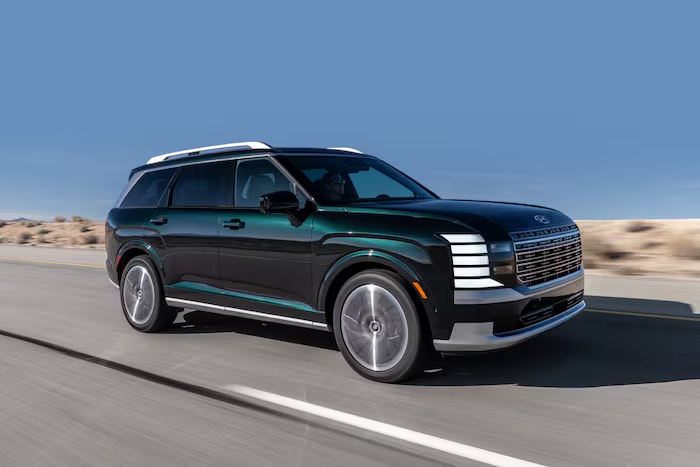
Three-row sport utility vehicles have become integral to American family transportation, offering the combination of passenger capacity, cargo flexibility and everyday practicality that appeals to households across the country. With more than a dozen mainstream options available in the midsize segment, buyers often struggle to narrow down their choices without expert guidance. Edmunds automotive experts have evaluated the full field of contenders and compiled a definitive ranking of the five strongest performers currently available.
The Hyundai Palisade claims the top position in Edmunds’ midsize three-row rankings, delivering a serene cabin that provides generous space for occupants in all seating rows. The vehicle excels on both extended highway journeys and routine city driving with its exceptionally composed suspension tuning. Wireless smartphone integration and strategically placed USB charging ports throughout the three-row layout keep passengers connected, though maximum cargo volume trails some competitors due to clever internal storage solutions that compensate for the limitation.
The 2026 Palisade starts at $41,035, with the hybrid variant priced at $45,760 and delivering up to 34 mpg combined while providing superior acceleration compared to the gasoline-only model. Edmunds recommends the hybrid option for buyers with adequate budget flexibility, citing the fuel economy gains and performance improvements.
The Kia Telluride serves as a mechanically related alternative with a distinctly sportier visual identity, featuring an aggressive upright grille, vertical headlight design and 20-inch wheel packages that convey truck-inspired styling. The standard turbocharged engine delivers more initial acceleration than the base Palisade, while the Telluride adds rear cargo volume, exceptional second-row legroom and dual wireless phone chargers as standard equipment. The 2027 Telluride begins at $40,735, with the hybrid version commanding $48,035 and including ventilated front seating and advanced cruise control systems as additional standard features.
Toyota’s Grand Highlander takes a more understated design approach while compensating with a refined driving experience, superior driver assistance technologies and accommodating third-row seating arrangements. The hybrid variant achieves 36 mpg combined consumption, making it the efficiency leader among the five finalists, though both versions command premium pricing within the midsize category. The 2026 Grand Highlander opens at $43,855, with hybrid pricing set at $47,205.
The Ford Explorer distinguishes itself through athletic handling characteristics and brisk acceleration potential, particularly in the Explorer ST trim that houses a 400-horsepower V6 engine capable of reaching 60 mph from standstill in 5.6 seconds. Google-integrated infotainment technology with a 13.2-inch display, wireless smartphone connectivity and optional BlueCruise autonomous driving capabilities represent technology highlights. Limitations include restricted cargo space, cramped third-row legroom and the absence of a hybrid powertrain option, though the 2027 Explorer starts at $40,260 for buyers prioritizing dynamic performance.
Volkswagen’s Atlas rounds out the top five with abundant interior dimensions that accommodate full-size adults across all three seating rows, complemented by a hushed cabin environment and effortless entry and exit characteristics. The vehicle provides class-leading maximum cargo capacity with flat-folding rear seats, smooth suspension damping without excessive body float and extensive standard features including synthetic leather trim, heated and ventilated front seating and heated steering wheels even on base models. Starting at $40,785 for the 2026 model year, the Atlas lacks hybrid alternatives and presents some complexity in control operation, yet delivers comprehensive capability for the asking price.
Today’s midsize three-row SUV segment offers distinct value propositions addressing diverse buyer priorities, whether those center on cargo maximization, fuel efficiency optimization or performance-oriented driving dynamics.


More Stories
Looney Tunes’ ‘Coyote vs. Acme’ Debuts With $15.5 Million as ‘Spider-Man’ Holds Box Office Crown
Trump Calls NASA to Congratulate Agency on Roman Space Telescope Launch
Meta Ordered to Implement Sweeping Teen Safety Restrictions Under Settlement